There’s a persistent myth in public speaking circles that the best presentations are the most complex ones. That a sophisticated topic signals a sophisticated speaker. That choosing something straightforward is somehow a concession — a sign that you couldn’t find anything more impressive to say.
That myth has ended more presentations before they started than any amount of poor preparation ever has.
A focused topic is often easier to prepare and explain within a short time. The right scope depends on the audience and task; technical subjects can also work well when the presentation has a clear question and supporting structure.
This guide covers what simple actually means when it comes to presentations, why straightforward topics consistently can be easier to follow, which scenarios call for a simpler approach, a curated list of simple topics organized by context, and how to deliver a simple topic in a way that leaves a real impression.

What “Simple” Really Means in a Presentation Topic
Simple doesn’t mean shallow. That distinction matters enormously, and collapsing the two is the mistake most people make when they dismiss easy presentation ideas as unworthy of serious attention.
A simple presentation topic has a clear, bounded scope. It asks one question, makes one argument, or explores one idea — not seven. “How sleep affects memory” is simple. “The relationship between neuroscience, sleep research, memory consolidation, academic performance, and public health policy” is not a presentation topic; it’s a dissertation proposal.
Simplicity is about focus, not depth. A well-executed simple topic can carry genuine intellectual weight. “Why we procrastinate” sounds basic on the surface. But a presenter who has actually read the research — who understands the role of emotional regulation, the difference between task aversion and time management failure, the specific cognitive patterns involved — can deliver a simple-sounding talk that reveals something the audience genuinely didn’t know about their own behavior.
The test for whether a topic is appropriately simple is this: can you state it in one sentence, and does that sentence contain a complete, arguable idea? “Climate change is bad” fails the test because it contains no specific claim worth making. “Why individual behavior change alone cannot solve climate change — and what would actually work” passes the test because it has a scope, a position, and a direction.
Why Simple Presentation Topics Often Work Better
The case for choosing a straightforward speech topic isn’t just about ease of preparation. It runs deeper than that.
Audiences follow simple arguments more reliably. Working memory has limits. When a presentation introduces five major concepts, three frameworks, and a dozen supporting examples in twenty minutes, the audience is managing cognitive load rather than absorbing meaning. A simple topic with a clear through-line gives the audience somewhere to put each new piece of information — it slots into a structure they can hold in their head. That’s how presentations actually change minds.
Simple topics force better storytelling. When a subject is complex, it’s easy to hide behind the complexity. Lots of information, dense slides, jargon — these can give the appearance of substance while avoiding the harder work of actually communicating something. A simple topic strips that cover away. You can’t hide. You have to find a story, a human angle, a reason the audience should care. That pressure, uncomfortable as it is, produces better presentations.
They’re significantly easier to rehearse. A presentation with a clean, simple structure can be internalized in a way that a sprawling, multi-threaded talk cannot. And presentations that are genuinely internalized — where the speaker knows the argument well enough to step away from the slides and just talk — are in a completely different league from presentations that are being read. Simple topics make that level of mastery achievable in normal preparation time.
Simple presentations are more accessible to mixed audiences. When you’re not sure exactly who will be in the room — different backgrounds, different levels of familiarity with your subject — a simple, clearly explained topic is far more likely to land for everyone than a technically dense one designed for specialists. Accessibility isn’t condescension. It’s competence.
When to Choose a Simple Presentation Topic
Not every situation calls for simplicity. But there are specific contexts where a straightforward speech topic is clearly the right choice.
When your time is limited. A five-minute slot usually needs a tightly bounded question. Choosing a narrow, simple topic for a short slot isn’t settling — it’s the only way to actually finish a thought. The biggest mistake in short presentations is choosing a topic sized for a forty-minute keynote and then delivering an introduction.
When your audience is unfamiliar with your subject. Experts can follow complex presentations because they have pre-existing frameworks to attach new information to. General audiences don’t have that scaffolding. A simple topic gives you room to build the foundation before adding any weight.
When you’re a less experienced presenter. Delivery demands cognitive resources. If you’re simultaneously managing nerves, remembering content, watching audience reactions, and operating slides, a simple topic reduces the load on all of those fronts. As your comfort with presenting grows, you can expand the complexity of what you take on. Starting simple isn’t a ceiling — it’s a foundation.
When the setting is informal or conversational. Office meetings, classroom discussions, club presentations, team check-ins — these contexts reward clarity and practicality over intellectual density. A simple, immediately applicable topic fits the register of these spaces in a way that a highly theoretical presentation does not.
When the goal is action, not awareness. If you want your audience to do something specific after you’ve finished — change a habit, adopt a tool, try an approach — simplicity is your ally. Complex presentations create understanding. Simple presentations create momentum.
60+ Simple Presentation Topics Organized by Context
Easy Presentation Ideas for Students
These work for classroom assignments, club meetings, and short academic presentations. Each topic is focused enough to cover in five to ten minutes and broad enough to have genuine content.
- Why getting enough sleep improves test scores — the research explained simply
- How social media algorithms decide what you see
- How first impressions form and what influences them
- Why some habits stick and others don’t
- How the human brain processes fear
- The history of emojis — from Japanese phones to universal language
- Why music affects your mood
- How to tell the difference between a reliable source and an unreliable one
- The science of why we dream
- What makes a password actually secure
- Why we remember some things and forget others
- How the placebo effect actually works
- The psychology behind why we buy things we don’t need
- What causes stage fright — and three things that help
- How color affects mood and behavior
Straightforward Speech Topics for Work and Professional Settings
These work for team meetings, short internal presentations, and professional development contexts. They’re scoped for quick delivery and immediate relevance.
- Three things that make emails more likely to get a response
- How to give feedback that actually lands
- The difference between being busy and being productive
- Why checklists prevent mistakes that experience doesn’t
- How to disagree professionally without damaging relationships
- The science of decision fatigue — and how to work around it
- Why meetings fail, and one structural change that fixes most of it
- What research says about the most effective way to take notes
- How to explain a complex idea to someone outside your field
- The cost of multitasking — why switching tasks isn’t actually faster
Simple Presentation Topics on Health and Lifestyle
Health topics are inherently relatable and easy to research. The key is choosing a specific question rather than a broad category.
- What actually happens to your body when you’re dehydrated
- How sitting for long periods affects your health — and what helps
- The science of why exercise improves mental health
- Why breakfast habits affect focus throughout the day
- How chronic stress physically changes the brain
- What the research says about screen time before bed
- Why some people are morning people and others aren’t — the science of chronotypes
- What researchers are studying about gut bacteria and mood
- Why maintaining dietary changes can be difficult
- What “healthy eating” actually means when you cut through the contradictions
Easy Speech Topics on Technology and Daily Life
These work well because the audience is already living inside these topics — they just haven’t thought carefully about what they’re experiencing.
- How your smartphone tracks your location — even when you think it isn’t
- Why streaming services keep recommending the same kinds of things
- The simple reason autocomplete is subtly changing how people write
- What “going viral” actually requires — the mechanics behind spread
- How targeted advertising uses information about your online activity
- Why passwords are becoming obsolete — and what replaces them
- The reason apps are designed to be hard to quit
- How online reviews are gamed — and how to spot the fake ones
- What listening data can—and cannot—suggest about music preferences
- Why spam filters still let some spam through
Simple Topics on Science and the Natural World
Nature and basic science produce some of the most reliably engaging simple presentations because the subject matter does heavy lifting on its own. The presenter just needs to explain clearly.
- Why the sky is blue — the actual explanation, not the simplified version
- How birds navigate thousands of miles without GPS
- Why some animals hibernate and others don’t
- The reason fingerprints are unique
- What lightning actually is, physically
- How viruses are different from bacteria
- Why the ocean is salty
- What causes the northern lights
- How a bee colony decides to move — the democracy of the hive
- The reason we get goosebumps
Simple Presentation Ideas on Society and Culture
Social topics that are well-scoped produce excellent simple presentations because they connect personal experience to broader patterns — making both the familiar and the abstract feel suddenly relevant.
- Why people in cities tend to walk faster than people in small towns
- How language shapes the way we think
- Why some cultural trends return across generations
- Why people tip in some countries and not others
- How the meaning of the word “success” changes across generations
- The psychology of why people root for underdogs
- Why certain phrases become slang and spread so quickly
- How the design of a city affects how happy people are
- The reason handshakes became a greeting
- Why we celebrate certain milestones and ignore others that are just as significant
How to Deliver a Simple Topic Without It Feeling Thin
Choosing a simple topic is only half the work. The delivery is where many presenters undermine themselves — they choose a focused, manageable subject and then pad it out until it collapses under its own inflation, or they treat the simplicity as license to under-prepare.
Go deeper than the surface. A simple topic doesn’t mean a surface-level treatment. If you’re presenting on why we dream, don’t stop at “scientists don’t fully know.” Find the most credible current theory, explain the mechanism, describe what the supporting evidence looks like, and tell the audience what this means for their own sleep. The same amount of preparation that would go into a complex topic should go into your simple one — it just produces depth in a single direction rather than breadth across many.
Find the one thing the audience doesn’t know. Every simple topic has a piece of received wisdom attached to it that doesn’t hold up. Every common understanding has a complication most people haven’t heard about. Find that gap — between what your audience currently believes and what the evidence actually says — and put it at the center of your presentation. That tension is what transforms a simple topic into a memorable one.
Use a relevant story as your entry point. For a hypothetical talk about checklists, describe a team that keeps overlooking the same handoff step, then ask how a checklist might help. If you use a real case, name the source and verify the outcome rather than inventing a number.
Build in a moment of genuine surprise. Plan for one specific point in your presentation where the audience learns something that genuinely contradicts their expectation. That moment of surprise — when it’s earned and backed by real evidence — is what people remember. Everything before it is setup; everything after it is the implication. Structure your simple presentation around that moment.
End with the “so what.” Simple topics can end weakly if the presenter doesn’t answer the question the audience is implicitly asking: why does this matter? What should I do differently? What does this change? The conclusion of a simple presentation should answer that question directly. Don’t summarize — extend. Take your simple argument one step further than the audience expected you to go.
Common Mistakes When Presenting Simple Topics
Padding instead of deepening. Adding more information to fill time is not the same as adding more value. If you have a focused, simple topic and twelve minutes to fill, the answer is not to add three more tangentially related points. It’s to go deeper on the points you already have.
Apologizing for the simplicity. Never signal to your audience that you’re worried the topic isn’t impressive enough. “I know this might seem basic, but…” is the fastest way to lose a room before you’ve even started. If you’ve prepared well and have something genuine to say, the topic is as simple as it needs to be.
Rushing through because it seems obvious. A common mistake with easy presentation topics is assuming the audience already knows the interesting parts. They don’t. What’s obvious to someone who has spent time with a subject is almost always news to someone who hasn’t. Take the time to explain the mechanism. Show your work. Don’t skip the interesting middle because you’re worried about being condescending.
Losing the central question. An informative talk does not need a provocative claim, but it does need a purpose. For example, “What does sleep research tell us about memory?” gives the audience a question to follow. Let the evidence determine the answer.
Turning a Simple Topic into a Polished Presentation with Presenti AI
Once you’ve chosen and refined your simple presentation topic, the next challenge is building slides that support it without overwhelming it. A common failure mode is adding too much visual complexity to compensate for a topic’s simplicity — the result is a cluttered deck that fights against the clarity you’ve worked to create.
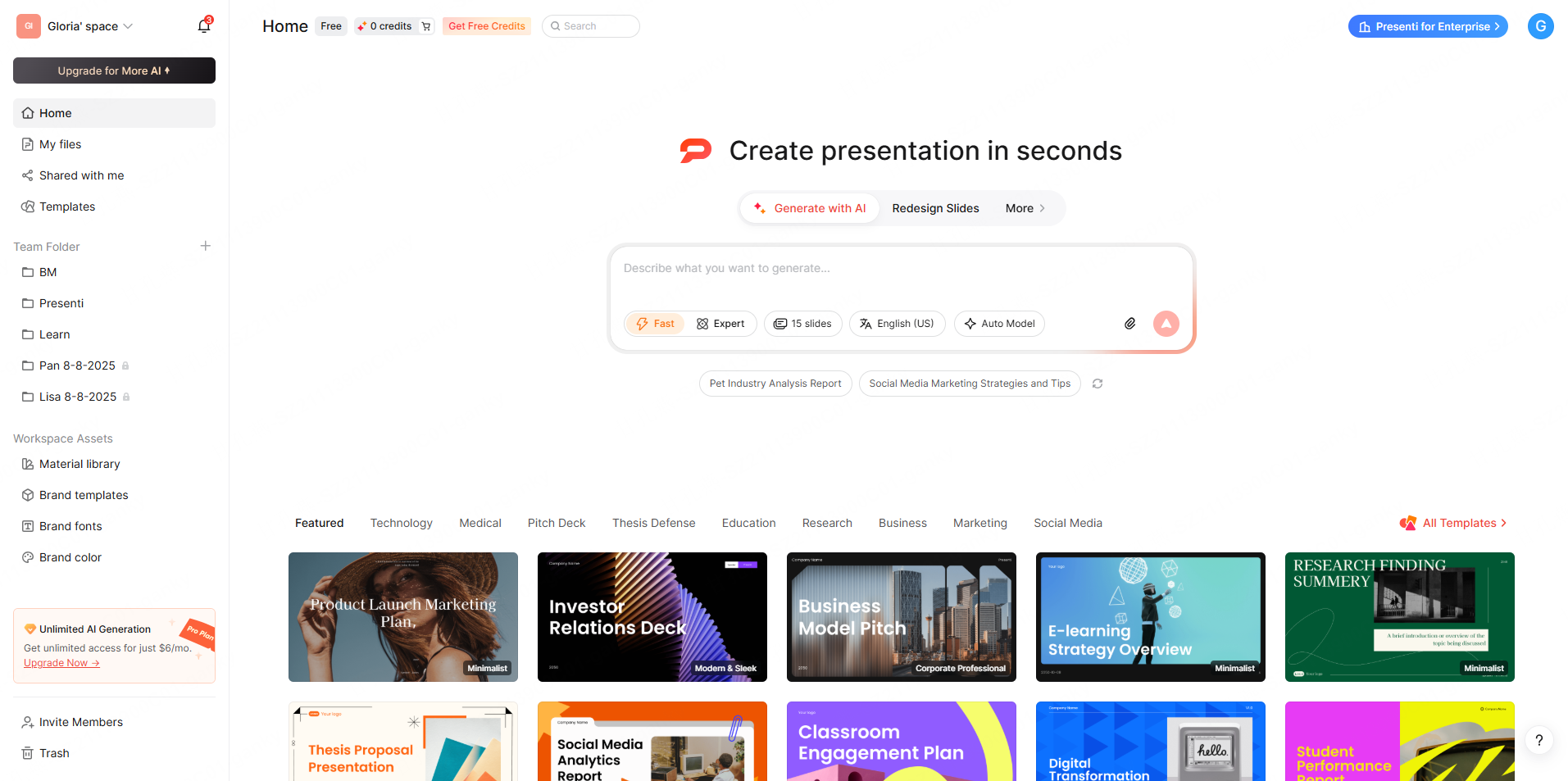
Presenti is an AI presentation maker that works especially well for simple, focused topics because it generates clean, logically structured decks without the visual noise that comes from trying to do too much. Here’s how to use it from topic to finished presentation.
Step 1: Define your one-sentence argument. Before opening Presenti or any other tool, write down the single claim your presentation makes. Something like: “Poor sleep doesn’t just make you tired — it physically impairs the brain’s ability to form new memories, and here’s what the evidence shows.” That sentence is your creative brief.
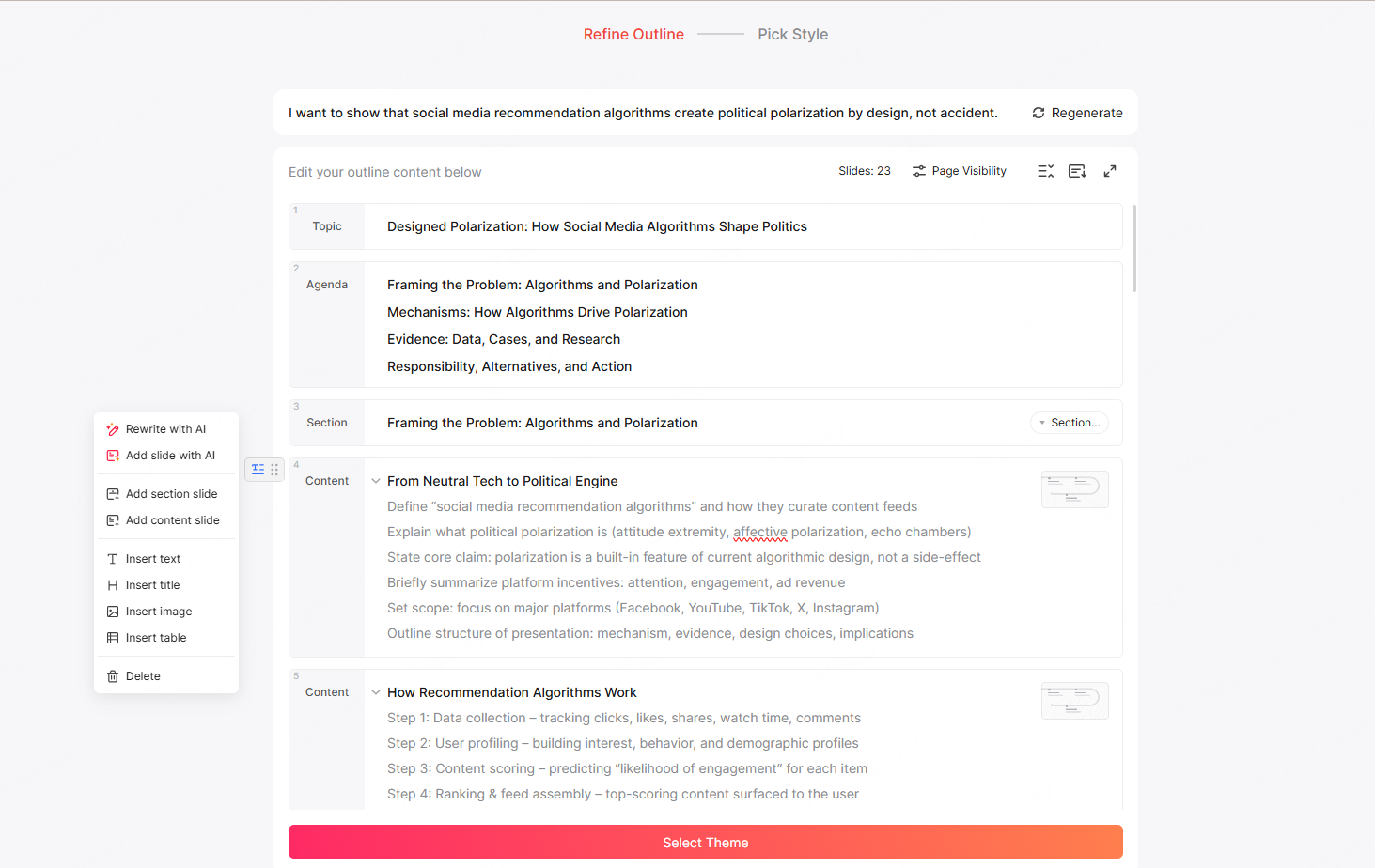
Step 2: Open Presenti and input your brief. Go to presenti.ai and start a new project. Enter your one-sentence argument or a brief outline — three to five bullet points covering your main supporting ideas. Presenti’s AI generates a complete slide structure with section headings, content blocks, and a logical narrative arc. For a simple topic, the generated structure is usually close to what you need with minor adjustments.
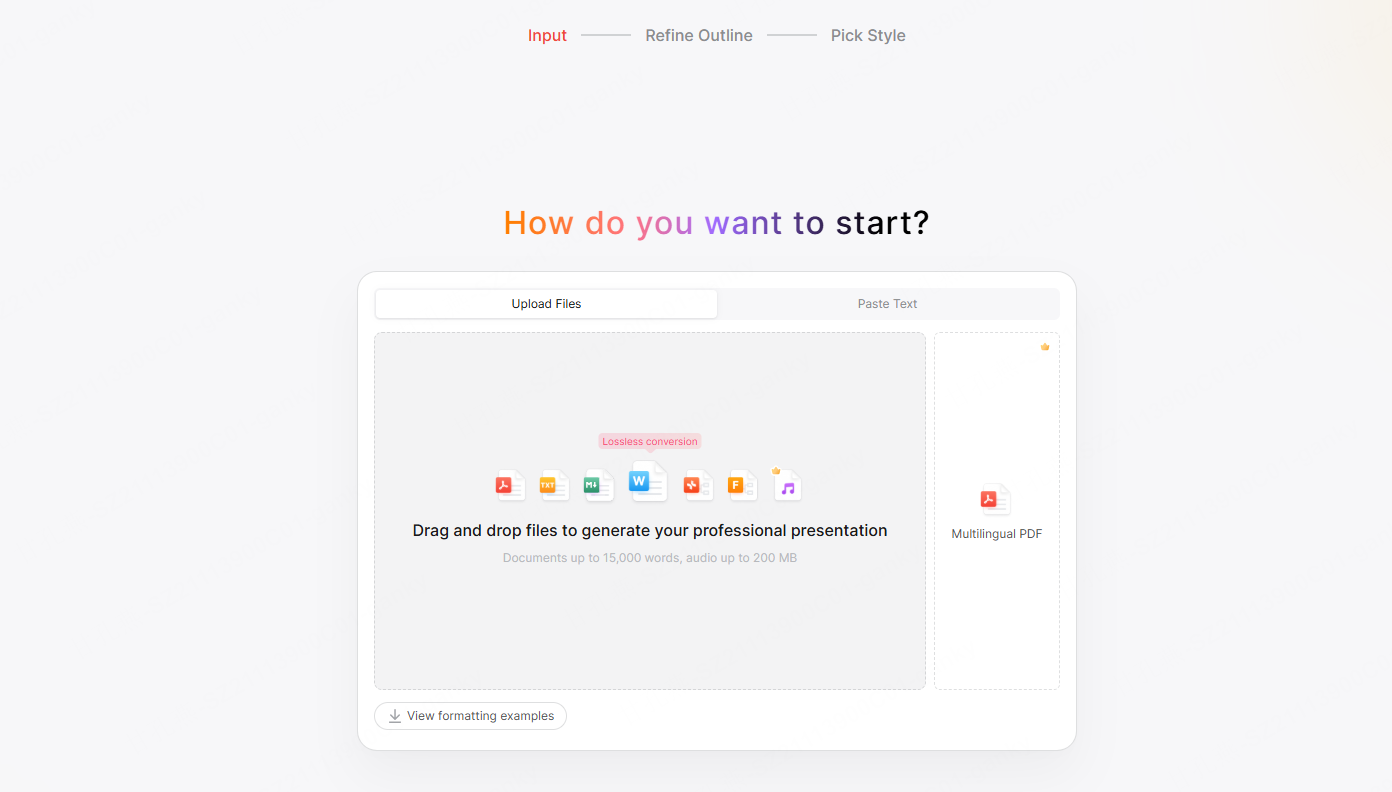
Or Upload any source material you’ve gathered. If you’ve collected research articles, notes in a Word document, or a PDF of relevant data, use a supported input in Presenti; Word/PDF/TXT uploads are listed on paid plans. The AI extracts relevant content and places it into the appropriate slides, which eliminates most of the manual copy-paste work that makes presentation building tedious.
Step 3: Check the structure for your surprise moment. Review the generated outline and locate where your key counterintuitive point sits. If it’s buried in the middle of a long list of supporting slides, move it. The moment of genuine surprise should come early enough to hold attention but late enough that you’ve laid the necessary groundwork. Drag and reorder slides in Presenti’s editor until the sequence feels right.
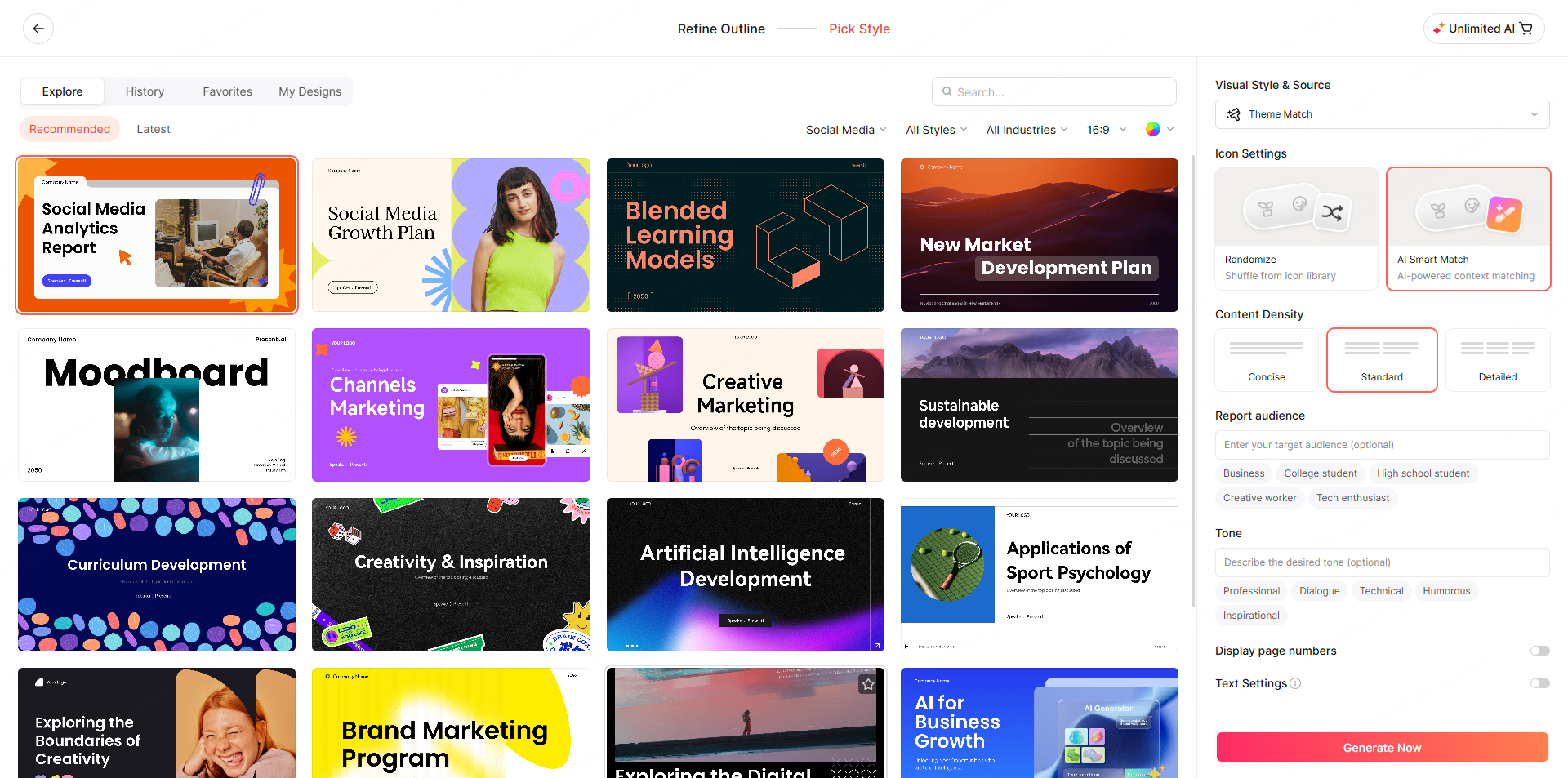
Step 4: Choose a clean template. For simple topics, visual restraint serves better than visual complexity. In Presenti’s template library, select a design that prioritizes whitespace, clear typography, and minimal decoration. A clean template signals confidence — it says the argument doesn’t need visual noise to hold attention because the content itself is sufficient.
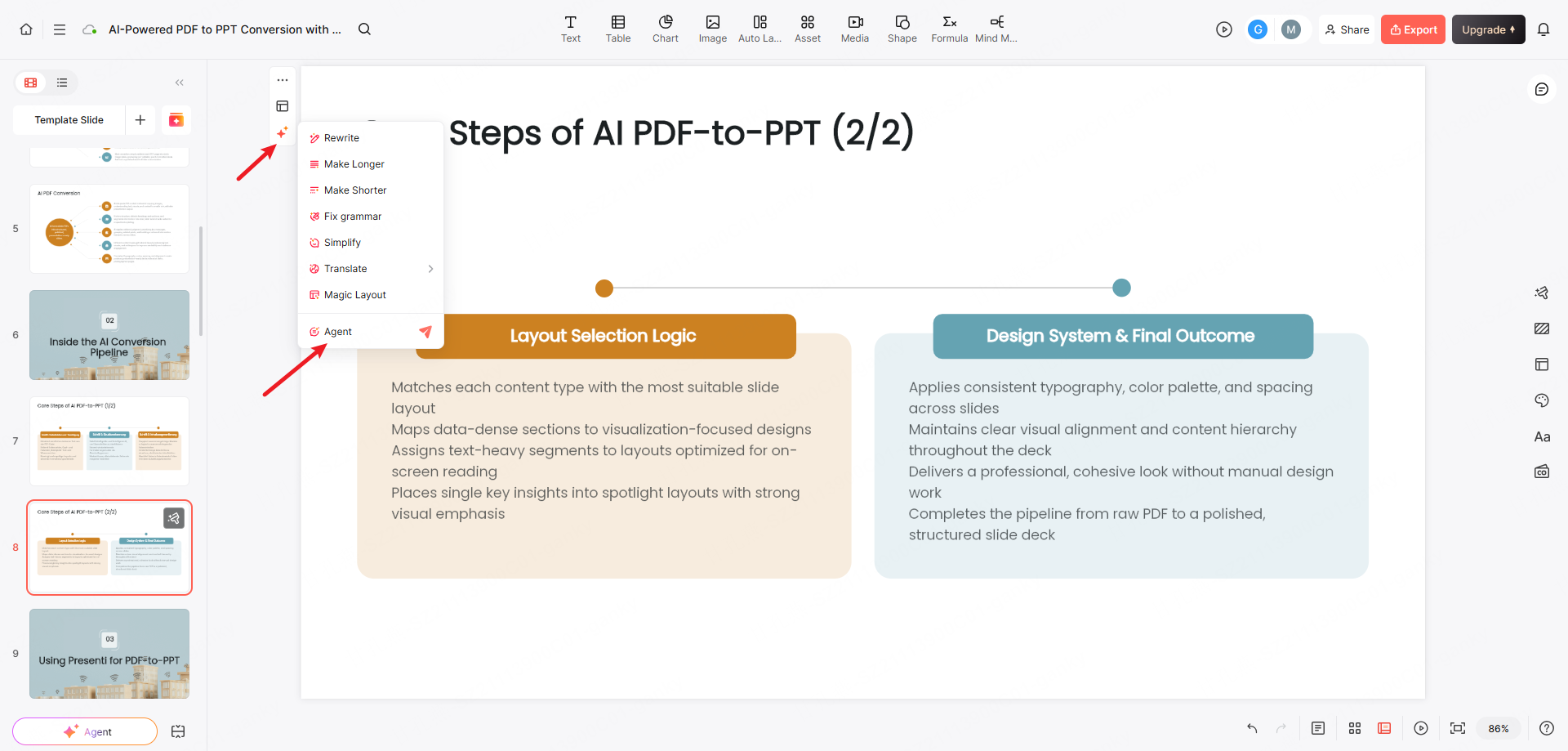
Step 5: Refine with the AI Agent. Presenti’s conversational editing interface lets you adjust slides using plain language. “Make this slide more concise,” “replace this bullet list with a single key statement,” “add a visual here to illustrate the contrast” — the AI executes the change without requiring design skills. This is particularly useful for simple topics because every slide needs to earn its place; the AI can help you cut what doesn’t.
Step 6: Export and rehearse out loud. With a plan that includes export, save the deck as PPTX or PDF and open it in your presentation software. Run through it out loud — not silently, out loud — at least twice before the actual presentation. For a simple topic, this rehearsal is where the presentation really comes together. You’re not just memorizing content; you’re finding the natural pauses, the moment you step away from the slide to just speak directly to the audience, the place where you invite a question. Those moments are built in rehearsal, not in the deck.

Allow time for source review and rehearsal as well as slide creation. A narrow topic helps you decide which evidence to include and which detail belongs in notes or an appendix.
The Honest Case for Keeping It Simple
Somewhere along the way, “simple” became a word people apologize for. In presentations, in writing, in conversation — choosing clarity over complexity started to feel like an admission of something.
It isn’t. The hardest thing to do in any communication is to take a real idea and make it clear. Not dumbed down. Not stripped of nuance. Clear. Organized. Genuinely understandable to the specific people you’re speaking to.
That’s what the best simple presentation topics demand. Not less thinking — different thinking. Not less preparation — more deliberate preparation. Not less ambition — the specific ambition to actually be understood.
Pick a simple topic. Go deep on it. Deliver it like it matters. Use rehearsal and audience feedback to check whether the scope works.