A thesis defense presentation is one of the most high-stakes academic moments you will ever face. Years of research, late nights, and intellectual struggle converge into a single room, a single committee, and a single opportunity to demonstrate that your work deserves to stand. Yet most graduate students receive almost no formal guidance on how to actually build the slides, structure the narrative, or manage the clock. This guide covers everything — how long to prepare, what to include, how to structure it, and how modern AI tools like Presenti AI are transforming the way students create their defense presentations from scratch.
How Long Does It Take to Put Together a Thesis Defense Presentation?
This is the question almost everyone asks first, and the honest answer is: more time than you think.
A master’s defense schedule depends on the department. Work backward from the confirmed presentation length and reserve time for a slide draft, advisor feedback, visual revisions, and several rehearsals. A two-to-four-week preparation window can be a planning example, not a requirement or typical result for every student.
A PhD defense may require a longer preparation window because the argument, methods, and contribution need careful scrutiny. Confirm the presentation and questioning format with your advisor; four to six weeks is an example planning window to adapt to your situation.
A three minute thesis presentation — common in graduate-level competitions like the 3MT — operates by completely different rules. You have up to 180 seconds to communicate the core problem, your approach, and your contribution. Building that kind of precision takes at least a week of distillation, scripting, and rehearsal on its own.
The most common mistake: starting the presentation too late. Defense prep is not a weekend task. It is a process.
What to Include in a Thesis Defense Presentation
The specific content varies by discipline and institution, but the core architecture of a strong thesis defense presentation is consistent across fields. Here is what every well-structured defense deck should contain:
1. Title Slide
Your name, thesis title, department, institution, advisor name, and defense date. Simple, clean, professional.
2. Agenda or Roadmap Slide
A brief overview of what you will cover. This orients the committee and signals that your presentation is organized deliberately.
3. Introduction and Motivation
What is the problem? Why does it matter? Who is affected? This section establishes the intellectual stakes. Do not assume the committee remembers every detail of your written thesis — frame the problem freshly.
4. Literature Review or Theoretical Framework
Where does your work sit in the existing body of scholarship? What gap does it address? Keep this focused. The committee does not need a comprehensive survey — they need to understand the conceptual foundation you are building on.
5. Research Questions and Objectives
State your research questions explicitly. Numbered, clearly worded, one per bullet. This is the anchor of your entire presentation.
6. Methodology
How did you answer your research questions? What design, data sources, instruments, or analytical frameworks did you use? Anticipate methodological challenges — the committee will raise them regardless.
7. Results and Findings
The core of your defense. Present findings clearly, using visual aids — charts, tables, figures — to support interpretation. Organize results to map directly onto your research questions.
8. Discussion
What do your findings mean? How do they connect to the existing literature? What is surprising, confirmatory, or contradictory? This is where intellectual maturity shows.
9. Limitations
Every study has them. Acknowledging limitations proactively demonstrates scholarly integrity and pre-empts committee criticism.
10. Conclusions and Contributions
What did you find? What does it contribute? Be specific. “This study contributes to the literature” is not a contribution — a finding that resolves a specific gap is.
11. Future Research Directions
Where should the field go next? This positions you as a scholar looking forward, not just reporting backward.
12. References and Acknowledgments
Brief, but necessary.
How Many Slides Should a Thesis Defense Presentation Have?
Start with your department’s time limit and expected format. Rehearse a draft to decide the slide count: a dense results figure may need several minutes, while a section divider needs only a moment.
Resist the urge to put everything on the slides. Your slides support your spoken argument — they do not replace it. Dense, text-heavy thesis presentation slides are one of the most common and most damaging mistakes students make. The committee is watching you, not reading your PowerPoint.
Thesis Defense Presentation Structure: A Slide-by-Slide Example
Here is a practical thesis defense presentation example framework you can adapt:
- Slide 1: Title
- Slides 2–3: Introduction and problem statement
- Slide 4: Research questions
- Slides 5–7: Literature review and theoretical framework
- Slides 8–10: Methodology
- Slides 11–18: Results (organized by research question)
- Slides 19–21: Discussion
- Slide 22: Limitations
- Slide 23: Conclusions and contributions
- Slide 24: Future directions
- Slide 25: Thank you / Q&A
This structure works for both master’s and PhD levels. Adjust the depth and number of results slides based on the complexity of your findings.
Thesis Defense Presentation Design: What Good Slides Actually Look Like
Visual design is not decoration — it is communication. A thesis presentation PowerPoint template built for academic defense should prioritize clarity over creativity.
Key design principles:
- Consistent typography: One font family, two weights maximum. Avoid decorative typefaces.
- Minimal text per slide: Use short, readable text; move supporting detail to notes or backup slides where appropriate.
- High-contrast color palette: Dark text on light backgrounds reads clearly under projector conditions.
- Meaningful visuals: Every chart, diagram, or figure should earn its place. Label axes, include units, cite data sources.
- Slide numbers: Always. Committees reference specific slides during Q&A.
- Consistent header structure: The reader should always know which section of the defense they are in.
A good thesis presentation ppt template makes all of these decisions for you in advance. The less cognitive load you spend on formatting, the more you can invest in the content itself.
The Three Minute Thesis Presentation: A Special Case
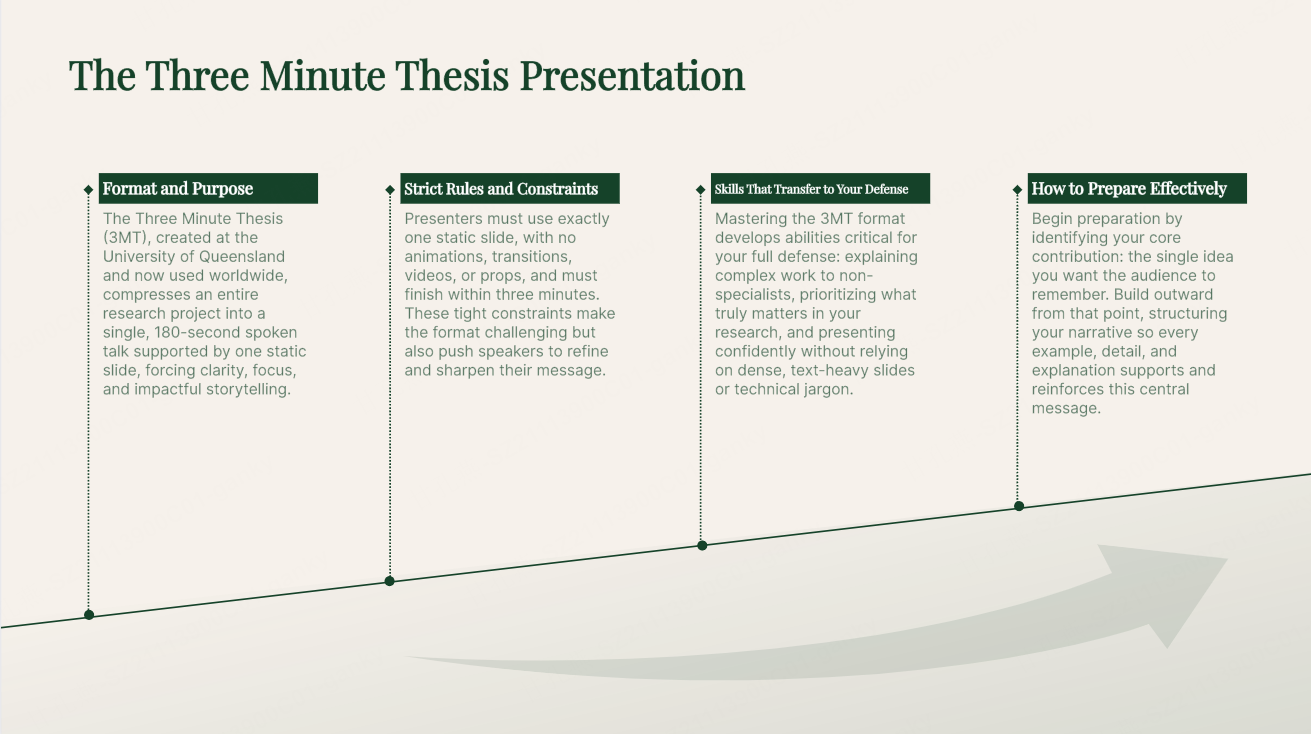
The three minute thesis presentation format — developed at the University of Queensland and now practiced globally — distills an entire research project into a single 180-second spoken presentation with one static slide. It is simultaneously the most liberating and most brutal constraint in academic communication.
The rules are strict: one slide, no animations, no additional props, no exceeding three minutes. But the discipline it demands teaches skills that apply directly to your full defense: the ability to explain your work to a non-specialist audience, to identify what actually matters in your research, and to present with confidence rather than hiding behind dense slides.
If you are preparing a 3 minute thesis presentation, start with your core contribution and work outward. What is the one thing you want the audience to remember? Build from there.
How Presenti AI Helps You Build a Thesis Defense Presentation
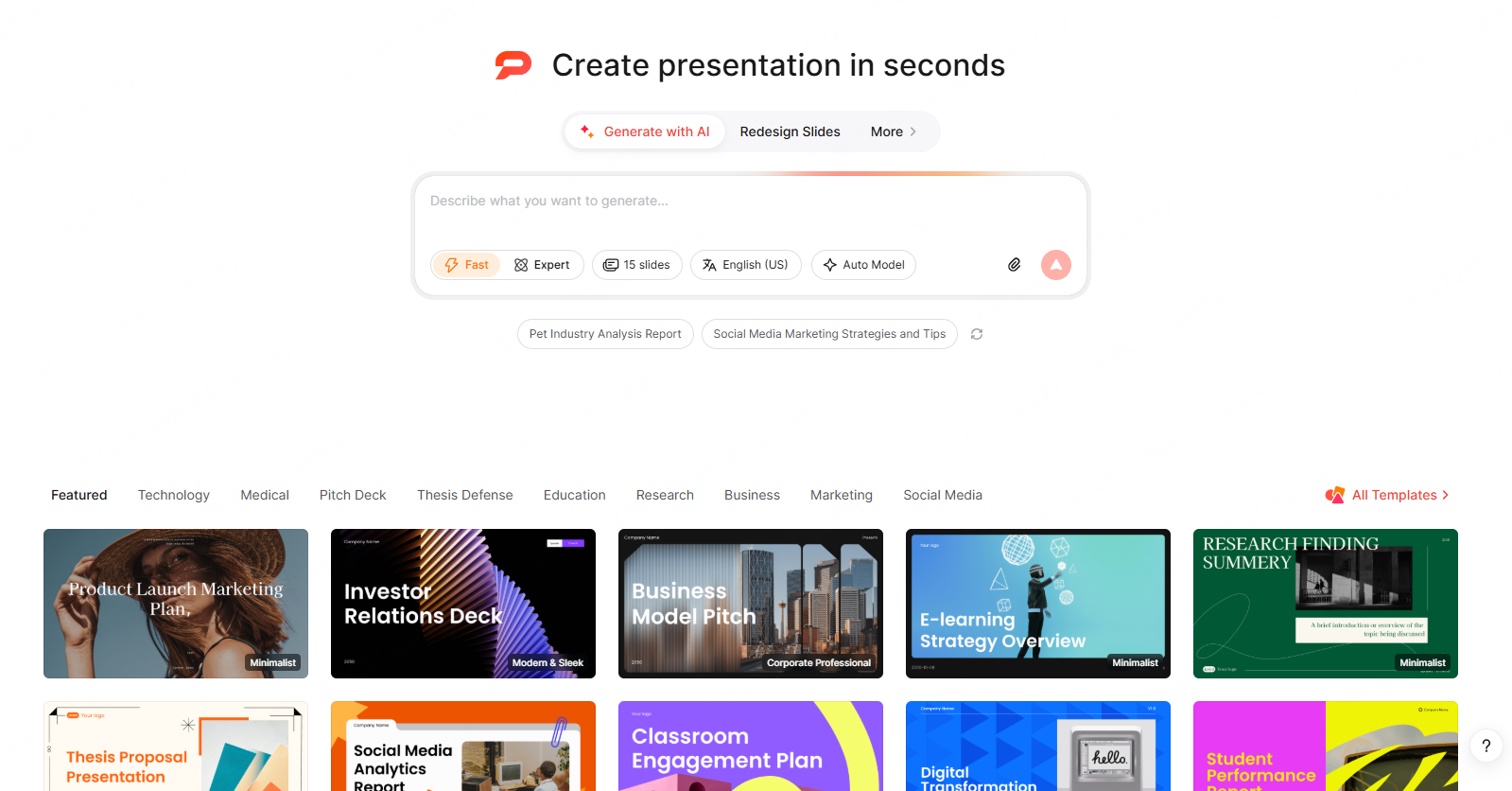
Preparing a PowerPoint presentation for thesis defense from scratch is a genuine production challenge on top of an already demanding intellectual task. You have a written thesis of 80 to 300 pages and need to transform it into a focused, visually coherent, academically rigorous slide deck — often under significant time pressure.
Presenti AI is built for exactly this kind of transformation.
Upload Your Thesis Directly
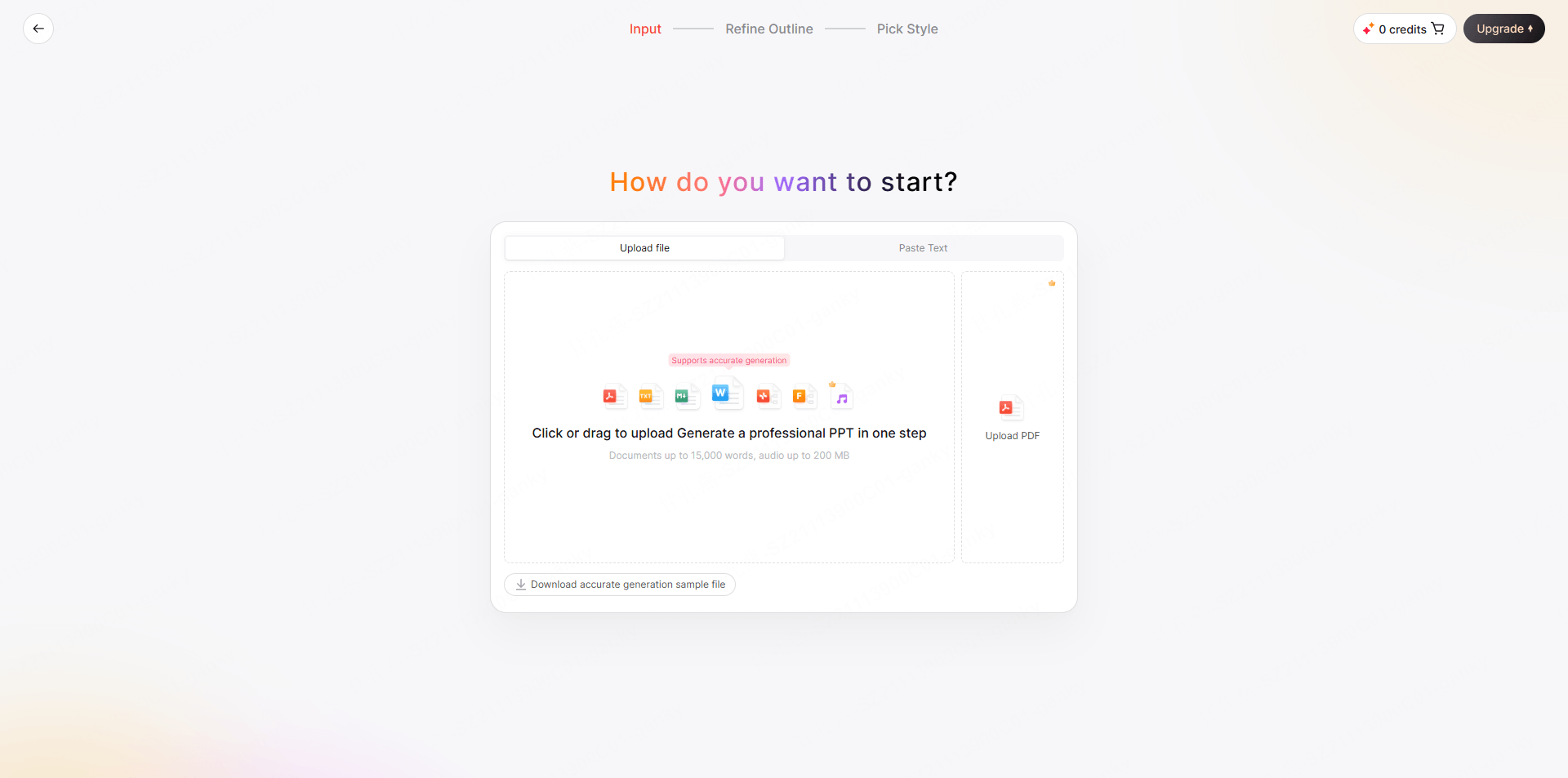
Presenti accepts multi-format input: Word documents, PDFs, TXT files, PPTX files, audio recordings, and web links. Upload your thesis draft, your chapter outlines, your advisor’s notes, or your methodology document — within the supported input and plan limits — and Presenti reads the content, identifies the structural logic, and builds a presentation framework around it.
For a long thesis, begin with a focused chapter outline or summary and check the account’s file limits before uploading.
Generate From an Outline or Prompt
If you prefer to start lighter, type your research topic, key questions, and major findings directly into Presenti. Describe your field, your methodology, and your committee’s likely areas of interest. The AI drafts a complete thesis presentation slide sequence, with appropriate section breaks and content placeholders, ready for you to populate and refine.
One-Click Theme Switching for Academic Contexts
Your institution may have specific color schemes, logo requirements, or visual standards for formal presentations. Presenti’s one-click theme switching lets you apply a complete visual identity — typography, color palette, layout style — across every slide in the deck simultaneously. Apply the closest suitable theme, then check the institution’s logo, colors, type, and required title-slide details.
Hypothetical Example: A Master’s Thesis Defense
As an illustration, consider a master’s student in public health preparing a defense on vaccination uptake disparities in rural communities. They have a 95-page thesis, three weeks until their defense, and no design background.
Using Presenti, they upload their thesis PDF and a TXT file containing their advisor’s feedback notes. Presenti extracts the problem statement, research questions, methodology, and key findings, and builds a structured 28-slide draft deck. The student reviews the draft, adjusts the findings slides to match their exact data visualizations, and applies their university’s color theme in one click. They then verify the figures, citations, and claims against the thesis and rehearse with their advisor.
The same workflow applies for a PhD candidate in computational linguistics, an engineering student defending a materials science dissertation, or a business school student presenting a strategy-focused master’s thesis. The format of the input changes. The draft still needs the researcher’s review and rehearsal.
Script and Speaking Notes Generation
Presenti does not just build slides — it can also generate speaker notes for each slide, giving you a starting point for your defense script. This is particularly useful for students who struggle to translate their written academic voice into confident spoken delivery. Refine the notes to match your natural speech patterns, and you have the foundation of a rehearsable script.
Tips for Delivering Your Thesis Defense With Confidence
Building strong slides is necessary. Delivering them effectively is a different skill.
Practice out loud, not in your head. Reading through your slides silently does not replicate the experience of speaking under committee scrutiny. Present to a mirror, a friend, or a recording device at least five times before the actual defense.
Anticipate questions. For every major methodological decision in your thesis, prepare a one-paragraph answer. The most common Q&A territory: why you chose your sample, why you excluded alternative frameworks, and what you would do differently.
Know your transitions. The moments between slides are where many students lose confidence. Practice moving from one section to the next with explicit verbal signposting: “Having established the theoretical framework, I will now walk through the methodology.”
Time yourself. Every rehearsal. Your committee has other commitments. Running over is unprofessional and creates a poor first impression before Q&A even begins.
Prepare backup slides. Build an appendix of supplementary slides — additional data tables, extended methodology details, alternative analyses — that you can navigate to if committee questions go deep. Having those slides ready signals preparation and thoroughness.
Conclusion
A well-prepared thesis defense presentation is not just a formality — it is the scholarly argument you make for your own work. The structure, the design, the delivery, and the preparation time all signal to your committee how seriously you have taken this process. Whether you are building a 20-minute master’s defense, a 45-minute PhD presentation, or a three minute thesis competition entry, the fundamentals are the same: clear structure, evidence-driven content, and rigorous rehearsal.
Use a focused outline or supported source document to create an initial slide draft in Presenti. Check import limits and paid export access, then verify every finding, citation, and figure before rehearsing the defense.
Frequently Asked Questions
Q1: How many slides should a thesis defense presentation have?
Follow your department’s format and time limit. Choose the slide count by rehearsing the explanation, allowing more time for complex findings and leaving room for questions.
Q2: What is the best structure for a thesis defense presentation?
The standard structure is: title slide, agenda, introduction and problem statement, literature review or theoretical framework, research questions, methodology, results, discussion, limitations, conclusions and contributions, future directions, and a closing acknowledgment slide. This order ensures the committee follows the logical arc of your research from problem to solution.
Q3: How long does it take to prepare a thesis defense presentation?
Preparation time varies by institution, discipline, and how complete the research and visuals are. Work backward from the defense date and include advisor feedback, revisions, and timed rehearsal.
Q4: What should a three minute thesis presentation include?
A three minute thesis presentation should cover: the core problem or gap your research addresses, your approach or methodology in plain language, and your key finding or contribution. One static slide is permitted. Every word should earn its place. Prioritize clarity for a non-specialist audience over technical completeness.
Q5: Can I use an AI tool to create my thesis defense presentation?
Yes — and for many students, it is the most efficient path from a completed thesis to a presentation-ready slide deck. Tools like Presenti AI accept your thesis document in PDF, Word, or text format and generate a structured presentation outline that you then refine with your own data and language. The AI handles layout and formatting; you provide the intellectual content and judgment. Allow time to verify sources, revise the slides, and rehearse; the amount of production work saved will vary.
Q6: What makes a thesis defense presentation slide design effective?
Effective defense slides use consistent typography, minimal text per slide that remains readable at the intended viewing distance, high-contrast color combinations that read clearly under projection, clearly labeled data visualizations, and slide numbers throughout. Avoid decorative fonts, excessive animation, and text-heavy slides that compete with your spoken delivery. The slide exists to support your argument, not to contain it.
Q7: What is the difference between a master’s and a PhD thesis defense presentation?
Master’s and doctoral defenses differ by institution and discipline. Both require a clear argument and defensible methods; a doctorate also requires the original contribution expected by the program. Confirm the local duration, format, and assessment criteria.