If your first language is not English, presenting in English feels harder. Vocabulary doesn't come naturally, and you're managing content, structure, and delivery while navigating a second language. A topic that interests you, matches your English level, and connects to your audience makes everything simpler. The wrong topic turns a demanding task into something overwhelming.
This guide offers 60 English presentation topics for all levels. You will learn how to choose topics at different proficiency levels, presentation topics for ESL learners, and how to build your presentation efficiently.

Understanding Your Context: Which English Presentation Are You Preparing For?
Before choosing a topic, ask yourself: who are you presenting to? The right topic for an ESL classroom differs greatly from a multinational boardroom.
Language learning contexts (ESL classes, speaking exams) prioritize clear communication over complex content. Choose topics simple enough to let your language skills shine.
Academic contexts (university seminars, conferences) demand intellectual rigor and specialized vocabulary. Pick topics reflecting genuine field knowledge.
Professional contexts (business meetings, client presentations) value clarity and relevance. Your topic should connect directly to your audience's work.
Everyday contexts (social clubs, community groups) reward warmth and personal stories. These allow lighter, more conversational topics.
Now let's explore 60 English presentation ideas tailored to each context and proficiency level.
30 Presentation Topics Based on English Proficiency Levels
One of the most practical decisions a presenter can make is calibrating topic complexity to current language ability. This isn’t about lowering ambition — it is about choosing material you can explain clearly with the language you know.
Topics for Beginner and Elementary English Levels (A1–A2)
At beginning levels, the priority is completing the presentation with confidence, not demonstrating sophisticated argument. Topics should be personally familiar, require minimal specialized vocabulary, and involve descriptions, simple explanations, or personal narratives rather than complex analysis.
Recommended topic directions:
- My hometown: what makes it special
- A traditional celebration in my culture
- My daily routine and why I’ve organized it this way
- My favorite food: how to make it and why it matters to my family
- An animal I find fascinating
- My hobby and what it has taught me
- A person who has influenced me
- My country’s most famous landmark
- The differences between my culture and English-speaking cultures I’ve encountered
- How I’m learning English — what works and what doesn’t
These topics succeed because the presenter has natural authority over the content. You know your hometown, your family traditions, your daily life. That knowledge creates fluency even at lower language levels — not because the English is perfect, but because the material is so internalized that finding words for it comes more naturally.
Topics for Intermediate English Levels (B1–B2)
At intermediate levels, speakers can handle longer sentences, more abstract ideas, and some degree of argumentation. Topics can introduce counterintuitive ideas, require moderate research, and involve simple comparisons or cause-and-effect relationships.
Recommended topic directions:
- The benefits and drawbacks of social media for teenagers
- Why learning a second language changes the way you think
- How travel affects people’s worldview
- The pros and cons of living in a big city versus a small town
- What young people today want from work — and how it differs from previous generations
- The role of technology in modern education
- Why some countries are happier than others — lessons from happiness research
- Environmental challenges in my home country: the problem and possible solutions
- How globalization has changed local food culture
- The importance of volunteering in building communities
These topics allow for genuine argument while staying within vocabulary ranges that intermediate speakers can handle comfortably. Each one has a naturally two-sided structure — advantages and disadvantages, causes and effects, comparisons — which gives presenters a ready-made framework that’s easy to signal in English.
Topics for Advanced and Proficient English Levels (C1–C2)
At higher levels, the full range of English presentation topics becomes available. Speakers at this level should prioritize topics where their intellectual depth can be demonstrated, not just their language competence. The most effective presentations at this level combine sophisticated argument with precise, varied vocabulary.
Recommended topic directions:
- The ethics of artificial intelligence: who is responsible when algorithms cause harm?
- Why the most popular mental health advice is often the least evidence-based
- The geopolitics of climate change: why agreements are harder than the science
- How English became the global language — and whether that’s changing
- The attention economy: how digital platforms profit from cognitive fragmentation
- What behavioral economics reveals about why people don’t act in their own interest
- Immigration and national identity: separating the research from the politics
- The future of work in an age of automation: who benefits, who loses, and why
- How the design of cities shapes mental health outcomes
- Why financial literacy education fails — and what would actually work
At C1–C2 level, the language ceases to be the primary challenge and becomes the medium through which genuinely complex ideas can be expressed. Choose precise language and a topic with enough depth for the audience, while explaining unfamiliar terms clearly.
30 English Presentation Topics Based on Context
Academic English Presentation Topics
Academic presentations in English require a combination of subject-matter knowledge and field-specific vocabulary. The topics below work across disciplines and reward the kind of evidence-based argument that academic audiences expect.
- The reproducibility crisis in social science research: causes and implications
- How AI tools are changing academic writing — and what universities should do about it
- The relationship between economic development and environmental degradation
- Cultural bias in standardized testing: what the research shows
- The history of colonialism in shaping current global wealth distribution
- Digital surveillance and civil liberties: where the line should be
- What neuroscience has revealed about how languages are stored in the brain
- The effectiveness of international climate agreements: a critical assessment
- How social media algorithms influence political polarization
- The ethics of gene editing: current possibilities and limits
Business English Presentation Topics
In professional contexts, English presentations need to be immediately relevant and practically actionable. These topics work for international business settings, cross-cultural teams, and professional development contexts.
- How to give constructive feedback across cultural differences
- The business case for diversity — and the evidence behind it
- Remote work and productivity: what recent studies show
- How to negotiate effectively in cross-cultural business contexts
- The changing relationship between companies and their employees after the pandemic
- What customer behavior data reveals about post-pandemic purchasing patterns
- Sustainability as business strategy: beyond greenwashing
- How to communicate bad news professionally in English
- Building trust in virtual teams
- Digital transformation: what it actually means for small and medium businesses
General Interest English Presentation Topics
These topics work across a wide range of English presentation contexts — language classes, community presentations, informal professional settings. They’re substantive enough to demonstrate range but accessible enough for mixed audiences.
- What your coffee order reveals about you — the psychology of preference signaling
- The science of sleep: why most people are getting it wrong
- How languages shape the way their speakers see color, time, and emotion
- The surprising history of a common everyday object
- Why people believe things that aren’t true — the psychology of misinformation
- What makes some cities more creative than others
- The economics of gift-giving: why we consistently choose the wrong presents
- How the design of everyday spaces influences our decisions without us noticing
- What children’s games reveal about the cultures that produce them
- The history of a word we use every day — and what it used to mean
5 Language Tricks That Make Any English Presentation Better
The right topic helps, but language technique matters more. Here are five skills that work across any subject.
1. Use Signposting Language
English audiences expect you to signal structure explicitly: "First, I'll explain the problem. Then, I'll look at three causes. Finally, I'll suggest solutions." This signals fluency and helps listeners follow even with limited vocabulary.
2. Choose Concrete Examples Over Abstract Claims
Instead of making a broad claim such as "social media harms young people," describe a verified study's population, method, result, and limitations. Cite the source and distinguish an association from a demonstrated cause; do not invent a statistic to make the example sound specific.
3. Build Your Connective Vocabulary
Words like "however," "despite this," "this suggests that," and "what's interesting here is" signal how ideas relate. Build a personal bank of these phrases and practice until they come naturally.
4. Slow Down at Key Moments
When making your central argument or key recommendation, deliberately slow down. Speakers at any proficiency level may rush under pressure. Practice this pause — it helps your point land.
5. Prepare Your Q&A Vocabulary Separately
The hardest part isn't the prepared content — it's handling questions. Prepare phrases like "That's a good question — let me think," or "Can you say more about what you mean?" These buy thinking time and sound natural.
Topics to Avoid in English Presentations (and Why)
Certain topics create predictable problems in English presentation contexts, regardless of the speaker’s language level.
Topics requiring highly specialized technical vocabulary are risky unless the audience shares that specialization. Medical, legal, or highly technical engineering topics require such precise vocabulary that errors become distracting. Choose these only when you’re certain of the audience’s background and your own command of the specific terminology.
Highly emotionally charged political topics are difficult in any language, but particularly in English presentations where cultural context matters enormously. What reads as a measured argument in one cultural context can read as inflammatory in another. Unless you know your audience very well, these topics carry risks that rarely pay off in a presentation context.
Topics requiring extensive local cultural knowledge can exclude international English audiences. A presentation about a domestic political controversy, a local cultural phenomenon, or a nationally specific event requires the speaker to build a lot of context before the argument can even begin — which eats time and can lose the audience before the main point is reached.
Topics you find genuinely boring are visible in any language. In English, where the language itself requires more cognitive effort, the absence of genuine interest is even more apparent. If the topic doesn’t engage you, it almost certainly won’t engage the audience.
From Topic to Presentation: Building Your English Presentation with Presenti AI
Once you’ve chosen your topic and identified your angle, the challenge becomes turning that idea into a structured, visually coherent presentation — in English, with clear language and a logical flow that supports your argument.
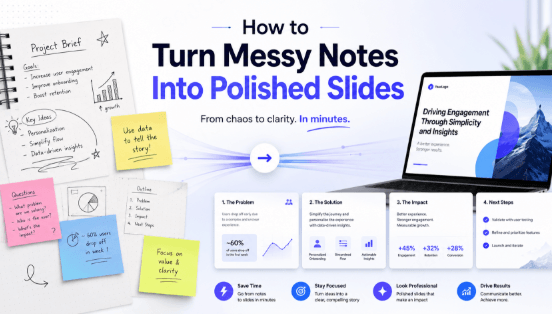
This is where Presenti makes a genuine difference. It’s an AI presentation maker that generates professionally structured, fully editable slide decks from your topic or outline. For English presentations specifically, Presenti handles the structural and design work so your preparation time goes where it matters most: rehearsing the spoken content.
Here’s the step-by-step process.
Step 1: Write your one-sentence argument in English. Before opening any tool, write the single claim your presentation makes, in English, in one sentence. Something like: “I want to examine how social media design choices may affect patterns of use.” Writing this sentence in English forces you to confront your vocabulary early — if you can’t express the argument in one clear sentence, you’ll struggle to express it across twenty slides.
Step 2: Open Presenti and enter your brief. Go to presenti.ai and start a new project. Paste in your one-sentence argument, or a rough outline if you’ve already sketched the key points. Presenti’s AI generates a complete slide structure — section headings, content blocks, and a narrative arc — built around the specific logic of your argument. For English presentations, the draft structure lets you review the order of ideas before refining individual word choices.
Step 3: Review the generated structure for logical flow. English academic and professional audiences follow arguments that move clearly from premise to evidence to conclusion. Review the structure Presenti generates and check: does each section follow logically from the one before it? Is the central argument clearly signposted? Does the conclusion answer the question the opening raised? Adjust sections that feel out of order before filling in the content.
Step 4: Upload your research material. If your account has the relevant paid input access, upload supported Word, PDF, or TXT source material. The AI extracts relevant content and places it in the appropriate slides. For English presentations built on evidence and examples, compare the generated wording with the original. AI paraphrasing can change meaning, especially for technical terms and qualified claims.
Step 5: Choose a template that fits your context. Presenti’s template library covers styles from clean and academic to bold and expressive. For academic English presentations, select a design that prioritizes clarity — clear headings, readable body text, minimal decoration. For business or general interest contexts, a slightly warmer template can signal approachability. Apply the template across the deck with one click.
Step 6: Refine the English on each slide. Shorten crowded text, explain specialized terms, and check grammar and word choice. If you use an AI rewriting feature available to your account, compare the revision with the intended meaning before accepting it. For non-native speakers, this refinement stage is particularly valuable: it’s a way to check that the written English on each slide is clear and natural before the presentation happens.
Step 7: Export and rehearse out loud — in English. Use an eligible paid plan to export PPTX or PDF, then open it in your presentation software. Then rehearse the entire presentation out loud, in English, at least three times. The first time, you’ll find the vocabulary gaps. The second time, you’ll work out the pacing. The third time, the language starts to feel like yours. For English presentations specifically, this spoken rehearsal is not optional — it’s where fluency is built.
Preparation time depends on your research, the draft's quality, and the revisions needed. The time saved on formatting and structure is time that goes directly into spoken rehearsal — which is, for English presentations more than any other context, the preparation that makes the difference between a presentation that works and one that doesn’t.
Conclusion
The right English presentation topic builds confidence. Pick a topic matched to your proficiency level, practice out loud, and let your genuine interest drive the presentation. When you're ready to build your slides efficiently, Presenti AI helps create a professional deck in minutes — so you can focus on delivering with confidence. Try it for free now!