A 4 Ps marketing presentation should turn Product, Price, Place, and Promotion into a connected set of choices that an audience can approve, challenge, and execute. The strongest deck does not stop at a four-part diagram. It shows the evidence behind each choice, the trade-offs between them, and the action plan that follows.
This guide is for marketing teams, founders, students, and consultants who need a practical 4 Ps presentation structure. It focuses on the deck and decision workflow rather than on using AI to invent a marketing mix.
What Are the 4 Ps of Marketing?
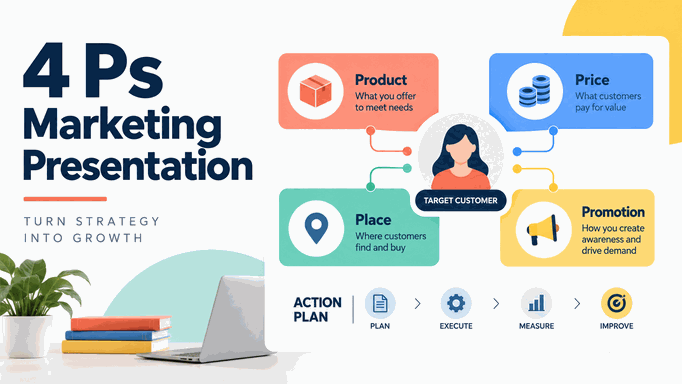
The 4 Ps are Product, Price, Place, and Promotion. Together they describe what you offer, what customers exchange for it, where they can obtain it, and how you communicate its value.
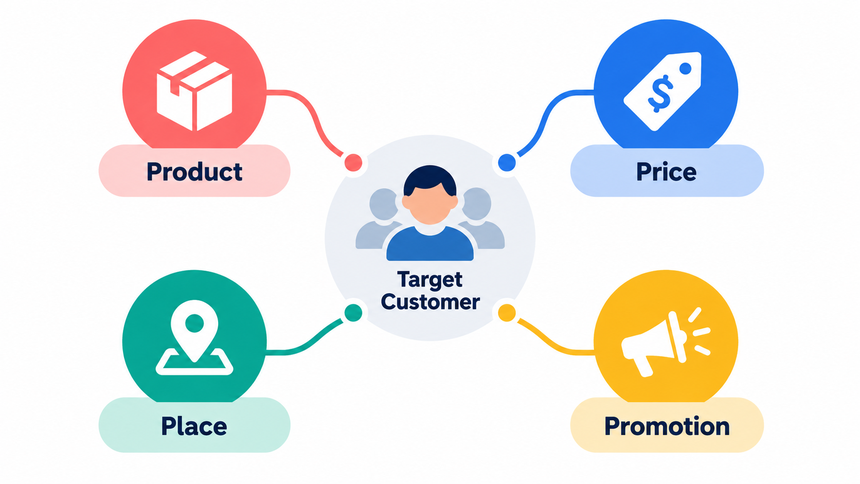
- Product: the solution, experience, features, quality, packaging, and support offered to the target customer.
- Price: the amount, model, discount logic, payment terms, and value signal.
- Place: the channels, locations, partners, logistics, and buying path that make the offer available.
- Promotion: the messages, media, campaigns, sales activity, and timing used to create demand.
The framework is useful because a decision in one area changes the others. A premium product promise may require a higher price, selective distribution, and promotion that emphasizes expertise instead of discounts.
What the Presentation Must Accomplish
A 4 Ps deck should create alignment on a marketing mix, not merely define marketing vocabulary. By the last slide, the audience should understand the target customer, the proposed choices, the evidence, the trade-offs, the owner of each action, and the metrics that will test the plan.
Start with the decision the meeting needs. Examples include approving a launch mix, choosing between two price and channel scenarios, or correcting an underperforming campaign. This keeps the presentation from becoming four disconnected mini-reports.
A Practical 4 Ps Slide Sequence
Most strategy reviews need more than one overview slide. The following ten-slide sequence creates a traceable path from customer evidence to execution.
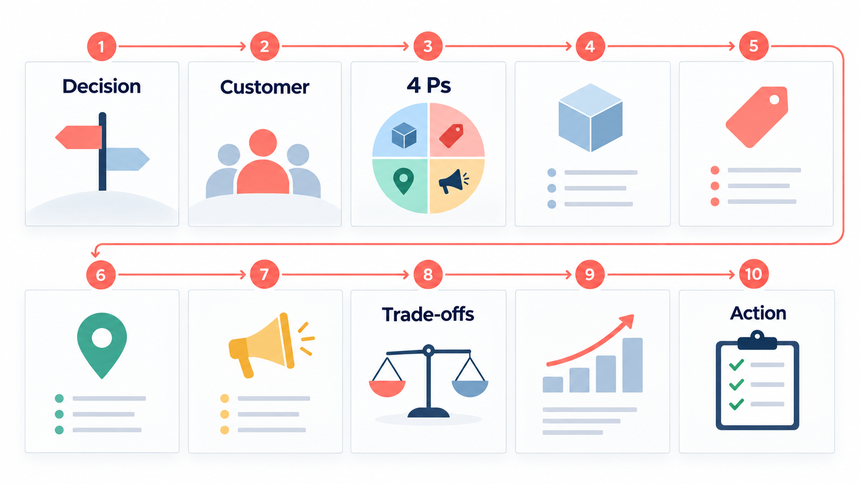
| Slide | Purpose | Evidence to include |
|---|---|---|
| 1. Decision and context | Name the choice and timing | Launch stage, market, audience, and constraint |
| 2. Target customer | Define whose behavior matters | Needs, buying situation, barriers, and alternatives |
| 3. Marketing mix overview | Show the connected proposal | One concise choice for each P |
| 4. Product | Explain the offer and differentiation | Customer evidence, use case, features, proof |
| 5. Price | Explain value and economics | Willingness to pay, costs, competitor context, margin |
| 6. Place | Explain access and distribution | Channel behavior, reach, friction, partner requirements |
| 7. Promotion | Connect message to channel | Message, media, funnel stage, budget, timing |
| 8. Trade-offs and risks | Make alternatives visible | Scenario comparison, assumptions, dependencies |
| 9. Metrics and learning plan | Define how the plan will be tested | Leading indicators, outcomes, thresholds, review dates |
| 10. Action plan | Turn approval into work | Owner, deliverable, date, dependency, next decision |
Use the overview slide as a map. The detailed slides should show why each choice is credible and how it connects to the other three.
Product: Show the Customer Problem and the Promise
The Product slide should explain what the offer helps a specific customer accomplish and why this option is meaningfully different. Avoid a feature inventory without a customer problem.
Useful evidence includes interview patterns, support requests, win-loss notes, usage data, prototype tests, and competitor gaps. Separate confirmed requirements from roadmap ideas. If a feature is not available at launch, label it accordingly.
A concise Product slide can use three blocks: customer job, proposed promise, and proof. End with the decision required, such as which segment or feature set to prioritize.
Price: Explain the Value Logic and the Constraint
The Price slide should show more than a number. Explain the pricing model, the reference point customers will compare, the expected value, the cost or margin constraint, and any assumptions that still need testing.
Compare scenarios using consistent units. If one option is monthly and another is annual, normalize them before presenting the difference. Show discounts, bundles, and channel fees when they materially change the economics.
Do not claim that a price is “optimal” without evidence. A strategy deck can recommend a test range and a decision threshold instead.
Place: Map the Buying and Delivery Path
Place covers how the customer discovers, evaluates, purchases, receives, and uses the offer. For software, that may include self-serve signup, sales-assisted evaluation, marketplaces, partners, and customer success. For a physical product, it may include retail, e-commerce, distributors, inventory, and fulfillment.
Show the path as a sequence and mark where friction occurs. Channel reach is not enough if customers abandon the purchase or the delivery model cannot support the promise.
Promotion: Match the Message to the Decision Stage
Promotion should connect one audience, one buying stage, one message, and one action. A long channel list is not a strategy.
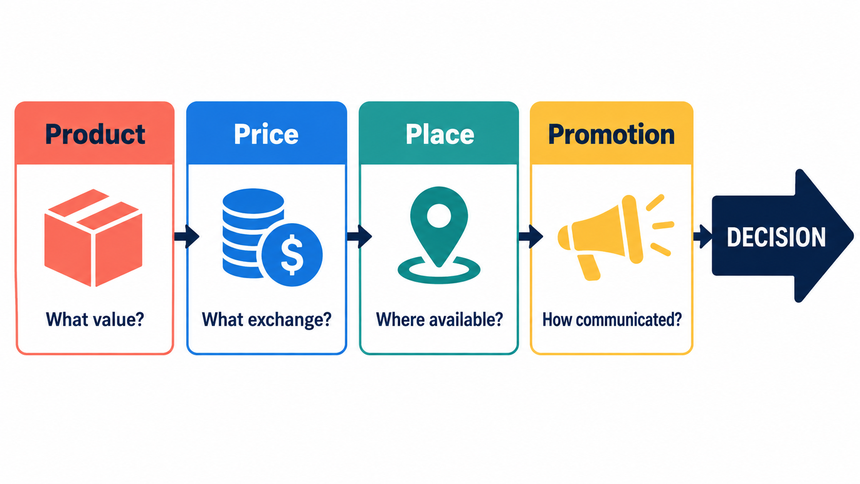
For each campaign, state the audience, the problem or desired outcome, the proof, the channel, the call to action, and the measure. Explain how the message reinforces the Product and Price choices. A premium offer promoted mainly through urgent discount language creates a visible contradiction.
For a broader deck format, organize the marketing presentation around audience, evidence, and action.
Show the Trade-offs Across All Four Ps
The four choices should work as a system. Use a consistency check before asking for approval.
| Question | What a coherent answer looks like | Warning sign |
|---|---|---|
| Does the product fit the audience? | The offer solves a named job with evidence | Features target several unrelated segments |
| Does price reinforce the promise? | The value story and reference point support the model | Price depends on unexplained discounts |
| Does place support the experience? | The channel can deliver the expected service and reach | Distribution adds friction the positioning ignores |
| Does promotion match the buying stage? | Message, proof, and CTA fit the audience's decision | Awareness content asks for a high-commitment action |
If the mix is inconsistent, do not hide the conflict. Present the alternatives and name what must be tested.
Worked Example: A Local Coffee Subscription
Consider an illustrative launch for a monthly coffee subscription aimed at remote professionals who value variety but do not want to research beans every week.
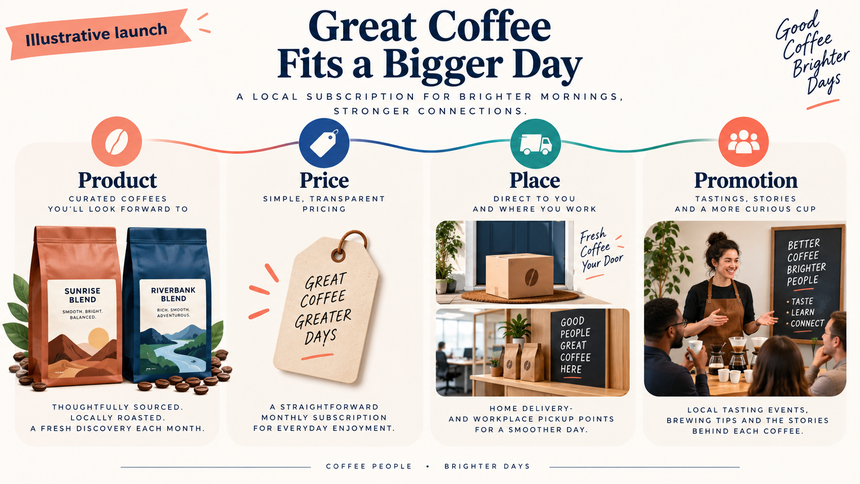
- Product: two curated bags per month, tasting notes, flexible skip controls, and beginner-friendly brewing guidance.
- Price: one standard plan positioned against buying two comparable specialty bags separately; shipping and margin assumptions remain visible.
- Place: direct online signup with local delivery first, followed by a workplace partnership pilot.
- Promotion: short educational content and a first-box sampling event, with referral messaging after the first successful delivery.
The deck should not present these choices as proven. It should label the evidence, assumptions, pilot size, success threshold, and review date. That turns a tidy framework into a learning plan.
Turn the Strategy into a 30-60-90 Day Plan
Close the deck with a staged plan rather than a generic conclusion.
- Days 1-30: validate the priority segment, finalize the offer, test pricing language, and confirm channel requirements.
- Days 31-60: launch a controlled pilot, collect behavior and feedback, and compare actual acquisition and fulfillment data with assumptions.
- Days 61-90: refine the mix, expand only the working channels, and prepare the next decision with documented evidence.
Name the owner, output, deadline, metric, and decision threshold for every action. “Launch campaign” is incomplete. “Demand lead launches the landing-page test by October 5; proceed to the pilot if qualified signup rate reaches the agreed threshold” is operational.
Build the Presentation with Presenti AI
Prepare the audience, decision, evidence, four proposed choices, risks, and action plan before generating slides. Presenti can use that approved input to create an editable deck draft and help structure the sequence.
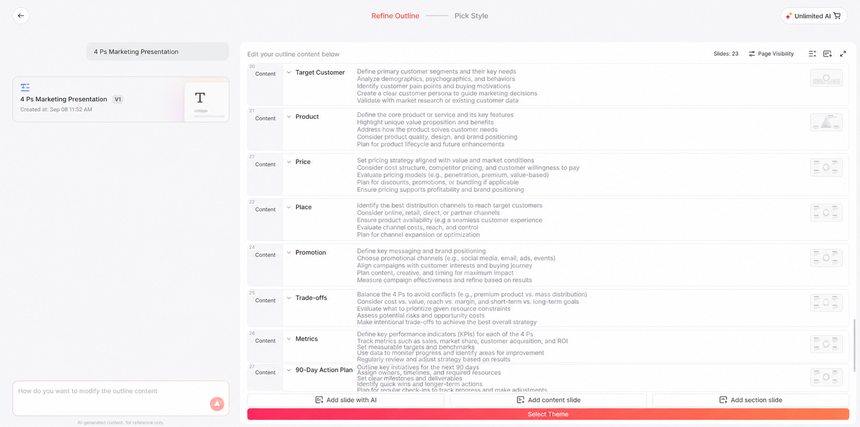
Review the outline before choosing a visual style. After generation, check every claim, number, chart, and label against the source. Replace generic visuals with evidence that supports the specific market and audience. The generated deck is a starting point, not a substitute for customer research or financial approval.
You can also start from a reusable structure in the Presenti presentation template library.
Common 4 Ps Presentation Mistakes
- Starting with four definitions instead of the business decision.
- Treating each P as independent and ignoring contradictions.
- Listing tactics without evidence, owners, timing, or measures.
- Using competitor examples as proof that the same mix will work.
- Hiding assumptions about price, margin, reach, or delivery capacity.
- Showing a polished diagram without a testing or execution plan.
- Letting AI-generated suggestions appear as verified customer insight.
4 Ps Presentation Checklist
- The opening names the audience, decision, market, and time horizon.
- Each P states a choice, its evidence, and its unresolved assumption.
- Product begins with a customer job or problem, not a feature list.
- Price uses consistent units and shows the value and economics logic.
- Place maps the actual buying and delivery path.
- Promotion connects audience, stage, message, channel, CTA, and measure.
- The deck tests consistency across all four Ps.
- Alternatives and trade-offs are visible before approval.
- The final plan names owners, dates, thresholds, and the next decision.
- All generated slides have been checked against the approved source material.
Frequently Asked Questions
What should a 4 Ps marketing presentation include?
Include the decision and target customer, one connected marketing mix overview, evidence-led slides for Product, Price, Place, and Promotion, trade-offs, metrics, and an owned action plan.
Should all four Ps fit on one slide?
Use one overview slide to show the relationship. Give each P a separate slide when the audience needs evidence, alternatives, or implementation detail.
Can the 4 Ps be used for services?
Yes, but the classic model may need additional considerations such as people, process, and physical evidence. State the chosen framework and why it fits the decision.
Can AI create a 4 Ps strategy?
AI can organize inputs, suggest questions, and draft a presentation structure. It cannot replace customer evidence, pricing approval, channel constraints, or human responsibility for the recommendation.
Bottom Line
A useful 4 Ps marketing presentation turns a familiar framework into a coherent decision. Show what the team will offer, charge, distribute, and communicate; explain how the choices reinforce each other; and finish with a measurable learning plan.