A customer onboarding kickoff presentation turns an agreed purchase into a shared delivery plan. It should make the customer’s goal, both teams’ responsibilities, the inputs needed to start, and the acceptance process clear. A product tour alone cannot do that.
Start with the outcome the customer has already agreed to pursue. Then show the work needed to reach it, including customer-owned tasks. Once that brief is settled, turn the onboarding plan into a slide draft with Presenti and edit it for the people attending. Keep commitments in the approved scope; do not let an attractive timeline create new promises.

Define what the meeting must settle
By the end of the kickoff, the participants should know who is doing what next and which unresolved decisions could prevent progress. That is different from persuading someone to buy. Avoid repeating the sales pitch or presenting a feature list before discussing the implementation work.
Asana’s project kickoff guidance describes aligning goals, scope, deliverables, responsibilities, and communication. For a customer engagement, make those responsibilities bilateral: what your team supplies, what the customer supplies, and who accepts each output.
Invite the people who can resolve the first implementation decisions. If the customer sponsor cannot attend, establish who can speak for the agreed goal and which decisions must wait. Attendance is not the same as decision authority.
Build the deck around a concrete implementation
Consider an illustrative onboarding project for a service-request portal. The customer wants one support team to run a pilot using three request types. The initial scope covers configuration, a test import, and a pilot rehearsal. A company-wide rollout and additional request types are outside this phase.
State the goal without inventing a result: “Prepare the support team to pilot three agreed request types.” Do not replace it with “Cut resolution time by 40%” unless that target, its baseline, and its measurement have actually been agreed. The kickoff can establish how success will be measured; it cannot report benefits that have not occurred.
| Agreed item | Meaning in the example | Evidence or open point |
|---|---|---|
| Pilot scope | One team and three named request types | Approved scope document and selected workflow list |
| Configuration | Forms and routing for those request types | Customer process owner confirms routing rules |
| Test import | A sample dataset in the test environment | Customer data owner supplies an approved sample |
| Pilot readiness | Users complete agreed sample tasks | Rehearsal record and named acceptance owner |
Keep the approved scope reference accessible to meeting participants. The table helps people understand it, but a slide is not a substitute for the governing agreement or change process.
Show responsibilities on both sides
A vendor-only task list hides the dependencies most likely to stall onboarding. Give each deliverable a delivery owner, a customer input owner, and an acceptance owner. One person may fill more than one role, but the role should still be explicit.
| Work | Delivery-team responsibility | Customer responsibility | Acceptance |
|---|---|---|---|
| Routing configuration | Configure the agreed rules | Process owner provides and clarifies the rules | Process owner checks sample request paths |
| Test import | Map fields and run the test import | Data owner provides an approved sample and explains fields | Data owner checks agreed reconciliation results |
| Pilot rehearsal | Prepare the rehearsal and record issues | Team lead makes pilot users available | Pilot owner reviews results and unresolved issues |
Replace role placeholders with confirmed names in the private working deck. Do not use the public article’s example names or roles as a ready-made approval chain. If a role is unassigned, mark it as a decision to resolve rather than quietly assigning it to whoever is in the meeting.
Agree acceptance before turning dates into commitments
“Import complete” can mean that a file was uploaded, that records were created, or that the customer checked the results. Those are different states. Agree observable acceptance evidence while the work is still being planned.
In the example, a test import could require all 50 approved sample records to be accounted for. If 47 import successfully and three fail, the reconciliation is complete only when all three failures are identified and explained; the import is not automatically accepted. The acceptance owner decides whether the unresolved issues are acceptable for the next step.
Similarly, “training delivered” is not the same as “pilot team ready.” A rehearsal might ask two designated users to submit, route, and close each request type in the test environment. Record what happened and what needs attention. This is a proposed example criterion, not a universal requirement for every onboarding project.
Make the timeline conditional where it really is conditional
A polished timeline is dangerous when it conceals missing inputs. Show the prerequisite beside each milestone: approved rules before configuration, an approved sample before import testing, and available users before the rehearsal.
For example, the working plan might target a Thursday test import if the approved sample arrives on Monday. If it arrives on Wednesday, do not simply keep Thursday green. The implementation lead must assess the remaining preparation time and either reconfirm the date or propose a revised sequence.
Use three clear labels: agreed date, planning target, and not yet scheduled. Explain the reason for each provisional date in ordinary language. Avoid filling the whole timeline with caveats; put the condition next to the milestone it affects.
Leave with a usable first-week action table
| Next action | Owner role | Needed by | Completion evidence |
|---|---|---|---|
| Confirm the three request types and their routing | Customer process owner | Monday, before configuration begins | Reviewed workflow list |
| Provide the approved 50-record sample | Customer data owner | Monday, before import preparation | Sample available through the agreed secure channel |
| Return field-mapping questions | Implementation lead | After inspecting the sample | Questions assigned to a named resolver |
| Confirm pilot participants and rehearsal availability | Customer team lead | Before booking the rehearsal | Named participants and confirmed time |
The weekdays are illustrative. Replace them with real dates only after confirming the dependencies. Review the table in the meeting so that silence is not mistaken for agreement.
Also agree how a blocked action will be raised. A useful rule names the contact, the information to include, and the next decision point. “Escalate if necessary” leaves all three unresolved.
Use a seven-slide kickoff outline
- Purpose and desired outcome: what this phase is meant to make possible.
- Scope: included deliverables and the most relevant exclusions.
- Working example: one request or user journey through the planned solution.
- Shared responsibilities: delivery, customer inputs, and acceptance ownership.
- Milestones and dependencies: agreed dates versus conditional targets.
- Communication: working channel, review meetings, and how blockers reach a decision-maker.
- First-week actions: owner, due point, and evidence for each action.
Keep deeper product demonstrations in an appendix or a separate session when they distract from the kickoff decisions. Later, a quarterly business review can compare observed outcomes with the customer’s goal. That later review has a different job from agreeing the implementation plan now.
Give the slide tool the boundaries as well as the plan
Use Presenti’s Paste Text mode with the agreed brief. Ask for an editable structure, not an invented project plan. The following example keeps the customer’s work visible:
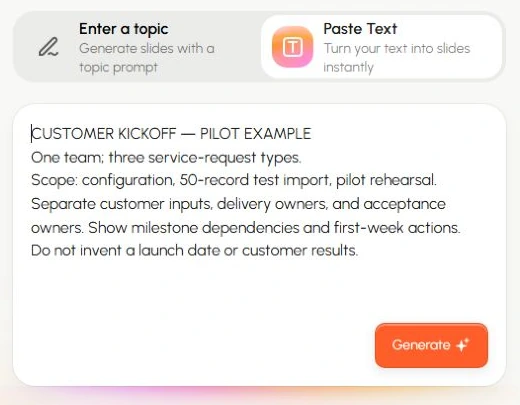
Create a seven-slide customer onboarding kickoff draft for an illustrative service-request portal pilot. Scope: one team, three request types, configuration, a 50-record test import, and a pilot rehearsal. Show customer and delivery-team responsibilities separately. Distinguish agreed scope from proposed acceptance criteria and conditional dates. End with first-week actions. Do not invent customer results, contract terms, a launch date, or a promised implementation duration.
Before sharing, check that every owner has agreed to their role and that the customer can distinguish a proposal from a commitment. The deck is ready when both sides can explain the next action in the same terms.