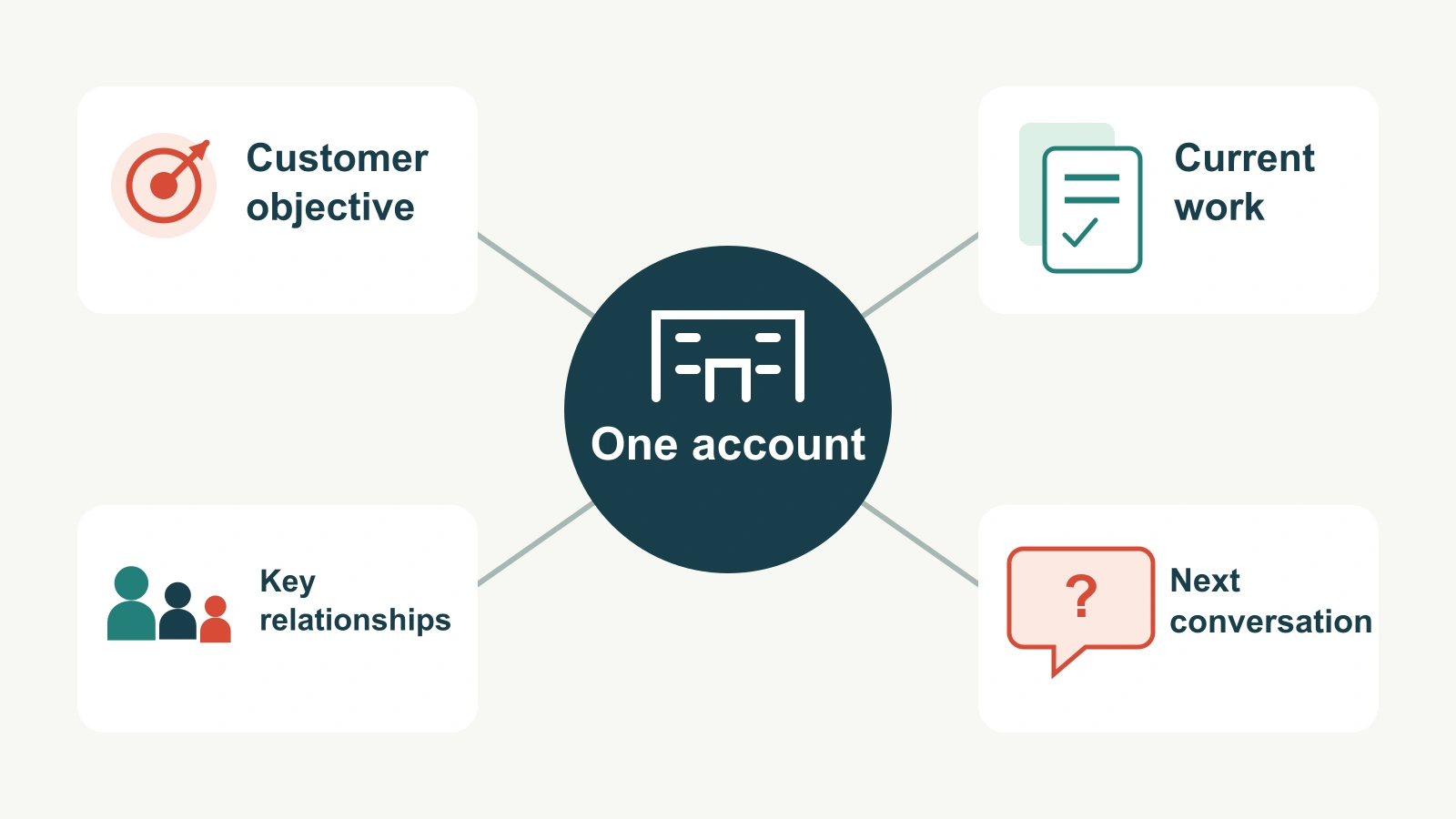
An account plan presentation should explain how you will help one customer achieve a specific objective—and what your team needs to learn or do next. It is not a company profile followed by a revenue target. The most useful plan connects the customer's priorities, the relationship you actually have, the work already in place and a small number of credible next actions.
This guide uses a fictional customer, Willow Facilities, to build an internal account plan and a shorter customer-facing discussion. It is different from a sales strategy presentation, which decides where a sales organization will compete across markets or segments. Here, the unit of planning is one account.
Prepare the facts and open questions first. Then you can turn the account brief into an editable slide draft without asking the presentation tool to invent the customer research. Keep sensitive account information in your organization's approved systems and use only material authorized for the drafting workflow.
Start with the customer's objective, not your sales target
Willow Facilities manages maintenance requests for several office locations. Your company provides the request-management service used by its central team. During the last discussion, the operations director said that handovers between daytime and evening staff were causing repeated questions. That is the confirmed customer concern. It is not yet evidence that Willow needs a larger contract.
An internal headline such as “Expand Willow by 30%” tells colleagues what you want. It does not explain why Willow would want to change anything. A more useful account-plan headline is “Understand the handover problem before proposing a wider rollout.” Your commercial target can remain in the internal plan, but it should not replace the customer's reason to act.
Write the objective in language the customer could recognize. Include who expressed it and what remains unconfirmed. For example: “Operations wants staff to pick up open maintenance requests without repeating questions; the affected locations and current delay have not yet been established.” This creates a practical next step: establish the scope and impact before choosing a solution.
Make the current position specific
The plan needs enough account context to support a decision, not every fact in the CRM. A short table can separate what is known from what the team has inferred.
| Area | What the example account records establish | What remains open |
|---|---|---|
| Current use | The central operations team uses the request service. | Which local teams use other methods, and why? |
| Customer priority | The operations director raised repeated handover questions. | Which handovers are affected and what is their impact? |
| Relationship | The account manager meets the operations director and service coordinator. | Who approves a change that affects local teams? |
| Current commitment | The existing service scope is documented. | Whether the proposed investigation requires extra support time. |
| Possible opportunity | A wider rollout has been discussed internally. | Whether the customer wants it or has a budget for it. |
“Discussed internally” and “requested by the customer” are different statuses. Keep them different on the slide. A useful plan makes uncertainty visible so the account team can reduce it; a polished plan that turns assumptions into facts sends everyone into the next meeting with the wrong expectations.
Attach dates to time-sensitive account facts. An organizational chart or budget assumption from last year may still be useful background, but it should not silently become today's decision map.
Map roles and relationships without guessing authority
A relationship map should help the team decide whom to involve and what to ask. It should not assign influence scores just to fill a template.
For Willow, begin with three roles: the operations director who raised the problem, the service coordinator who can describe the current handover, and a local team lead who would experience a change. A fourth role—who approves a rollout across locations—is unknown. Show that gap rather than assuming the most senior person in your contact list is the buyer.
- Concern: What does this person need from the work?
- Contribution: What can they explain, provide or decide?
- Relationship: Who on your team has a current, appropriate contact route?
- Next question: What do you need to clarify with them?
For the service coordinator, the next question might be: “Can we walk through a recent handover that required clarification?” For the director: “Who would need to agree before we test a change with one local team?” These questions are more actionable than marking both contacts “high influence.”
Do not confuse a relationship map with an approved communication plan. Before contacting additional people, agree the route with the account owner and respect the customer's working arrangements. More contacts are not automatically better contacts.
Choose the next conversation before the next offer
The account team has three plausible actions: offer a wider rollout, demonstrate more features, or investigate one handover with the people doing the work. The third action best matches what is currently known. The customer has identified a problem, but neither its scope nor the fit of a proposed solution is established.
That does not mean every account plan must start with research. If the customer has already approved a defined expansion, the next action may be delivery planning. The point is to match the action to the evidence and the actual stage of the relationship.
For Willow, the internal plan could propose the following sequence:
- Ask the operations director whether reviewing one handover would be useful, and who should attend.
- With permission, examine a recent request and record where information was missing or repeated.
- Compare the observed problem with what the existing service can already support.
- Bring back a bounded recommendation: change the working practice, adjust the current setup, run a small test, or investigate further.
The fourth step is intentionally not “close the expansion.” A wider rollout may become appropriate, but the plan should not present it as the inevitable result of the investigation.
Separate internal planning from the customer-facing discussion
Your internal account plan can include commercial priorities, resource constraints and unconfirmed opportunity hypotheses. The customer-facing version should focus on the shared problem, agreed information and proposed next steps. Do not export the internal deck and assume that hiding one slide makes it safe to share.
| Internal plan item | Customer-facing treatment |
|---|---|
| Possible expansion opportunity | Leave out unless it is relevant to a solution the customer wants to discuss. |
| Unconfirmed decision authority | Ask who should be involved; do not publish an assumed power map. |
| Customer's stated handover concern | Restate it and invite correction. |
| Proposed investigation | Show the scope, participants, time requested and expected output. |
| Internal staffing constraint | Communicate only the delivery implications and commitments the team can make. |
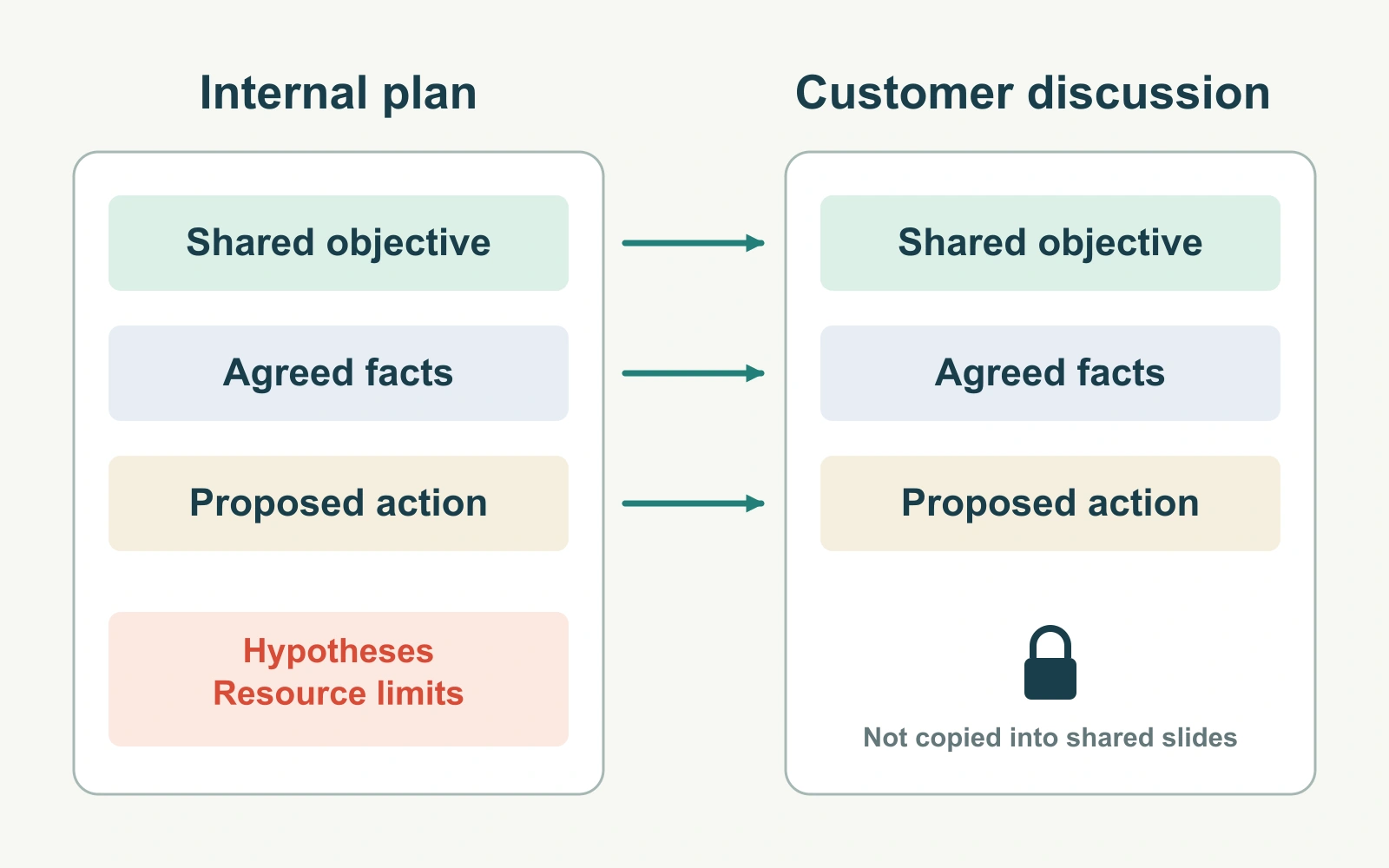
For Willow, a three-part discussion might be enough: “What we heard,” “What we suggest examining,” and “What we need to agree.” Keep the longer internal plan available to the account team rather than making the customer read through your sales process.
Make the plan usable after the meeting
Each next action needs an owner, an intended output and a real agreement. “Arrange a workshop” is incomplete if nobody has accepted the invitation or specified what the session will resolve.
A better internal entry is: “Account manager to ask the operations director whether a 30-minute handover review is useful; proposed output is one agreed example of the current difficulty and a decision on whether to investigate further.” The time is a proposal in this fictional example, not a commitment made by Willow.
Update the plan when the conversation changes the facts. If Willow says the repeated questions occur because access permissions differ between shifts, record that explanation and its source. Do not retain the old generic “training problem” assumption simply because it appears in an attractive slide.
A customer-success quarterly review can later assess agreed outcomes. The account plan has a different job: keep the team aligned on the customer's priorities, the relationship and the next useful action between those reviews.
Copy this account-plan brief
Account and planning audience: [name; internal team]. Customer objective: [stated concern, source and date]. Current relationship and scope: [confirmed facts]. Open questions: [what is unknown and why it matters]. Relevant roles: [contribution, known contact route and unconfirmed authority]. Next action: [proposal, owner, intended output and agreement needed]. Commercial hypothesis: [internal only, clearly labeled]. Customer-facing summary: [shared objective, agreed facts and proposed next step].
Use that brief to create the slide draft, then read it as if you were the customer. Could you distinguish something you actually said from something the seller hopes is true? Could you see what you are being asked to agree? If not, revise the claim before adjusting the design.
A strong account plan is useful because it guides the next conversation. It should become more accurate as the relationship develops, not simply longer.