A literary thesis statement has one job most students get wrong on the first try: it has to argue something, not just describe it. "The novel explores themes of isolation" is a topic. It's not yet a thesis, because nobody could disagree with it.
The examples below cover the most common categories a literary analysis thesis can take — theme, character, symbolism, structure, and comparison — along with a simple formula for building one from scratch when you're staring at a blank page.

What Makes a Literary Criticism Thesis Different
A literary criticism thesis isn't a summary of what happens in a book — it's an argument about what the book means, how it achieves an effect, or why a specific choice the author made matters. Plot summary answers "what happened." A literary thesis answers "so what."
The strongest literary theses share three traits:
- Arguable — a reasonable person could push back on it. If everyone would immediately agree, it's not a thesis.
- Textually specific — it points to something concrete in the text (a symbol, a character's arc, a narrative choice), not a vague theme floating above it.
- Significant — it explains why the point matters, not just that it's true.
Examples of Thesis Statements for Literary Analysis, by Category
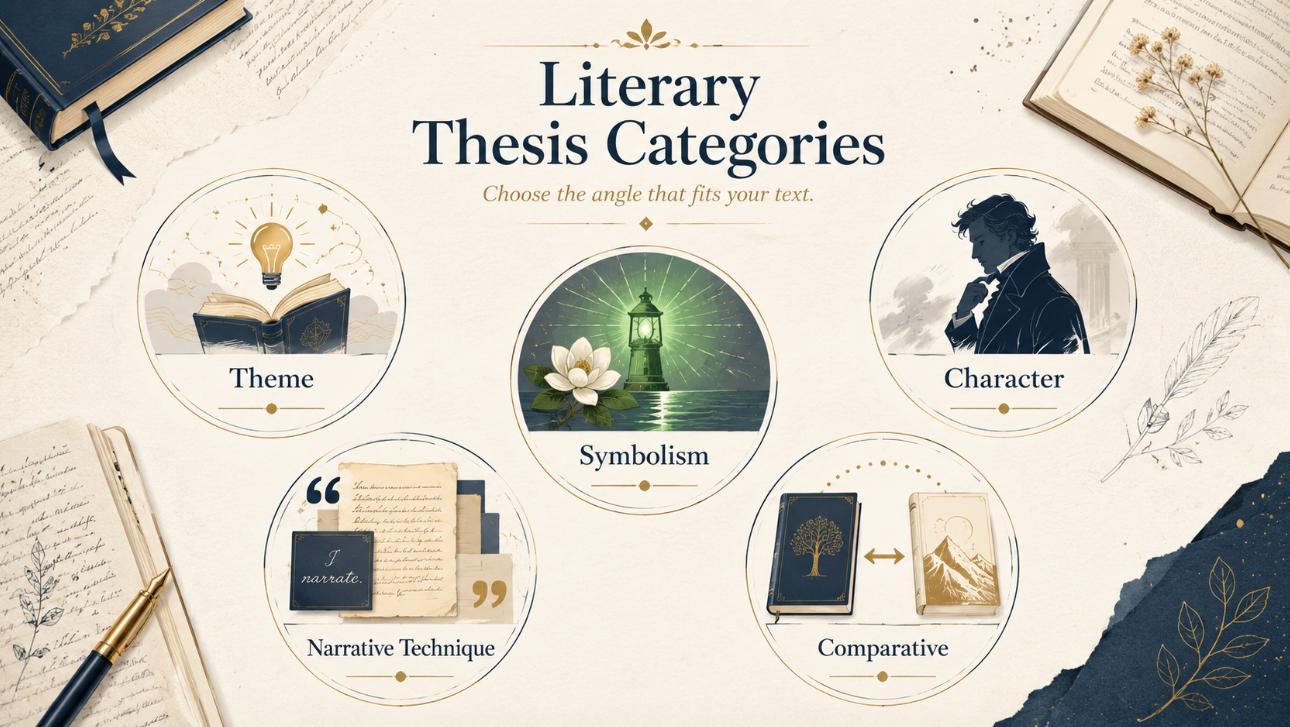
Literary theses tend to cluster into a handful of recognizable types. Seeing one from each category makes it easier to spot which angle fits your own text.
Theme-based Example
In The Great Gatsby, Fitzgerald frames the American Dream not as an achievable goal but as a mechanism that consumes the people who chase it, most visibly through Gatsby's fatal inability to separate love from wealth.
Character-based Example
Hamlet's repeated delays are not evidence of weakness but of a character who understands, more clearly than anyone around him, that revenge cannot restore what has already been lost.
Symbolism-based Example
The green light in The Great Gatsby shifts meaning across the novel, moving from a symbol of romantic hope to a marker of the unreachable past, tracking Gatsby's own transformation from dreamer to casualty.
Structure or narrative technique Example
By narrating The Remains of the Day entirely through Stevens's unreliable first-person account, Ishiguro forces readers to reconstruct the emotional truths the narrator himself cannot admit.
Comparative Example
While both Frankenstein and Brave New World warn against unchecked scientific ambition, Shelley locates the danger in individual hubris, while Huxley locates it in the erasure of individuality altogether.
Examples of Literary Thesis Statements in Practice
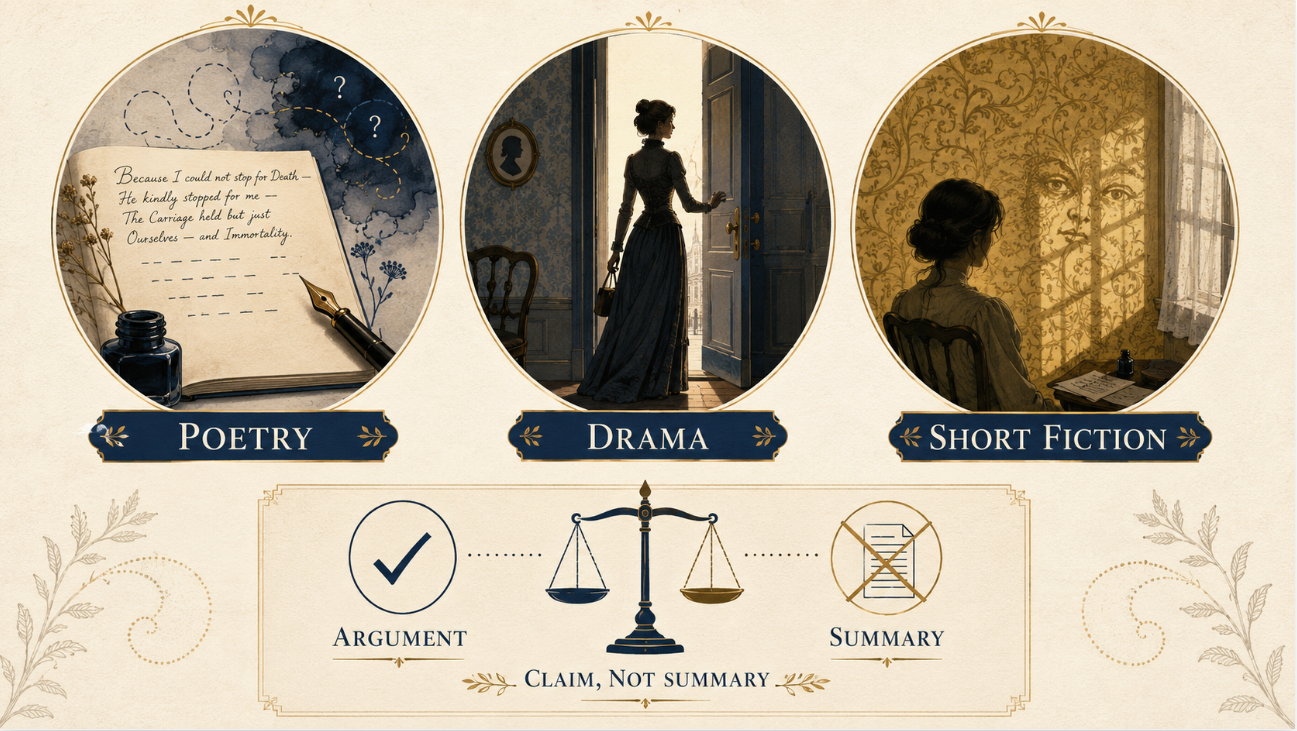
A few illustrative interpretations, each of which would need support from specific passages, with the argument doing real work rather than just naming a topic:
Example — Poetry analysis
In a selection of Dickinson’s poems, her use of dashes functions less as punctuation than as a visual representation of interrupted thought, mirroring the psychological uncertainty at the center of her work.
Example — Drama analysis
In A Doll's House, Nora's final decision to leave is less a rejection of her family than a rejection of the only self she has ever been allowed to perform.
Example — Short fiction analysis
The unnamed narrator in "The Yellow Wallpaper" is not simply descending into madness — she is narrating the only form of resistance available to her within a system designed to silence her.
Notice what these all avoid: none of them describe what happens in the story. Each one takes a position that a classmate reading the same text could reasonably argue against — which is exactly what makes it a thesis instead of a summary.
A Simple Formula for Building Your Own
If you're stuck, this structure works as scaffolding for a first draft — you can (and should) smooth out the mechanical phrasing once the argument itself is solid.
In [work], [author] uses [literary device, choice, or structural element] to [argue / reveal / complicate] [your interpretive claim], which suggests [why this matters].
Worked example using the formula:
In Beloved, Morrison uses a fragmented, non-linear timeline to reveal how trauma resists straightforward narration, which suggests that healing requires confronting memory on its own terms rather than in chronological order.
Once you've got a version that fits the formula, go back and tighten the language — the formula exists to help you find the argument, not to survive into your final draft word-for-word.
Mistakes That Turn a Thesis Back Into a Summary
- Describing instead of arguing. "The author uses symbolism throughout the novel" states a fact everyone already knows from reading the book. It doesn't argue anything.
- Being too broad to test. "Love is a major theme in the novel" could apply to almost any novel ever written. Narrow it to what this specific text does with that theme.
- Skipping the "so what." Identifying a symbol or device isn't enough on its own — the thesis needs to say what that device reveals or accomplishes.
- Making a claim the text can't actually support. An arguable thesis still has to be defensible with real textual evidence — not just interesting to assert.
Presenti AI: Presenting Your Literary Analysis
Once your thesis and supporting evidence are locked in, the next hurdle for a lot of students is turning a written analysis into a class presentation or seminar talk — pulling the argument, key quotes, and textual evidence out of paragraph form and into something visual.

Presenti AI can draft slides from your thesis and outline. Markdown/XMind input is listed on the free plan; Word/PDF/TXT input and editable PPTX/PDF export are listed on paid plans. Compare the generated slides with your argument, quotations, and citations before presenting.
The Bottom Line
A strong literary thesis argues something specific and defensible about how a text works, not just what it's about. Whether you're writing about theme, character, symbolism, structure, or a comparison between two works, the test is the same: could someone else, having read the same book, reasonably disagree with you? If the answer is yes, you've got a thesis. If the answer is no, you've probably still got a summary.