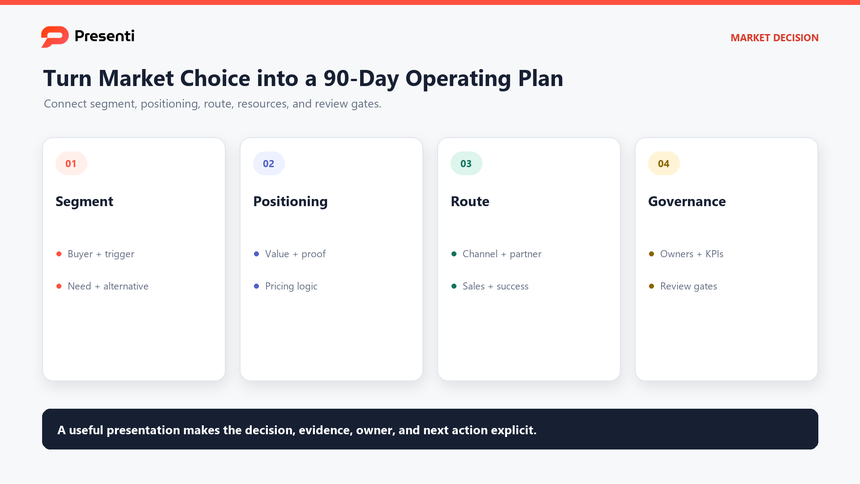
A go-to-market strategy template should turn a market choice into a clear operating plan: which segments the team will pursue, how the offer will be positioned, which channels and sales motions will reach buyers, what the 90-day plan looks like, and how leaders will know whether the strategy is working. A useful GTM presentation is not a list of marketing tactics. It is a decision document that connects customer choice, commercial model, execution, and measurement.
This guide is for product marketing, sales, growth, partnerships, finance, and leadership teams preparing a new market entry, segment expansion, pricing change, partner motion, or major commercial pivot. It applies to a go-to-market plan presentation for a startup, an enterprise business unit, or a team that needs a repeatable GTM strategy deck.

What Should a Go-to-Market Strategy Presentation Decide?
The presentation should answer five questions: which segment deserves focus, why the offer is credible for that segment, how the team will reach and convert buyers, what resources and dependencies are required, and what evidence will trigger a change. If the deck only lists channels and activities, the team has a campaign calendar but not a GTM strategy.
Start with a one-sentence GTM thesis. For example: "Enter the mid-market operations segment with a guided implementation offer, using partner referrals and a 30-day proof program, supported by a specialist sales motion and measured by qualified pipeline, activation, and expansion within two quarters." That sentence ties the segment, offer, route, capability, and success measure together.
| GTM question | Evidence to show | Decision expected |
|---|---|---|
| Which market will we pursue? | Segment size, need, urgency, accessibility, competitive alternatives | Commit to a priority segment and defer others |
| Why will buyers choose us? | Value proposition, proof, pricing logic, and limits | Approve positioning and offer |
| How will we reach them? | Channel roles, partner model, sales motion, and content path | Fund the route to market |
| What must be true? | Resources, capabilities, dependencies, risks, and assumptions | Approve the operating plan |
| How will we learn? | Leading indicators, outcome measures, review gates | Set continue, adjust, or stop rules |
Make the scope explicit. A GTM strategy may cover a new product, a new segment, a new geography, a new channel, or a new pricing model. Each scope changes the evidence and the owner. State what is included, excluded, and assumed so the audience does not treat a focused plan as a complete company strategy.
Which Slides Belong in a GTM Deck?
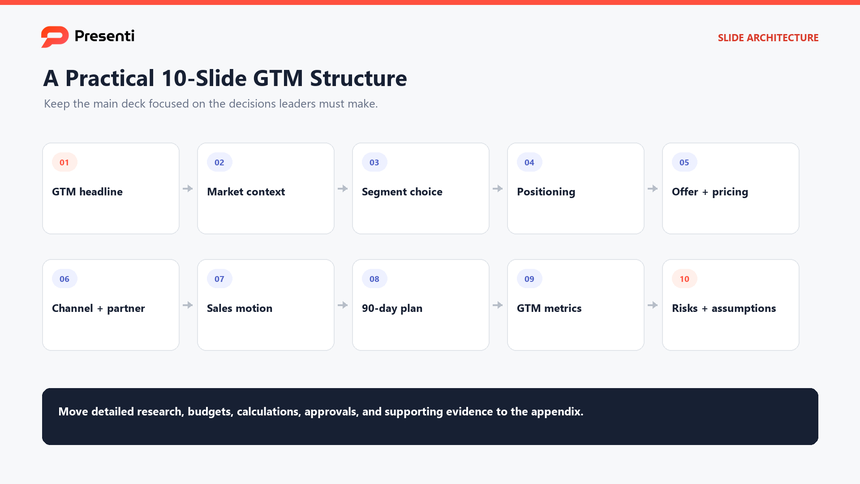
A practical GTM deck usually needs ten to twelve core slides, with an appendix for research detail, financial scenarios, channel budgets, localization, legal review, and supporting data. Keep the main sequence focused on the decisions leaders must make.
Use this go-to-market strategy template to keep the core decision story focused while moving detailed market research, budgets, and scenario models to the appendix.
- GTM headline and decision. State the market, offer, route, and approval needed.
- Market context. Show the customer problem, demand signal, and why now.
- Segment choice. Define the priority buyer, trigger, need, and excluded segments.
- Positioning and value proposition. State the promise, proof, differentiation, and boundaries.
- Offer and pricing logic. Explain packaging, commercial terms, and assumptions.
- Channel and partner route. Give each route a role in awareness, evaluation, and conversion.
- Sales and success motion. Show qualification, handoff, enablement, and post-sale ownership.
- 90-day plan. Sequence milestones, owners, resources, dependencies, and decision gates.
- GTM metrics. Define leading and outcome measures with targets and review dates.
- Risks and assumptions. Name material risks, triggers, mitigations, and exit conditions.
If the audience already knows the market, combine context and segment choice. If the plan introduces a new channel or partner model, give that route its own slide because the operating implications are different. The structure should follow the decision, not a fixed template count.
How Do You Choose Segments and Position the Offer?
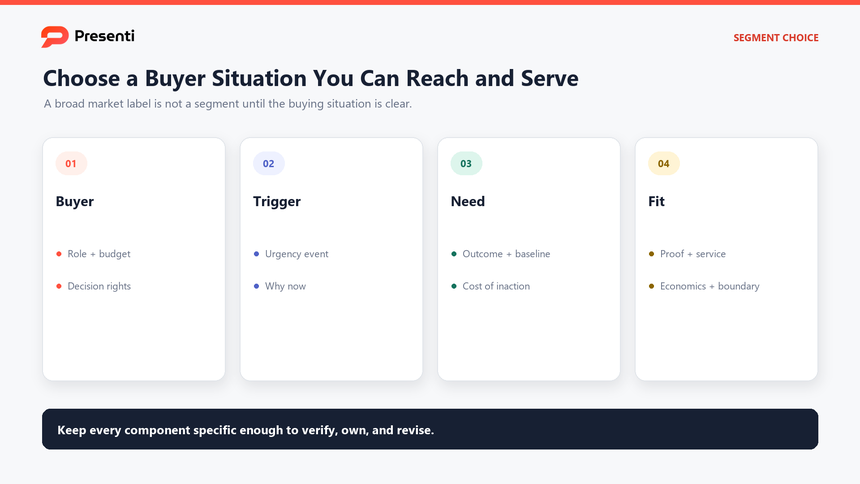
Start with a segment you can reach, serve, and measure. A useful segment statement names the buyer role, the situation that triggers action, the problem, the current alternative, and the reason the team can win. A broad market label such as "small business" is not a segment until the buying situation and service model are clear.
| Segment element | Question to answer | Evidence to show |
|---|---|---|
| Buyer role | Who owns the problem and the budget? | Role, decision rights, buying process |
| Trigger | What event creates urgency? | Customer interviews, sales notes, support pattern |
| Need | What outcome must change? | Baseline, consequence, priority |
| Alternative | What do they use today? | Incumbent product, manual process, internal build |
| Fit | Why can we serve this segment better? | Product advantage, proof, service model, economics |
Then position the offer for that segment. Use one main promise, three supporting claims, and the proof for each claim. State the boundaries as well: which use cases, company sizes, regions, or buying situations are not a fit. Boundaries make the GTM plan more credible and reduce wasted pipeline.
How Should You Map Channels, Pricing, and the 90-Day Plan?
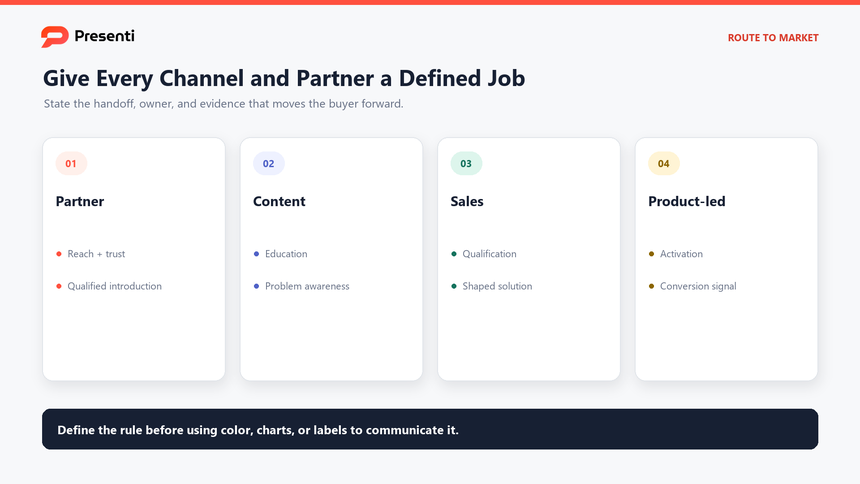
Give every route to market a job. A partner may create reach, a content program may educate, a sales motion may qualify, and a product-led trial may prove value. These routes should connect rather than compete for the same credit. State the handoff, owner, and evidence that moves a buyer from one stage to the next.
| GTM route | Primary job | Owner | Evidence of progress |
|---|---|---|---|
| Partner or referral | Reach a trusted audience and create an introduction | Partnerships | Qualified introduction and discovery scheduled |
| Content and community | Educate the market and create problem awareness | Marketing | Engaged audience and inbound demand |
| Sales-assisted motion | Qualify, shape the solution, and manage the buying process | Sales | Qualified pipeline and agreed next step |
| Product-led or trial | Let the buyer experience value before purchase | Growth or product | Activation and conversion signal |
Connect pricing to the value logic, packaging, and buying process. Show the assumptions behind the model and the scenarios that would change the decision. The GTM deck does not need every financial detail, but it should make the commercial trade-offs visible to the approving audience.
For an illustrative 90-day plan, use days 1–30 to validate the segment and prepare the offer, days 31–60 to test one or two routes with named owners, and days 61–90 to compare results with the agreed thresholds. Give each phase a deliverable, dependency, budget, and review date. Adapt the sequence to the sales cycle; the final review may call for another test rather than expansion.
Which GTM Metrics and Review Gates Matter?
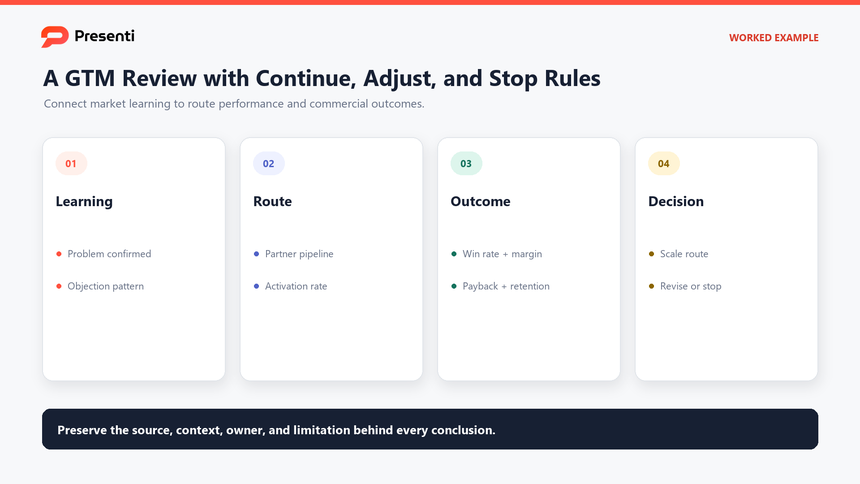
Use a compact measurement model that connects market learning to commercial outcomes. Leading indicators show whether the audience is engaging and the message is landing. Pipeline and activation measures show whether the route is converting. Revenue, retention, and expansion show whether the strategy is creating durable value.
| Measure type | Example measure | Question it answers | Review action |
|---|---|---|---|
| Market learning | Qualified conversations, problem confirmation, objection pattern | Is the segment real and reachable? | Adjust segment, message, or offer |
| Route performance | Partner introductions, qualified pipeline, activation rate | Which route produces quality demand? | Shift resources toward the stronger route |
| Commercial outcome | Win rate, revenue, gross margin, payback | Is the model economically viable? | Scale, revise, or stop the plan |
| Customer outcome | Time to value, retention, expansion | Does the offer create durable value? | Change onboarding, service, or positioning |
Define review gates before the plan starts. Each gate should name the date, owner, evidence, and decision. This turns a GTM strategy template into a management system that can adapt when the market responds differently than expected.
How Can Presenti Turn a GTM Brief into an Editable Deck?
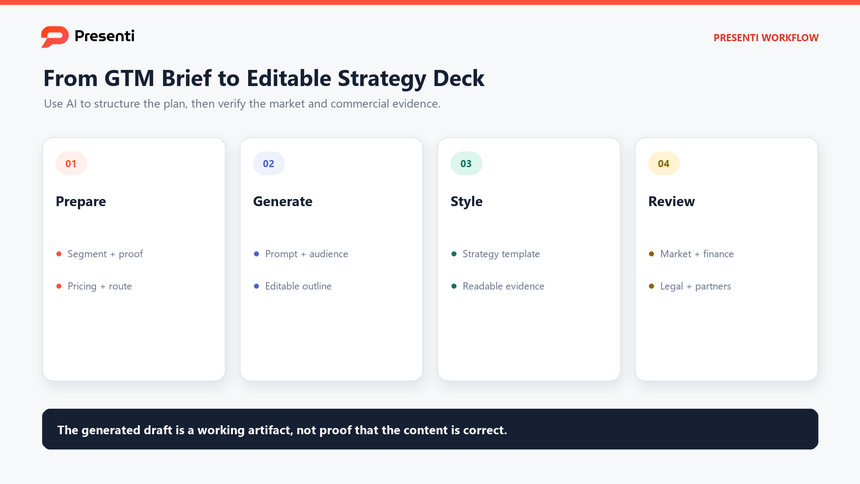
Once the team has the segment, positioning, route, 90-day plan, and measurement logic, Presenti can organize the brief into an editable first draft. Use text to presentation for a written strategy note, or upload a Word, PDF, or Markdown file when the plan already exists in a document.
The tool can structure the deck and provide a visual starting point, but it cannot validate market size, confirm pricing, approve partner commitments, or decide whether the strategy should proceed. Keep those checks with the GTM owner and the approving leaders.
Step 1: Prepare a decision-ready GTM brief
Include the market, segment, customer problem, trigger, positioning, offer, pricing assumptions, route to market, partner model, sales motion, resources, dependencies, 90-day milestones, KPIs, risks, and review gates. Remove confidential customer, pricing, or partner terms that are not approved for the working file.
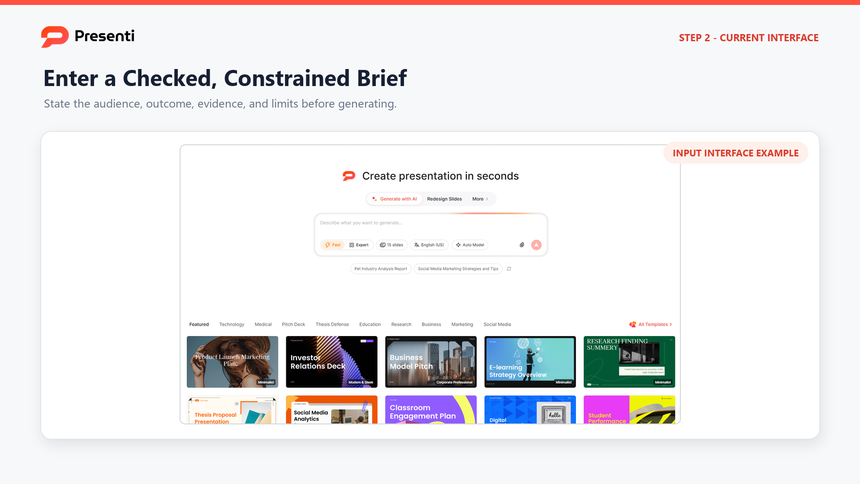
Step 2: Enter a constrained prompt
Use a prompt such as:
Create a 10-slide go-to-market strategy presentation for an executive decision meeting. Audience: product, marketing, sales, partnerships, finance, and leadership. Include the GTM thesis, market context, priority segment, buyer trigger, positioning, offer and pricing assumptions, channel and partner model, sales motion, 90-day plan, KPIs, risks, and decision gates. Use placeholders for unverified market, pricing, and customer evidence. Do not invent market size, partner commitments, or financial results.
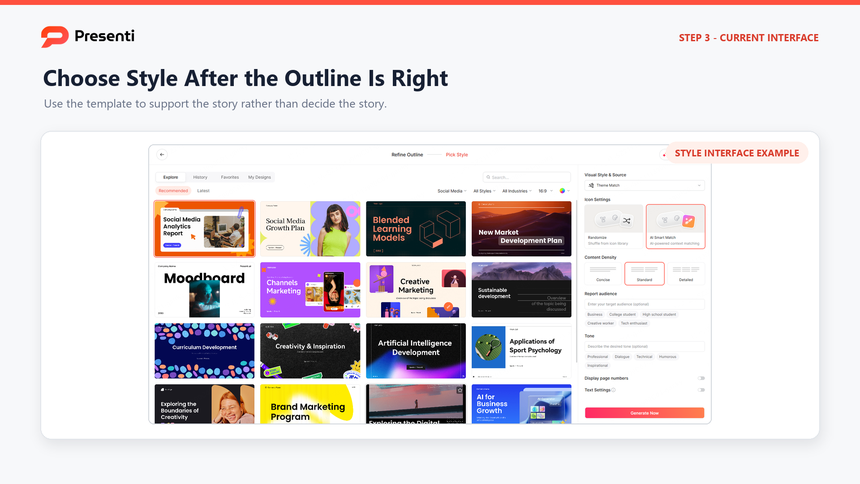
Step 3: Review the outline, then choose a template
Check that the story moves from market choice to positioning, route, operating plan, measurement, and risk. Remove generic marketing slides, combine repeated channel slides, and make the approval request explicit. Then open the Presenti template center, preview a strategy or business template, and apply it after the logic is correct.
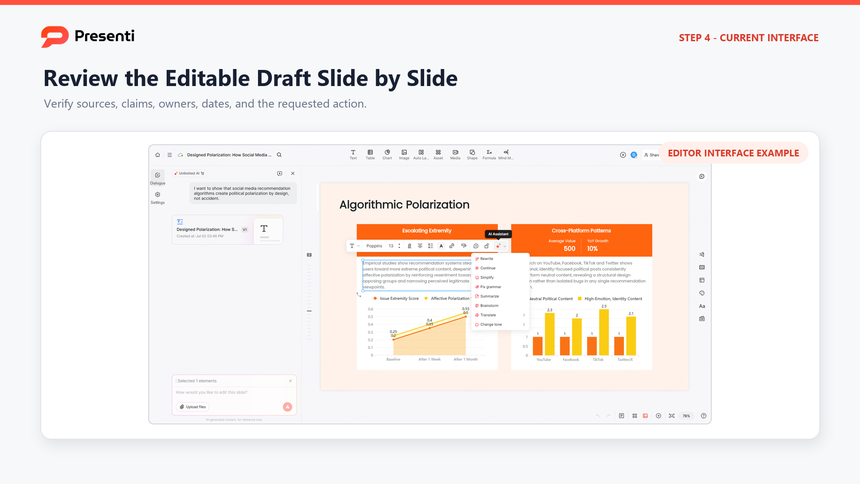
Step 4: Verify the editable deck
Compare every market claim, segment assumption, partner commitment, price, date, owner, and metric with the approved source. Rehearse the decision ask with the GTM owner and remove internal notes, placeholder text, and unapproved customer or partner details before the review.
The finished presentation should make the market choice easier to approve and easier to review once the first evidence arrives.
Frequently Asked Questions
What should a go-to-market strategy presentation include?
Include the GTM thesis, market context, priority segment, buyer trigger, positioning, offer and pricing assumptions, channel and partner model, sales motion, 90-day plan, KPIs, risks, and review gates.
How is a GTM strategy different from a marketing plan?
A GTM strategy defines the market choice, offer, route to market, commercial model, and decision rules. A marketing plan executes the communication and demand activities that support part of that strategy.
How many slides should a GTM deck have?
Ten to twelve core slides are usually enough for an executive review. Use an appendix for market research, financial scenarios, channel budgets, localization, legal review, and detailed partner plans.
Who owns the GTM plan?
Ownership depends on the organization and scope, but the plan needs one accountable leader, clear functional owners, a decision cadence, and a single source of truth for assumptions and evidence.
How often should the GTM plan be reviewed?
Review leading indicators frequently enough to correct the plan before the next major investment. Review commercial outcomes after enough evidence has accumulated to judge the strategy rather than normal market noise.
Bottom Line
Build your go-to-market strategy around a specific segment and buying situation. Explain the offer, the role of each channel, and the resources needed for the first 90 days. Show the assumptions behind pricing and pipeline targets so the team can decide what to test first and when to expand.