A grant proposal presentation gives reviewers a quick way to judge fit, feasibility and expected benefit. It should answer the funder’s questions in their order, not reproduce every paragraph of the written application. A pitch deck workflow can help you make the story visual, but a grant presentation still needs a traceable budget and a realistic evaluation plan.

Start with a bounded need
Define who is affected, where and during what period. Use a source the audience can inspect, and separate observed facts from your interpretation. Avoid a dramatic statistic that has no local relevance. One sentence should connect the need to the people the project can actually reach.
State the gap in current services or knowledge, then show why the proposed work is timely. If another organization already serves the group, explain the complement rather than implying that no help exists. Precision builds trust faster than a larger problem statement.
Show the method as a sequence
Use a simple chain: activities → outputs → short-term outcome → longer-term contribution. Name the participants, the delivery setting and the capability required. If the method depends on a partner, show the partner’s role and the evidence that the relationship is ready.
A method slide should also say what you will not do. Scope limits protect the proposal from promising a result outside its time, budget or authority. Put assumptions in a visible note and list the decision that would change the design.
Make the budget a model, not a decoration
Group costs by the work they enable: people, materials, delivery, evaluation and overhead where allowed. Show the unit or quantity behind the largest lines. Reviewers should be able to see how the requested amount follows from the method.
Explain matching funds or in-kind support without treating them as guaranteed cash. Mark estimates, confirmed contributions and pending commitments differently. If the project can be phased, show what the requested grant unlocks first and what depends on later funding.

Define measurable impact and learning
Choose a small set of indicators that match the stated outcome. For each one, name the baseline, target, collection method and review point. Not every meaningful change can be reduced to a single number; pair a count with a short qualitative method when appropriate.
Describe what you will do if the result is weaker than expected. A learning plan is not an admission of failure. It shows that the team will use evidence to adjust delivery and report what actually happened.
Close on the reviewer’s decision
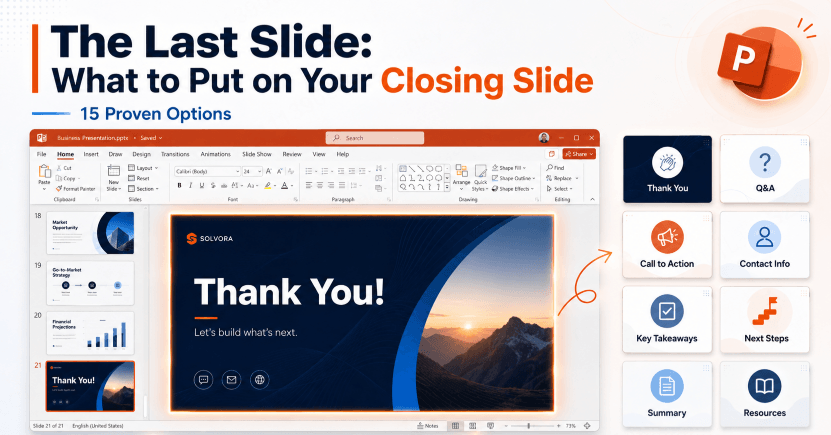
End with the amount requested, the decision date and the next step after approval. Summarize the strongest evidence for fit and feasibility, then name one risk and its mitigation. Do not hide uncertainty in a final “impact” word cloud.
Before sharing, ask someone outside the project to answer three questions from the deck: who benefits, what will happen first and how will you know it helped? If they cannot answer without the written application, the presentation needs a clearer spine.