An investor update template helps founders explain what changed, what is going well, what is difficult, and where investors can help. Keep the format consistent so readers can compare one update with the next. Include the reporting period, a few useful metrics, important milestones, and a specific request when you have one.
This guide is for founders and operators preparing a monthly or quarterly update for existing investors, advisors, or a board conversation. It shows how to choose a small KPI set, connect milestones to decisions, state a funding ask without invented forecasts, and turn a verified brief into an editable presentation draft.

What Should an Investor Update Template Include?
A useful update has a stable order and a clear job for every block: subject and period, one-sentence summary, headline metrics, progress against the last commitments, highlights, lowlights or risks, next priorities, cash context, and specific asks. Team or product notes belong only when they change execution, risk, or the decision in front of the reader.
Record the reporting period, data cutoff, source of each number, and any change in how a metric is calculated. The Yonder investor update guide and the Startup Project template offer examples of concise summaries, consistent metrics, challenges, and requests for help.
| Block | Purpose | Minimum useful content | Remove or qualify |
|---|---|---|---|
| Period and summary | Orient the reader before detail | Dates, one material change, and why it matters now | Unbounded adjectives such as "exceptional" or "breakthrough" |
| Metrics | Show the operating signal | Current value, prior value, definition, and source or owner | Vanity numbers with no denominator, period, or decision link |
| Milestones | Explain what moved | Outcome, evidence, status, and next gate | Activity lists that do not change a plan |
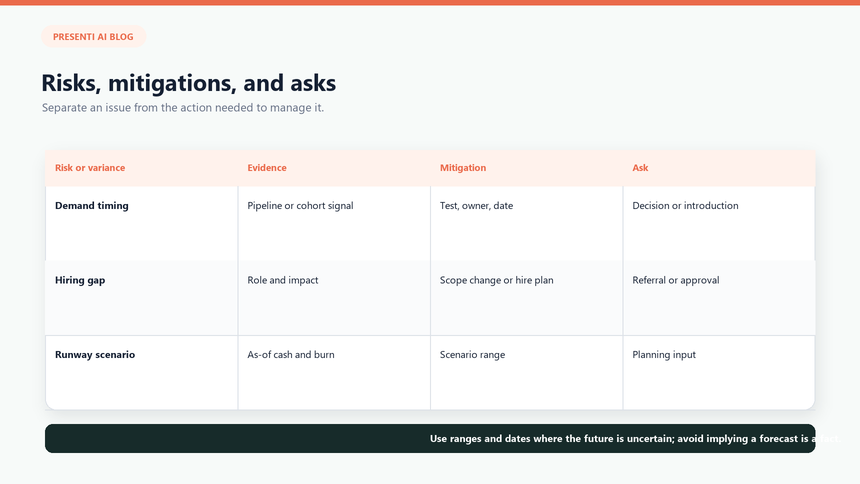
| Risks and lowlights | Make help possible | What happened, impact, response, and unresolved uncertainty | A red label without an owner or recovery path |
| Ask and next period | Turn attention into action | Specific request, target profile, context, owner, and response date | "Please help with sales" or a funding amount without a stated use |
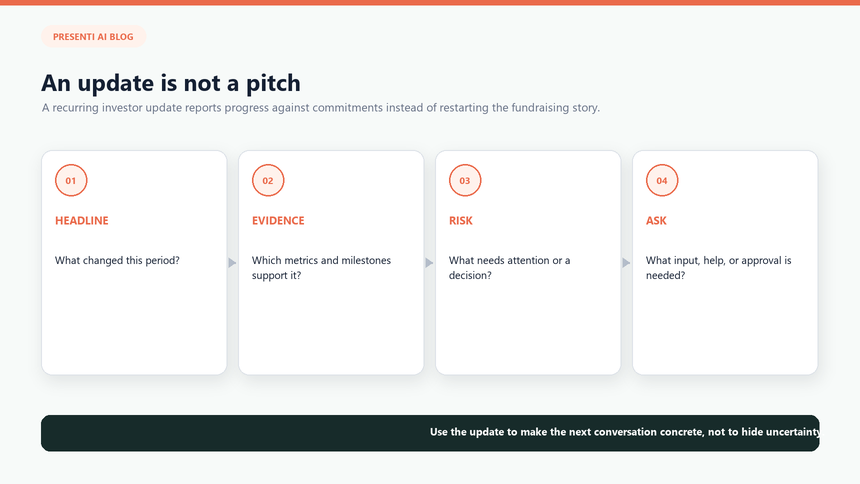
Use an investor presentation template only after deciding what the reader must understand. If the same information can be read in a few bullets, do not inflate it into slides. Use slides when a group needs to compare trends, inspect a milestone gate, or discuss an ask together.
Which Metrics and Milestones Belong in the Update?
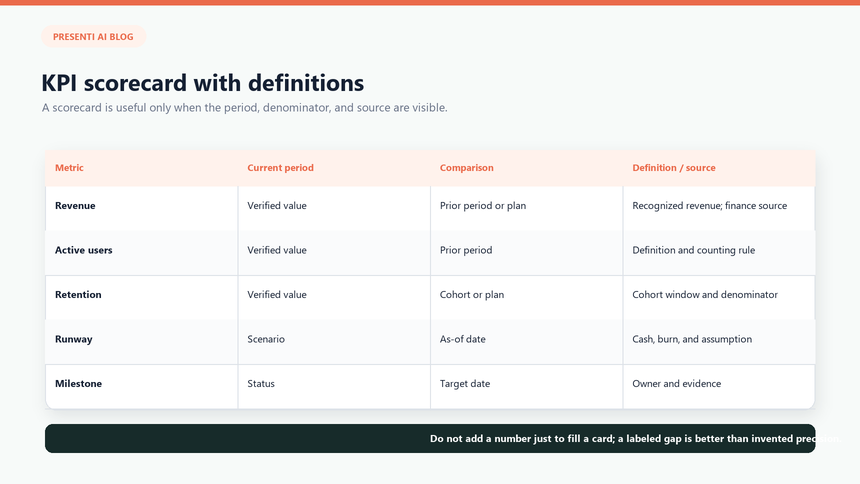
Choose metrics by decision value, not by how impressive they look. A compact set usually includes one financial signal, one customer or usage signal, one delivery or product signal, and a cash or capacity context where relevant. The exact measures depend on the business model and stage.
For every KPI, preserve the same definition and show the comparison basis. A change from monthly active users to weekly active users can create a false trend; so can mixing bookings with recognized revenue or cash received. Add a footnote when a one-time event, restatement, or data delay affects the reading. If a number is an estimate, label it and identify the person who will confirm it.
| Signal family | Useful question | Example row to adapt |
|---|---|---|
| Financial | What changed in the economics during this period? | Revenue: [actual] vs [prior], basis: [recognized or billed], owner: [name] |
| Customer or usage | Did the intended users adopt, retain, or expand? | Activated accounts: [actual] vs [prior], cohort and event definition attached |
| Product or delivery | What shipped or learned, and what decision follows? | Release [name], evidence [source], next gate [date] |
| Cash and capacity | What constraint changes the next plan? | Cash date, reviewed burn basis, hiring or vendor capacity, and assumptions |
| Risk | Which uncertainty could change the recommendation? | Risk, leading signal, response owner, and review trigger |
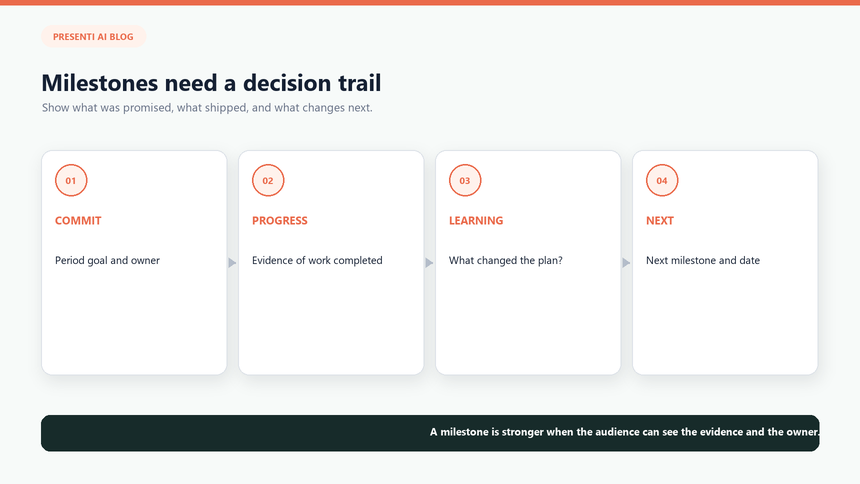
Milestones should describe outcomes and gates rather than effort. "Interviewed 12 prospects" is an activity; "validated the top two onboarding objections and changed the trial flow" is a milestone with a decision consequence. Link each milestone to the previous commitment as completed, partial, changed, or stopped.
Avoid using a benchmark or target as if it were a result. Label a forecast's assumptions, range, and owner.
How Should You Structure the Update?
A concise investor update presentation can fit a ten-slide decision path. The first slide should tell a reader what changed and what you need; the remaining slides supply evidence, context, and a next step. Keep detailed reconciliations and legal documents in an appendix for the right reviewers.
- Cover and reporting period. Show the company, period, audience, and a one-line state of the business. Do not imply that a slide is audited unless it has been reviewed under the appropriate process.
- Executive summary. Give two or three changes, one constraint, and the decision or help requested.
- KPI scorecard. Show the selected metrics beside the prior period, target where approved, definitions, and a short interpretation.
- Progress against commitments. Mark last period's priorities as complete, partial, changed, or stopped, with evidence.
- Milestones and customer learning. Show shipped outcomes, adoption evidence, research, or a release gate rather than a task list.
- Risks and lowlights. State what missed, the impact, the response, and what remains unknown.
- Product, go-to-market, or team changes. Include only changes that affect the next decision, capacity, or risk.
- Cash and capacity context. Present reviewed figures and assumptions; separate actuals from a planning scenario.
- Request for help. State whether you are asking for introductions, feedback, hiring help, a financing conversation, or another defined action. If discussing capital, name the intended use and review the wording with qualified legal and financial advisers.
- Next period and response path. List the next two or three priorities, owners, dates, and how readers should respond.
An investor deck template should make comparison easy, not dictate a story the evidence cannot support. Keep titles message-led, use comparable chart scales, and put the source and cutoff date near each visual. Move dense detail to the appendix.
How Do You Ask Investors for Help?
Start with the help you actually need. An introduction to a potential customer, advice on a hire, and a financing discussion are different requests. Give enough context for the investor to respond or forward the request to the right person. If you are raising capital, explain the intended use and the milestones it would support.
| Ask component | Question to answer | Example wording |
|---|---|---|
| Request | What do you want the reader to do? | "Can you introduce us to two operators who have scaled [specific motion]?" |
| Context | Why is the request relevant now? | "We are testing [priority] after [dated evidence]." |
| Target | Who or what profile is a fit? | Role, sector, geography, stage, or decision owner, without invented names |
| Use or next gate | What will happen after help arrives? | Milestone, review date, and owner; distinguish plan from observed result |
| Response path | How should the reader respond? | Reply by [date], nominate a contact, or book a defined review |
For a financing discussion, state when cash figures were measured and explain the assumptions behind planned spending. Keep forecasts separate from results, and have the relevant finance and legal advisers review financing terms and disclosures.
Separate an investor update from a live fundraising pitch. An update records movement for an existing relationship; a pitch asks a new audience to evaluate an opportunity. Keep the full market and product narrative in the appropriate pitch-deck workflow.
What Does a Complete Investor Update Example Look Like?
The following example uses a fictional software company, Northstar Flow, to show the structure. The events and planning details are illustrative; metric values are left as placeholders.
Northstar Flow is a fictional workflow software company preparing a September update with a September 20 cutoff. The founder starts with a reviewed KPI sheet, August commitments, release notes, a risk log, and a request for two customer introductions. The summary says: "Activation improved after the onboarding change, the enterprise pilot moved one week later than planned, and we need two design-partner introductions before the next test."
| Section | Illustrative entry | Reader check |
|---|---|---|
| KPI scorecard | Activated accounts: [value] vs [prior], definition and source attached; revenue: [value] vs [prior], recognized basis confirmed | Compare September 1–20 with August 1–20 for period totals, or wait for a full-month comparison; label the cutoff |
| Milestone | Onboarding experiment completed; next test waits for two design partners | Outcome and next gate are distinct |
| Lowlight | Enterprise pilot slipped one week because security review is incomplete | Impact, owner, and revised date are visible |
| Cash context | Cash at cutoff and reviewed monthly burn are recorded; any scenario is labeled planning-only | Actuals are not mixed with estimates |
| Ask | Two introductions to operations leaders at mid-market logistics companies, with a forwardable one-sentence brief | Target profile and action are specific |
The final slide lists October priorities: finish the security review, run the design-partner test, and confirm the KPI definitions. Add an owner and date for each item so the next update can show what happened.
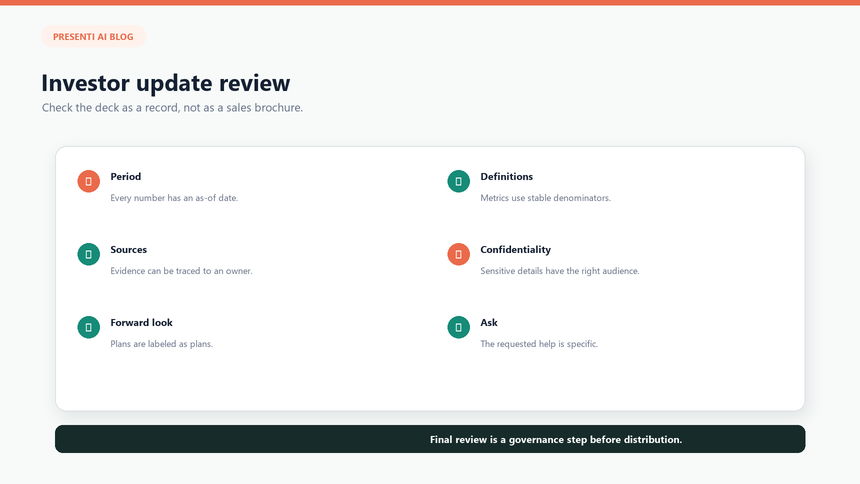
Before sending, read the update as a first-time recipient: Can the reader distinguish actual, estimated, and missing values, see what changed, and answer the ask in one reply? If not, revise the brief before polishing the layout.
How Can Presenti Turn a KPI Brief into an Editable Investor Update Deck?
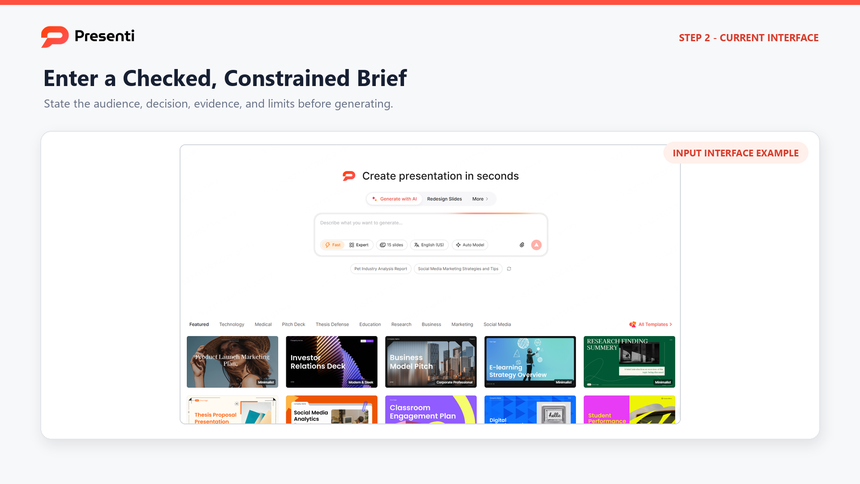
Presenti is useful after the source material is checked. Use text to presentation when the KPI brief, prior update, milestone notes, and ask exist as text. The workflow is brief to outline, template to editable deck, then human review. Presenti can design a draft; it cannot reconcile books, verify definitions, or approve financing terms.
Prepare a compact evidence packet: period, KPI table, definitions, comparison basis, owners, commitments, milestone evidence, risks, cash context, audience, and desired response. Remove secrets and mark missing values with placeholders.
Step 1: Enter the verified KPI brief
Use a constrained instruction such as: "Create a ten-slide investor update for [company] covering [period]. Use only the supplied KPI table, definitions, milestone notes, risk log, cash context, and ask. Show actual, estimated, and missing values distinctly. Include summary, KPIs, progress against commitments, milestones, lowlights, capacity, cash context, ask, and next-period owners. Do not invent metrics, customers, forecasts, funding terms, or outcomes."
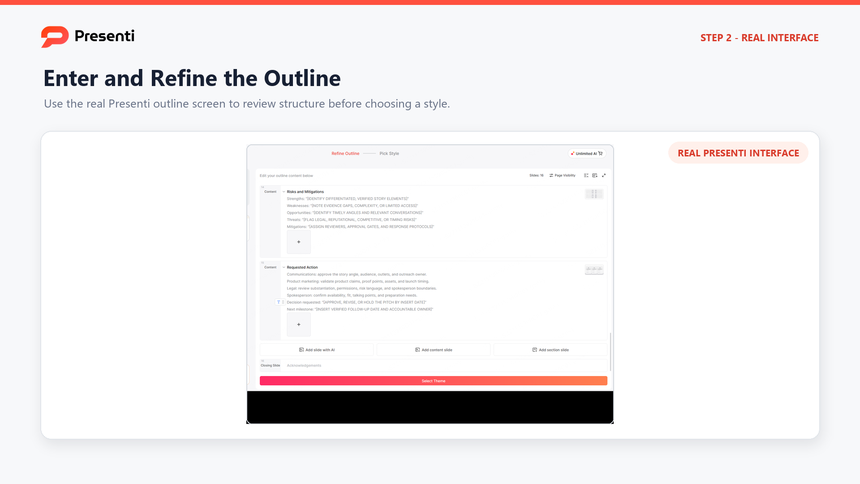
Step 2: Review the outline before design
Confirm that the outline starts with the reporting period and ends with a response path. Merge duplicate KPI slides, move reconciliations to an appendix, and rewrite any headline that turns a plan into a result.
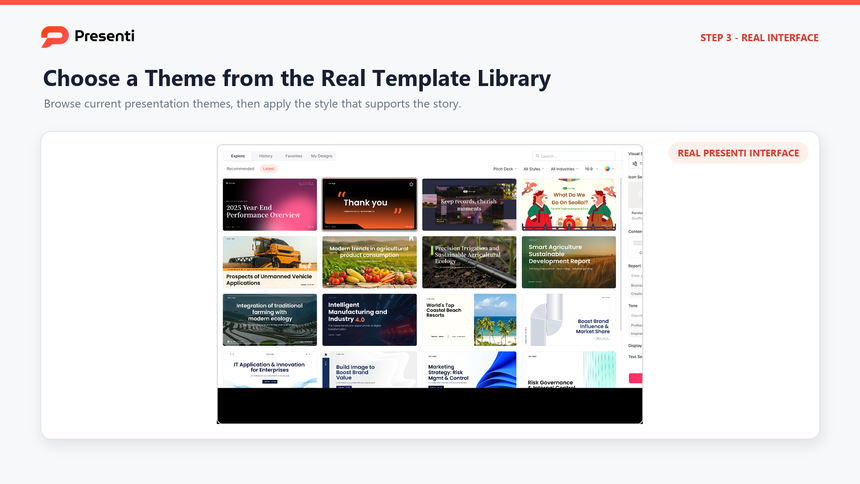
Step 3: Choose a template that can carry evidence
Choose a restrained visual system from the Presenti presentation template library after the outline is stable. Favor layouts with enough room for a comparison table, source note, risk owner, and ask. A decorative dashboard that forces tiny labels is a poor fit, even if its thumbnail looks polished.
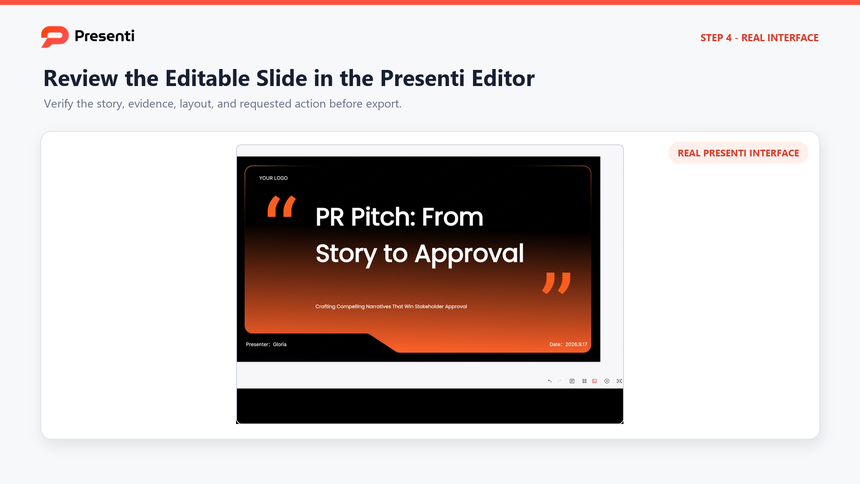
Step 4: Edit the generated deck against the source
Compare every number, date, label, chart scale, and milestone status with the KPI brief. Replace generic claims, expose assumptions, and add the source or owner near each visual. Ask the responsible owners to review their parts. A polished slide is still a draft until those checks pass.
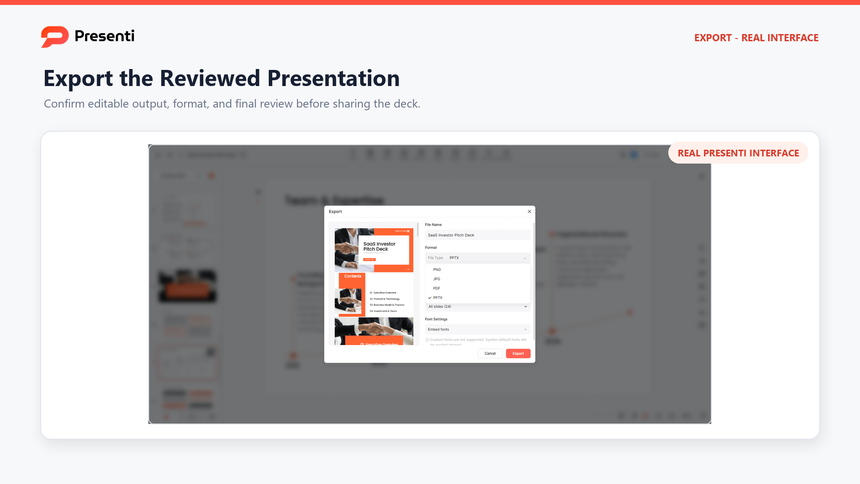
Step 5: Review export and response path
PowerPoint and PDF exports require an eligible paid plan. Before sharing, open the exported file and check tables, source notes, links, and readability. Make sure the request is clear and that estimated or partial-period figures cannot be mistaken for completed results.
Frequently Asked Questions
How often should an investor update be sent?
Use a cadence that matches your reporting commitments and business speed. Monthly or quarterly can work when the period, definitions, and owner stay consistent. Send an urgent risk or decision when it needs attention.
Should an update be an email or a deck?
Choose email when a few bullets answer the question. Choose slides when readers need to compare trends, inspect a milestone gate, or discuss an ask together. The format should reduce reader effort.
Which metrics should an early-stage company show?
Show the smallest set that explains the current decision: a financial, customer or usage, product or delivery, and cash or capacity signal where relevant. Define each metric and mark estimates, one-time items, missing values, and method changes.
How specific should a request to investors be?
For a request for help, name the action and the person or organization you want to reach. For a funding discussion, state the intended use of capital, relevant timing, and the next conversation you want to have. Have the appropriate advisers review any proposed financing terms.
Can AI write the update for me?
AI can organize supplied notes and create an editable draft. It cannot validate books, infer missing evidence, approve a financing statement, or replace human review. Keep actuals, estimates, and placeholders distinct, then ask responsible owners to check the file.
Make It Easy for Investors to Respond
Keep an investor update template consistent enough for readers to compare one period with the next. Show what changed in the metrics, which commitments were met or missed, and where the team needs help. A specific request, such as two relevant introductions, gives an investor a clear way to respond.