Staring at a blank slide the night before a class presentation is a rite of passage. Every student knows that feeling — the cursor blinking, the deadline approaching, and absolutely nothing coming to mind. The problem is almost never a lack of things to say. It’s a lack of a clear presentation topic idea to develop.
This guide gives you that starting point. Whether you’re in elementary school working on your first show-and-tell, a high schooler preparing for a debate, or a college student facing a 20-minute seminar, the right presentation topic changes everything. A good topic makes research feel less like a chore. It makes preparation faster. And it makes the presentation itself something an audience actually wants to sit through.
Here’s what we’ll cover: why presentation topic selection matters more than most students realize, the most common contexts where students need to present, age-appropriate topic recommendations for every grade level, and five practical tips for choosing a topic that works for your specific situation.

Why Choosing the Right Presentation Topic Actually Matters
Most students treat topic selection as a box to check before the “real” work begins. That’s a mistake. The topic is the foundation. Everything else — your research, your structure, your slides, your delivery — gets easier or harder depending on how well-chosen your starting point is.
Here’s the thing most people don’t say out loud: audiences can tell when a speaker doesn’t care about their topic. The energy drops. The eye contact disappears. The answers to questions get vague. Enthusiasm is almost impossible to fake for an extended period, and it’s immediately apparent when it’s absent.
Conversely, when a student is genuinely interested in what they’re presenting, something shifts. They use better examples. They anticipate questions. They speak with more confidence because they’ve thought about the subject beyond just what fits on the slides. That quality of engagement is what separates a forgettable presentation from one people actually remember.
There’s also a practical dimension. A topic that’s well-scoped — specific enough to cover meaningfully in the time available, but substantial enough to have real content — saves hours of prep time. “Climate change” is a semester’s worth of material. “Why my city’s recycling system is failing, and three fixes that have worked elsewhere” is a 10-minute talk. Precision at the topic-selection stage pays dividends throughout the entire process. The simple presentation topics guide develops this idea of a bounded scope, with examples that focus on one question rather than a whole subject area.
Common Scenarios Where Students Need to Present
Before diving into topic lists, it helps to understand the context you’re presenting in. The right topic for a science fair is very different from the right topic for a college seminar or a student council pitch.
Classroom assignments are the most common scenario. These range from short five-minute show-and-tell formats in elementary school to extended research presentations at the university level. Grading criteria typically reward clear structure, evidence-based arguments, and demonstrated understanding of the subject matter.
Debate and public speaking competitions require topics with genuine two-sided tension — issues where a reasonable case can be made on either side. The goal here isn’t just to inform but to persuade, which changes how you select and frame your subject. For a lighter classroom practice round, the funny debate topics for students separate prompts by age and language experience.
Club and extracurricular activities often involve pitching ideas, recruiting members, or reporting back to a group. These presentations tend to be shorter and more conversational, which actually makes topic selection harder — you need something that lands quickly and stays memorable.
Academic conferences and science fairs reward original research or genuine intellectual curiosity. The best topics in these contexts involve a real question the student investigated, not just a summary of existing information.
College application contexts — including interviews and scholarship presentations — require topics that reveal something authentic about the student’s thinking, values, or experience. Choose a topic that lets you explain your own experience or thinking with specific examples.
Presentation Topics for Elementary School Students (Ages 6–11)
Young students present best when the topic connects directly to their own experience or something they’ve personally discovered. Abstract concepts work less well at this stage than concrete, observable subjects.
The goal at this level is less about depth and more about confidence. A topic that genuinely excites a young student will produce a more successful presentation than a “correct” topic delivered without enthusiasm.
Recommended topics:
- My favorite animal and three surprising facts about it
- How volcanoes work — and the one I built at home
- Why dogs and cats behave so differently
- The life cycle of a butterfly
- What astronauts eat in space
- How books are made — from a tree to a shelf
- My favorite sport and the science behind it
- Why we need sleep — what happens to your brain at night
- The history of my town or neighborhood
- Recycling: what happens after you put something in the bin
The common thread across these topics is that they’re observable, concrete, and personally relevant. A child who loves dogs will have no trouble filling five minutes on canine behavior. Someone who built a volcano model has a natural story arc to follow: here’s what I wondered, here’s what I built, here’s what happened.
Presentation Topics for Middle School Students (Ages 11–14)
Middle school is where presentations start to require genuine research and structured argumentation. Students at this stage are capable of handling more complex ideas, and the best topics give them room to develop a point of view rather than just report information.
This is also the age where social awareness kicks in — students are paying close attention to what their peers find interesting, which can push them toward safe, predictable topics. The better instinct is to look for something slightly unexpected within a familiar subject area.
Recommended topics:
- Social media: how algorithms decide what you see
- The history of the internet — from military tool to global infrastructure
- Why some languages are dying out, and what that means
- How the human immune system actually fights viruses
- The psychology of advertising: how brands make you want things
- Black holes explained — what we actually know vs. what we assume
- Food deserts: why some neighborhoods don’t have access to healthy food
- The science of music: why certain songs make us emotional
- Climate change: the solutions that are already working
- How video games are designed to keep you playing
These topics share a quality: they take something students encounter in everyday life and reveal the mechanism underneath it. That structure — “here’s something familiar, here’s what’s actually going on beneath the surface” — is one of the most reliable frameworks for a compelling middle school presentation.
Presentation Topics for High School Students (Ages 14–18)
High school presentations carry real stakes. They’re graded more rigorously, they often require original analysis rather than just summary, and the audience — both teachers and classmates — expects a more sophisticated level of engagement.
The best high school presentation topics are ones where the student can take a genuine position. Not just “here is information about X” but “here is what I think about X, and here is why the evidence supports that view.” That argumentative quality is what separates an average high school presentation from an excellent one.
Recommended topics:
- Should social media platforms be regulated like broadcast media?
- The opioid crisis: examining marketing, prescribing, and other contributing factors
- Affirmative action: what the research actually says about its effectiveness
- Artificial intelligence in hiring: efficiency tool or discrimination machine?
- Why the United States doesn’t have universal healthcare — the political economy behind the gap
- The science of habit formation: why willpower alone doesn’t work
- Fast fashion’s true cost: labor, water, and a landfill crisis
- Mental health in schools: what student data shows and what’s not being addressed
- Cryptocurrency: legitimate financial innovation or speculative bubble?
- The gender pay gap: what raw numbers miss, and what adjusted numbers reveal
Each of these topics has genuine complexity, real evidence available on multiple sides, and immediate relevance to a high school student’s world. They reward preparation — the more a student digs in, the more interesting the presentation becomes.
Presentation Topics for College and University Students
College presentations are closest in format to professional contexts. The expectation is original thinking, command of existing literature, clear structure, and the ability to defend your argument under questioning. Topics that work best at this level are ones where the student has a genuine intellectual investment — not just a topic they were assigned, but one they actually find worth exploring.
Recommended topics by subject area:
Social Sciences:
- How misinformation spreads on social media — and when corrections help
- The psychology of political polarization: why people stop listening across the aisle
- Income inequality and social mobility: how much does your zip code still determine your future?
Technology:
- AI regulation: what governments are trying to do, and why it’s so difficult
- The attention economy: how tech companies profit from distraction
- Quantum computing for non-physicists: what changes when it actually works
Health and Medicine:
- The antibiotic resistance crisis: a slow-moving disaster most people ignore
- Psychedelic-assisted therapy: what the clinical research actually shows
- Mental health treatment gaps: why access remains wildly unequal
Environment:
- Carbon capture technology: how far along is it, really?
- The plastic problem: why recycling was always insufficient as a solution
- Water scarcity: the resource conflict that will define the next century
Business and Economics:
- The gig economy’s hidden costs: what platform workers don’t get told
- Why startups fail at different stages of development
- The economics of creator culture: how individuals are building media empires
At the college level, the topic itself is almost secondary to the angle. Two students can present on climate change and produce completely different, equally compelling talks if they’ve each identified a specific, arguable claim rather than defaulting to a general survey.
5 Tips for Choosing the Right Student Presentation Topic
1. Start with genuine curiosity, not convenience. The easiest topics to find information about are usually the most overused and least engaging to present. Ask yourself what you’d actually look up at midnight if no grade were attached. That impulse is usually pointing at something worth exploring.
2. Match the scope to your time limit. A five-minute presentation needs a tightly bounded question. A 20-minute seminar can handle something more layered. The most common mistake students make is choosing a topic that’s too broad for the time available, which forces them to skim everything without explaining anything.
3. Look for the unexpected angle. Every familiar topic has an underexplored dimension. Instead of “climate change” (the entire subject), try “how researchers evaluate the effectiveness of carbon offset programs.” Instead of “social media and mental health” (a well-worn path), try “why the research on social media’s effects is more contradictory than the headlines suggest.” Counterintuitive angles hold attention.
4. Check that real evidence exists. Before committing to a topic, spend 15 minutes searching for credible sources. If you can’t find substantial, reliable material in that time, the topic may be too niche, too recent, or too contested to build a strong presentation around. You need enough material to make an argument — not just enough to fill slides.
5. Consider your audience genuinely. A topic that fascinates you but has no entry point for your classmates will lose the room quickly. Ask: what does this audience already know about this subject? What would surprise them? What would be immediately relevant to their lives? A presentation on financial literacy hits differently in a class of college seniors than in a room of 12-year-olds. Calibrate accordingly.
Common Mistakes Students Make When Picking a Topic
Going too broad. “Technology and society” is not a presentation topic. It’s a graduate program. Narrow until the topic becomes a single arguable claim.
Choosing something purely because it seems safe. The most predictable topics — pollution, the importance of education, the history of a well-documented event — tend to produce the most forgettable presentations. A familiar topic can still work well when its question and evidence are specific.
Ignoring personal interest entirely. Some students pick topics based on what they think the teacher wants to hear. This almost always backfires, because genuine engagement is visible and its absence is equally visible.
Underestimating research time. A topic that seems simple often turns out to be more complex — and more interesting — once you start digging. Leave enough time to be surprised by what you find.
Starting with the slides instead of the argument. Opening a blank presentation and typing bullet points is not research. The slides should be the last thing you create, not the first. Start with your claim, then find evidence, then build the structure, then design the visual.
How to Turn Your Topic into a Presentation Using Presenti AI
Finding a compelling topic is the first step. The second — turning that topic into a structured, visually coherent presentation — is where most students lose hours they don’t have. Here’s a practical step-by-step process using Presenti, an AI presentation maker designed to handle the structural and design work so you can focus on the actual argument.
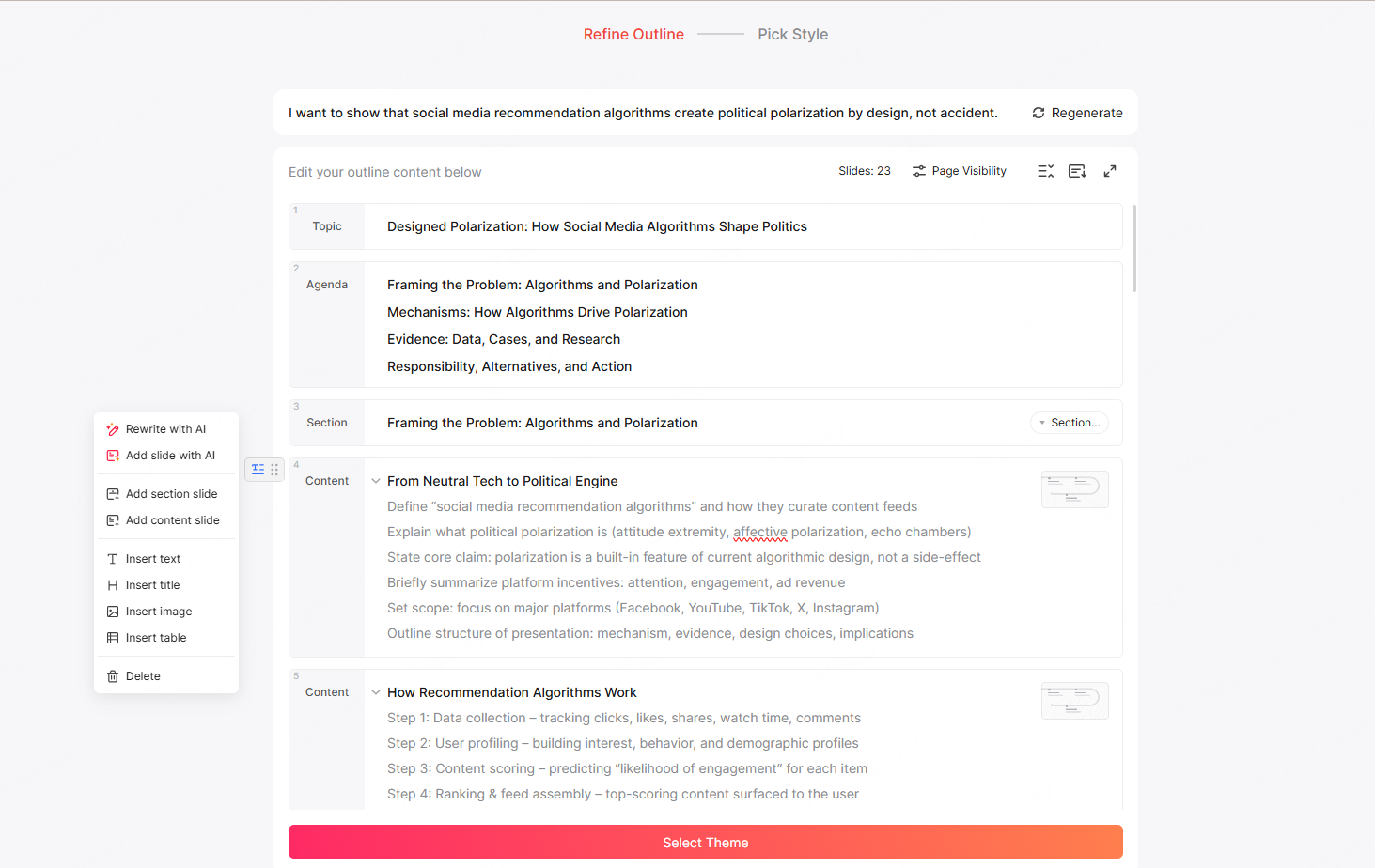
Step 1: Lock in your specific angle. Before opening any tool, write one sentence that captures what you want to argue or explain. Not “I’m presenting about social media” but “I want to examine how recommendation algorithms may affect exposure to political viewpoints.” That sentence becomes your brief.
Step 2: Open Presenti and enter your topic. Go to presenti.ai and paste in your one-sentence brief — or a rough outline if you’ve already drafted one. Presenti’s AI reads your input and generates a full slide structure, including suggested section headings, content blocks, and a logical narrative arc.
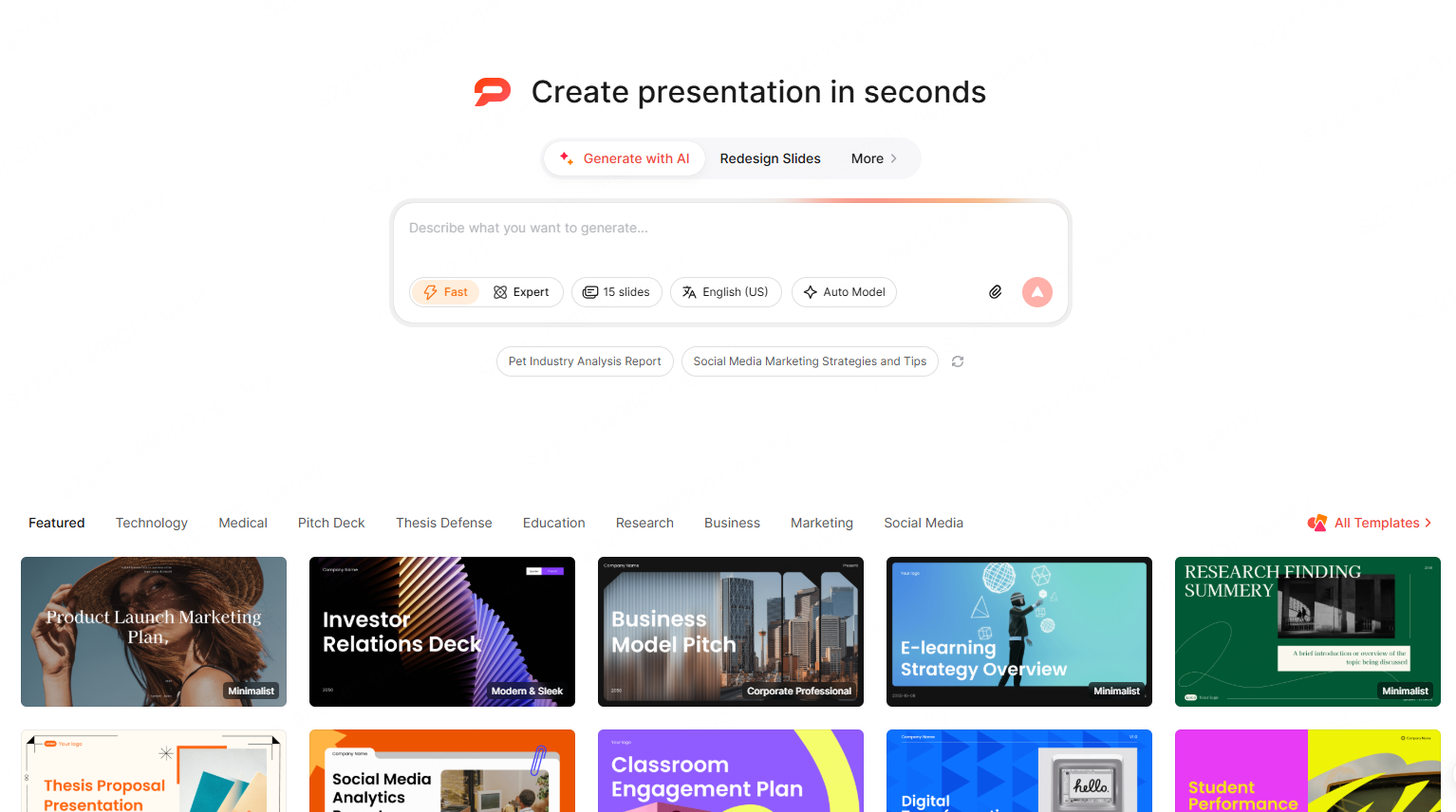
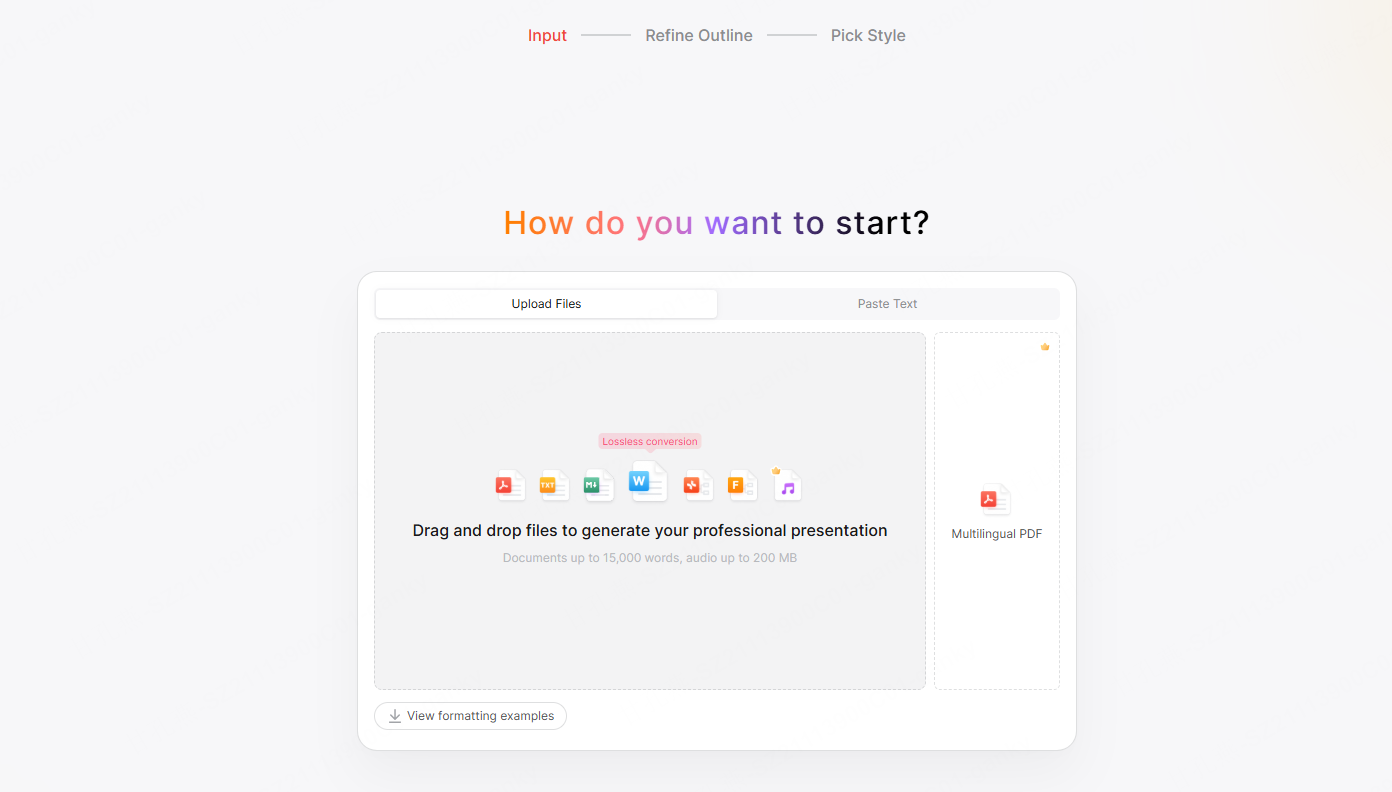
Or Import your research. Presenti's paid plans support PDFs, Word files, and TXT input. Review how the generated outline uses the source before developing the deck. If you’ve already written a draft essay or annotated bibliography, this step can save significant time.
Step 3: Review and edit the generated outline. The AI gives you a starting framework, not a finished product. Read through the proposed structure and ask: does this match what I want to argue? Is anything missing? Is anything in the wrong order? Make adjustments at the outline level before committing to slides.
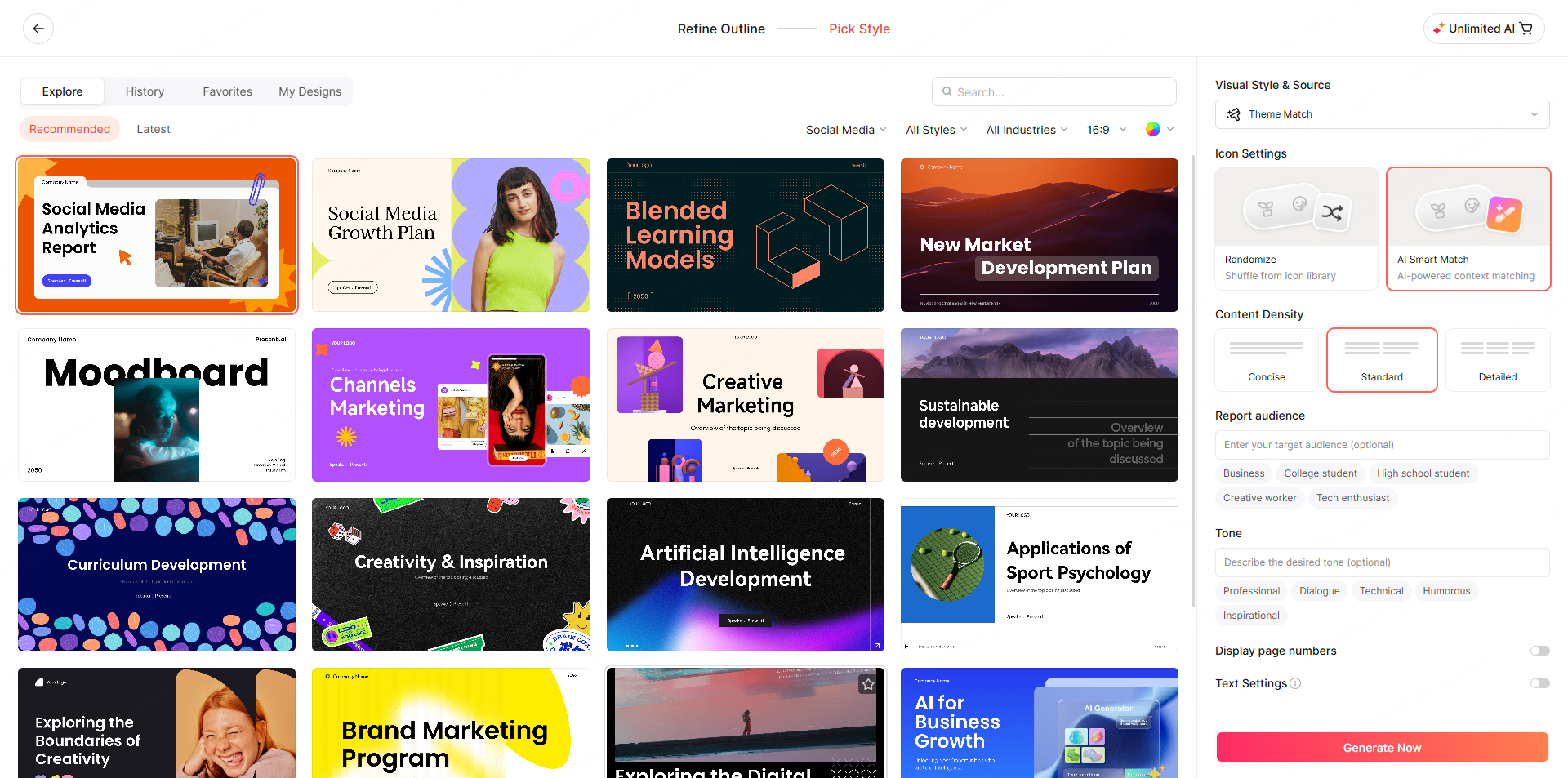
Step 4: Adjust the design template. Choose a template that fits your context — academic, professional, creative — and apply it across the deck. A theme provides a common visual starting point. Review font sizes, colors, spacing, and text fit after it is applied.
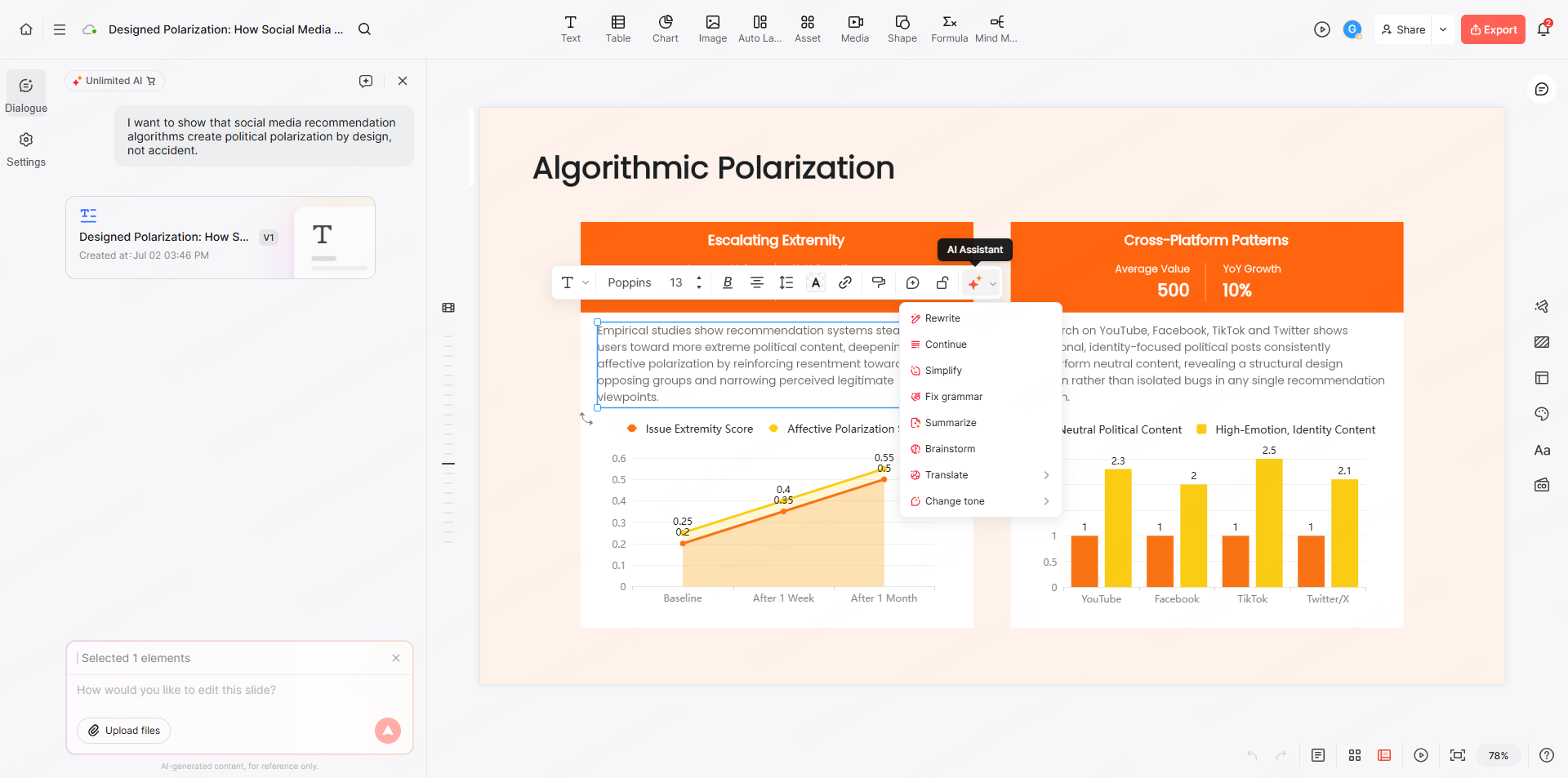
Step 5: Refine individual slides. Use Presenti’s editor to adjust specific slides where the AI-generated content doesn’t quite capture your intended meaning. Use the editing controls available in your account to shorten text, adjust layouts, and replace charts or images. Check that revisions preserve the source's meaning.
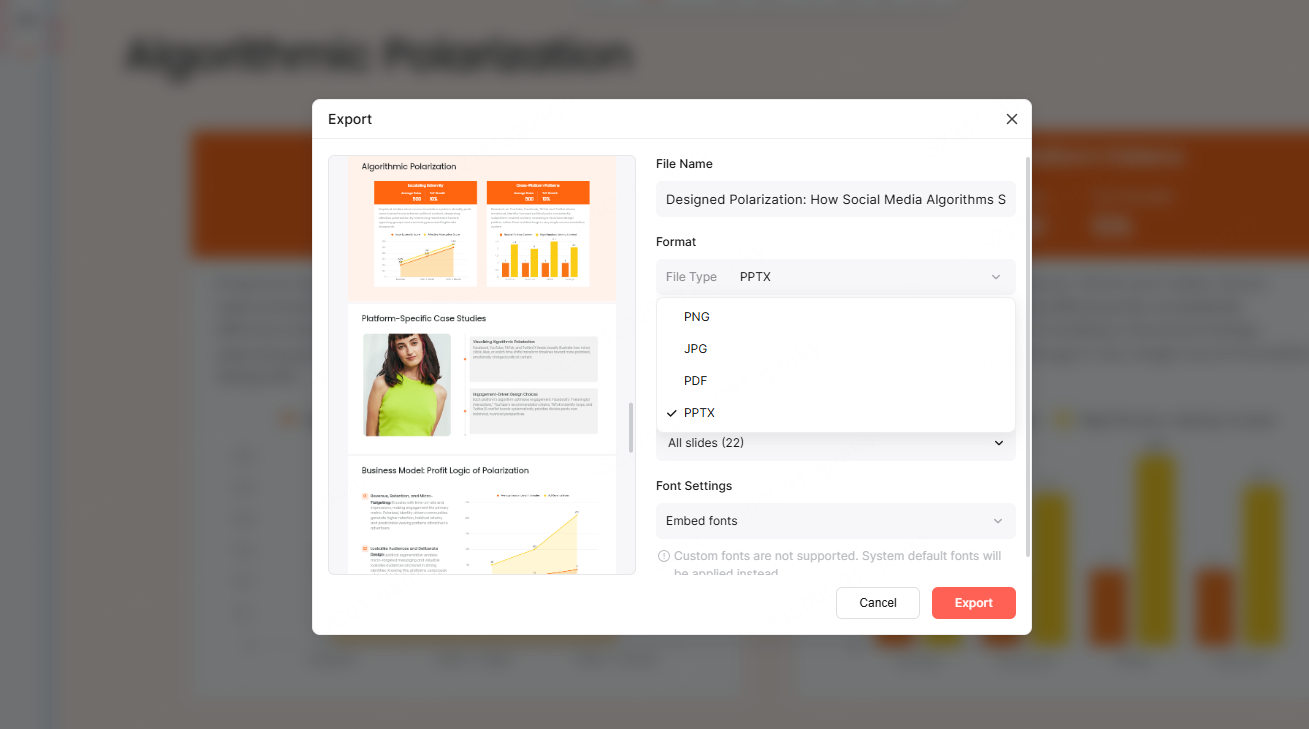
Step 6: Export and rehearse. Review Presenti's sharing options, or use an eligible paid plan to export PPTX or PDF. Open the file in your presentation software and rehearse aloud. The slides are a support structure for your spoken argument — not a script. The rehearsal is where the presentation actually comes together.
Allow time for research, source checks, slide revision, and rehearsal. The length of the process depends on the topic and the work needed to make the draft accurate and clear.
Final Thoughts
The right presentation topic won’t write your talk for you. But it makes every subsequent step — the research, the structure, the delivery — meaningfully easier. Start with genuine curiosity, narrow until you have a specific claim worth making, and give yourself enough time to be surprised by what you find.
The students who give the most memorable presentations aren’t always the ones who picked the most impressive topics. They’re the ones who cared enough about their subject to find something real to say about it. That quality — genuine intellectual engagement — is visible from the first slide and impossible to fake all the way to the last.
Pick your topic. Write your one-sentence argument. Then go build something worth watching.