A public relations pitch template should help a communications team turn one newsworthy idea into a journalist-ready story proposal: a clear angle, a defined audience, verifiable proof, an appropriate spokesperson, useful assets, and one specific next step. A strong PR pitch presentation is not a press release read aloud; it is the internal decision document that makes the eventual outreach relevant and defensible.
Here, "public relations pitch" means a planning deck for a journalist-facing story and internal approval, not an agency sales proposal. This guide is for communications teams, founders, product marketers, agencies, and subject-matter experts preparing a media pitch deck, launch announcement, expert interview, or public relations presentation template.

What Should a Public Relations Pitch Presentation Decide?
The pitch should help the team decide which story angle to pursue, which audience and outlets matter, what proof is credible, who will speak, and what action the journalist is being offered. If the deck only lists coverage wishes, it is not a pitch yet.
Those decisions match what journalists say they value. In Muck Rack's State of Journalism 2026, a survey with 897 valid responses after data cleaning, 70% of respondents selected clear relevance to their beat as an ideal pitch attribute, 58% selected access to relevant sources, 40% selected original data or research, and 37% selected high-resolution images. Treat those figures as direction for the pitch brief, not a guarantee of coverage.
Start with a one-sentence story thesis. For example: "Mid-market finance teams are changing how they prepare for audits because manual evidence collection no longer scales; new operational data shows the shift, and three practitioners can explain what changes next." That sentence names the audience, change, proof, and spokesperson.
| Pitch question | What the deck should show | Decision or action |
|---|---|---|
| Why this story now? | Timely change, trend, milestone, or consequence | Choose the angle worth pitching |
| Who cares? | Reader, outlet, beat, and format | Target the right media list |
| Why believe it? | Data, example, expert, source, and limitation | Prepare proof and fact-check material |
| What is the ask? | Interview, comment, demo, data, or embargo | Make the next step easy to accept |

Which Slides Belong in a PR Pitch Deck?
Ten core slides are a practical starting point for an internal review, with an appendix for background, data sources, spokesperson bios, prior coverage, and legal or privacy notes. The correct length depends on the complexity of the story, but the main deck should stay focused on the angle, proof, media fit, and ask.
Use this public relations pitch template to keep the story and approval path in one concise brief.
- Story headline. State the angle, audience, and why it matters now.
- Timeliness. Show the trigger, trend, milestone, or news hook.
- Audience and outlets. Name the reader, beat, format, and relevant context.
- Narrative arc. Show the change, tension, evidence, and next implication.
- Proof. Attach data, examples, sources, and limits.
- Spokesperson. Explain who can speak, why that person is credible, and what they can address.
- Assets. List images, quotes, fact sheets, demos, or data available to the journalist.
- Outreach plan. Show the sequence, timing, personalization, and owner.
- Risks and constraints. Name legal, privacy, competitive, timing, and reputational issues.
- Measurement and ask. Define the desired learning, responsible metric, and next action.

The PR pitch presentation should read like a useful editorial brief. A reviewer should be able to understand the story, verify the claim, identify the spokesperson, and approve or revise the outreach without a long verbal explanation.
How Do You Shape the Story and Audience Fit?
Start with the journalist's audience, not the company. A product milestone matters only when it connects to a change that audience already cares about. Describe the trend, tension, and consequence before introducing the company or product.
| Story element | Question to answer | Evidence to prepare |
|---|---|---|
| Trend | What is changing in the market or audience? | Data, research, customer pattern, or expert observation |
| Tension | What is difficult, contested, or newly urgent? | Example, consequence, or competing view |
| Proof | Why is the claim credible now? | Source, method, date, limitation, and independent context |
| Implication | What should the audience understand or do next? | Expert interpretation and a clear next question |
Match the story to the outlet. A business publication may want market evidence and executive context; a trade publication may want workflow detail; a podcast may want a strong expert conversation. The same source material can support different angles, but each outreach version should explain why this outlet, this beat, and this audience should care.

What Proof and Media Plan Does a Pitch Need?
Prepare the proof before the outreach. A pitch should make verification easier, not hide uncertainty behind polished copy. Include the source, method, date, sample or scope, and material limitations. If the data is proprietary, define what can be shared publicly and what, if anything, may be reviewed on agreed background terms.
This fact check is part of professional practice, not a formatting detail. The PRSA Code of Ethics calls for honest and accurate communications, investigation of the truthfulness of released information, and prompt correction of errors.
| Asset | Purpose | Owner | Readiness check |
|---|---|---|---|
| Fact sheet | Give concise, verifiable context | Communications | Every material claim has a source and date |
| Data summary | Support the trend or insight | Analytics or research | Method, sample, and limits are stated |
| Spokesperson brief | Prepare the expert for the interview | Communications and expert | Message, boundaries, and Q&A are approved |
| Media list | Match the story to the right outlet | PR lead | Beat, format, recent context, and contact are current |
| Visual assets | Help the outlet explain the story | Design or product marketing | Creator, license or permission, caption, and usage scope are documented |
Do not assume that owning a copy of an image gives the team permission to distribute it. The U.S. Copyright Office's photography guidance explains that the photographer is generally the initial copyright owner unless an exception or transfer applies. Confirm the applicable rights and release requirements for the intended market.
Plan the outreach sequence with timing and personalization. A media pitch deck can show the first wave, follow-up rule, embargo window, and owner for each relationship. It should also state what the team will do if the story changes, a claim fails verification, or the timing no longer works.

What Does a Practical Media Pitch Example Look Like?
Consider a data platform announcing a new report on how operations teams prepare for audits. The hook is a measurable shift in manual evidence collection. The proof is an anonymized dataset with a stated method and limitation. The spokesperson is the head of research, supported by a customer practitioner who has approved participation and can describe the workflow. The media plan targets three business and operations beats, with a 20-minute interview offer and an embargo window.
The ask is specific: review the data summary, speak with the research lead, and use the licensed charts if the story fits. The pitch also states what the team will not claim, which gives reviewers a practical boundary and helps protect credibility.

The approval deck should also show how the team will respond if the journalist asks for a different angle, more evidence, or another spokesperson. A good pitch system allows adaptation without inventing proof or promising coverage.
How Can Presenti Turn a PR Brief into an Editable Deck?
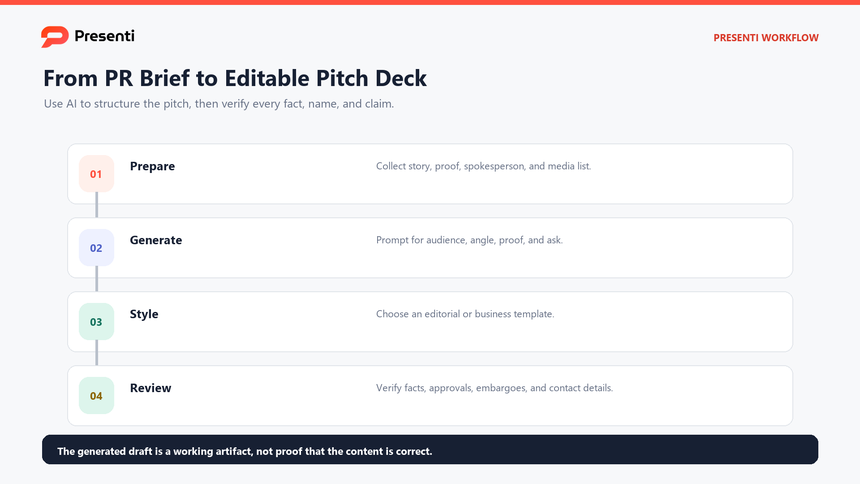
Once the team has approved the story, proof, spokesperson, media plan, and risk boundaries, Presenti can organize the material into an editable first draft. Start with a free Presenti account and use text to presentation for a checked brief or prompt; when the source already exists as a supported document, start from that source and verify how its headings, tables, citations, and images transfer into slides. After the outline is stable, choose a suitable style to obtain an editable PR template built around the actual story.
Presenti can structure the deck and provide a visual starting point, but it cannot confirm that a claim is true, a quote is approved, an embargo is agreed, an image is licensed, or a journalist will find the story relevant. Keep those decisions with the communications owner, subject-matter expert, legal reviewer where needed, and the person responsible for each media relationship.
Step 1: Prepare and approve the story brief
Include the angle, audience, outlet context, trend, proof, source notes, spokesperson, assets, embargo terms, risks, and requested action. Remove private customer information and unapproved claims before the material enters any generation workflow.
Step 2: Enter a constrained prompt or checked brief
Use a prompt such as:
Create a 10-slide public relations pitch presentation for an internal communications review. Audience: communications, product marketing, legal, and the spokesperson. Include the story headline, why now, audience and outlets, narrative arc, proof, sources, spokesperson fit, media assets, outreach plan, risks, and the requested action. Use placeholders for unverified facts. Do not invent coverage, customer quotes, data, or expert credentials.

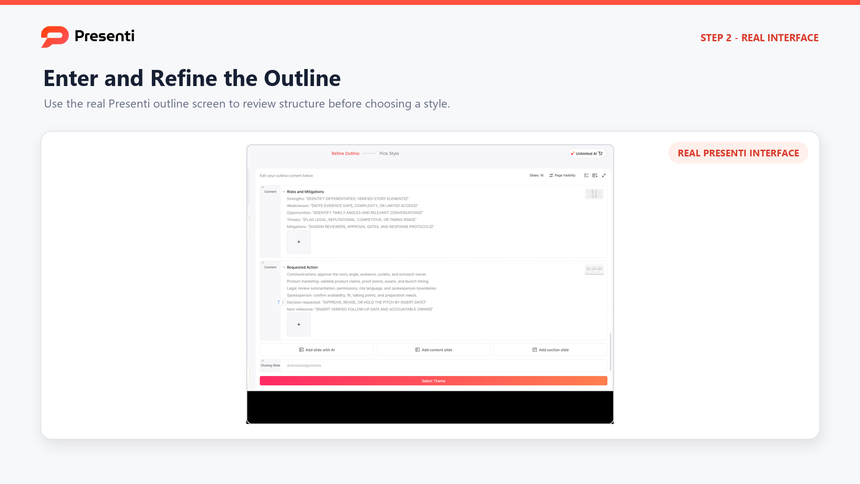
Step 3: Review and revise the generated outline
Check that the outline moves from the hook to proof, media fit, spokesperson, assets, risks, and one requested action. Remove generic company history, combine repeated background slides, and mark any missing evidence before choosing a design.
Step 4: Choose a template that supports the story
Open the Presenti template center and preview a business or editorial style after the narrative is stable. Choose for legibility, evidence density, and audience expectations rather than decoration alone.

Step 5: Edit, verify, and export the reviewed deck
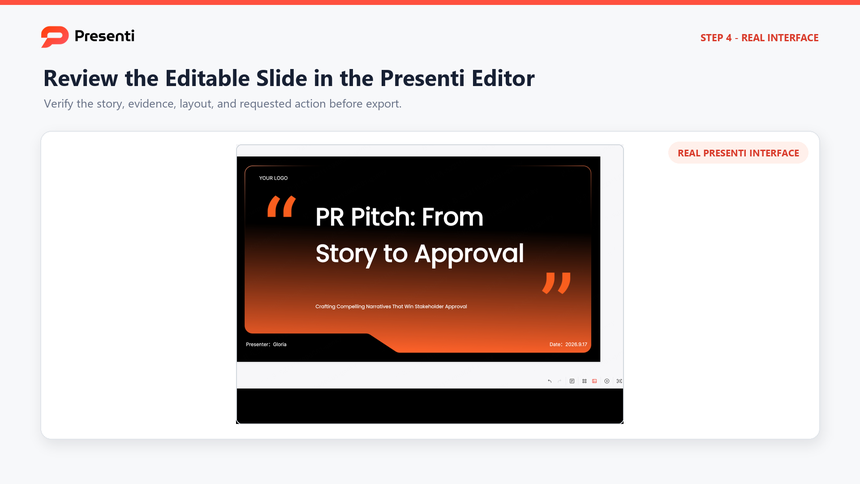
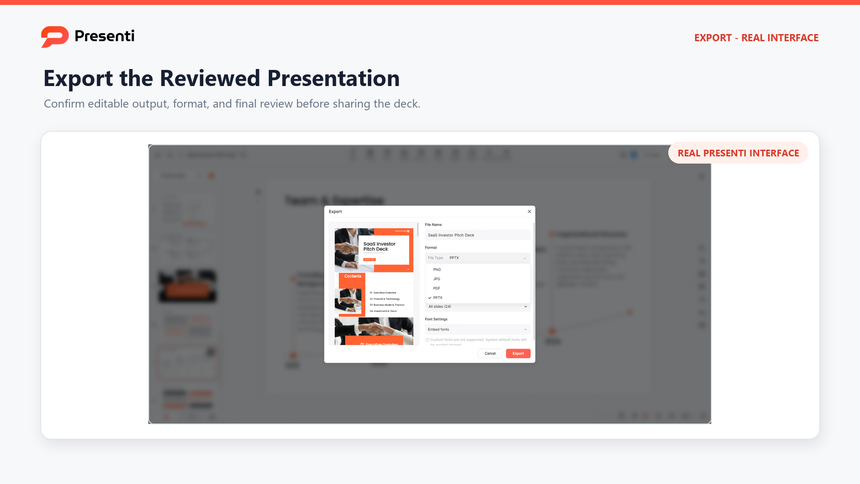
Word/PDF/TXT imports and editable PPTX/PDF exports are listed on paid plans; free AI usage is limited. In the editor, compare every fact, name, date, quote, source, and claim with the approved material. Confirm the spokesperson brief, legal or privacy review, embargo terms, usage rights, and contact details. Remove internal notes and unapproved language, then export only the version that passed the review.
The finished deck should make the story easier to understand and verify, not make an unapproved claim sound more convincing.
Frequently Asked Questions
What should a public relations pitch presentation include?
Include the story headline, why now, audience and outlets, narrative arc, proof, sources, spokesperson fit, media assets, outreach plan, risks, measurement, and the requested action.
How is a PR pitch different from a press release?
A press release is a formal announcement or source document intended for broad distribution. A media pitch is targeted outreach that explains why a specific journalist and audience should care and offers one useful next step.
Is this the same as a PR agency proposal?
No. This public relations pitch template is for planning and approving a journalist-facing story. An agency proposal has a different buyer and usually needs services, team credentials, scope, deliverables, fees, and commercial terms.
How many slides should a PR pitch deck have?
Use the fewest slides needed for an informed approval. Ten core slides are a practical starting point for the structure in this guide, while complex evidence, methodology, biographies, and risk notes can move to an appendix.
What makes a media pitch credible?
Specific audience fit, timely relevance, traceable proof, clear sources and limits, an appropriate spokesperson, approved assets, and an honest statement of what is still unknown make a pitch more credible.
How should PR results be measured?
Measure outreach quality, relevant replies, interviews, coverage fit, message accuracy, referral traffic, and business outcomes where attribution is honest. Coverage volume alone is incomplete.
Bottom Line
A public relations pitch works best when the story fits a specific journalist and audience. Lead with why the story matters now, provide the evidence and spokesperson needed to explore it, and make one clear offer such as an interview or access to a report. Keep approved quotes, media assets, and any embargo terms close to the brief.