A B2B marketing plan presentation explains which customers you will pursue, how you will reach them, and what the work will cost. It should connect the campaign plan to realistic sales assumptions, so marketing and sales can agree on priorities before committing time and budget.
Use this guide for an annual plan, quarterly review, or move into a new market. The slide outline and 90-day example show how to connect target accounts, channels, and sales opportunities. Replace the example assumptions with your own customer research and conversion data.
What Should a B2B Marketing Plan Presentation Decide?
The deck should answer five questions: which accounts or segments deserve investment, why the offer is credible for them, which channels and sales motions will reach them, what resources and dependencies are required, and what evidence will show whether the plan is working. If the slides only list campaigns, the team has a production schedule rather than a plan.
For a B2B marketing strategy presentation, start with a one-sentence plan thesis. For example: “Grow qualified pipeline in the mid-market operations segment by pairing account-based content with partner referrals and a specialist sales motion, measured by qualified meetings, pipeline velocity, and win rate over two quarters.” The example is a planning structure, not a performance benchmark.
| Plan question | Evidence to show | Decision expected |
|---|---|---|
| Which segment matters? | Account tiers, buying roles, triggers, needs, and exclusions | Commit to a priority market |
| Why will accounts engage? | Positioning, proof, content, and channel fit | Approve the message and route |
| How will pipeline grow? | Volume, conversion, cycle time, and ownership assumptions | Fund the plan and set targets |
| How will the team know? | Leading indicators, pipeline quality, and review gates | Continue, adjust, or stop the plan |

Which Slides Belong in a B2B Marketing Plan Deck?
A ten-slide core deck is a useful starting point for an executive review. Use an appendix for detailed budgets, campaign calendars, account-list rules, measurement definitions, and scenario models. This keeps the B2B marketing plan template focused on the decisions leaders must make.
- Plan headline and decision. State the goal, segment, route, and approval required.
- Market context. Show the demand signal, competitive context, and why the decision is needed now.
- Segment and account tiers. Define priority accounts, buying roles, triggers, and exclusions.
- Positioning and message. State the promise, proof, and buying-stage message.
- Channel roles. Give each route a job in awareness, education, intent, or conversion.
- Content and demand plan. Show the assets, offers, and interactions required.
- Pipeline math. Connect activity, conversion, cycle time, and qualified pipeline.
- 90-day plan. Sequence milestones, owners, resources, and dependencies.
- KPIs and review gates. Define leading and outcome measures with thresholds.
- Risks and assumptions. Name material risks, triggers, mitigations, and stop conditions.

Keep leading indicators separate from business outcomes. Reach, engagement, and meetings may signal movement, but the plan still needs to show how those signals connect to qualified pipeline, revenue, retention, or another agreed outcome.
How Do You Choose Segments and Account Tiers?
Start with the customer’s situation, not just company size or industry. What problem are they trying to solve, who is involved in the purchase, and what might make them act now? Group accounts by fit, readiness, and the level of attention your team can realistically provide.
| Tier | Account evidence | Route | Success signal |
|---|---|---|---|
| Tier 1 | High fit, high potential, active trigger | Sales-assisted and partner motion | Qualified meeting and agreed next step |
| Tier 2 | Good fit, less urgent or less ready | Content, webinar, and nurture | Engaged account and problem confirmation |
| Tier 3 | Broad fit or low intent | Self-serve, community, or light touch | Activation or qualified inbound signal |
| Excluded | Poor fit, high service risk, or weak economics | No proactive spend | Reason documented and reviewed |
Document what the team will not pursue. Explicit exclusions prevent the channel mix from spreading across too many audiences and help marketing and sales agree on qualification and handoff rules.

How Should You Map Channels, Pipeline, and KPIs?
Give every channel a job. A partner may create reach and trust, a content program may educate the market, a webinar may create intent, and a sales sequence may turn that intent into a qualified conversation. Each handoff should name the owner and the evidence required to move an account forward. If the plan changes target segments, selling capacity or revenue assumptions, align that handoff with the sales strategy presentation so both teams use the same operating choices.
| Pipeline step | Marketing input | Sales or success input | Measure |
|---|---|---|---|
| Reach | Targeted audience and account list | Account selection and exclusions | Qualified account reach |
| Engage | Content, event, or offer | Follow-up and discovery | Engaged accounts and meetings |
| Qualify | Intent signal and message fit | Qualification framework | Qualified pipeline |
| Convert | Proof, proposal, and enablement | Deal progression and approval | Win rate, cycle time, and revenue |
Show the assumptions behind the model: target-account count, reach rate, engagement rate, meeting rate, qualification rate, average deal size, cycle time, and conversion. Label each value as observed, planned, or assumed. If a metric depends on multi-touch attribution, name the selected attribution model and reporting window because different models may distribute credit differently.

What Does a Practical 90-Day B2B Plan Look Like?
Consider an illustrative B2B software company entering a new operations segment. The working plan covers 300 target accounts, with 60 Tier 1 accounts approached through partner referrals and sales-assisted content. These figures are examples, not benchmarks; a real team should replace them with its own capacity, historical conversion, and account evidence.
Days 1-30 align the account list, message, offer, owners, and enablement. Days 31-60 launch two demand tests and inspect qualified response. Days 61-90 scale the stronger route, document pipeline quality, and decide what to continue. The B2B demand generation plan sits inside the wider strategy: it tests how the chosen route creates and converts demand.
At the end of week four, compare partner introductions and qualified conversations with the plan. If introductions are low, find out whether the problem is partner activity, account fit, or the message before increasing spend. Allow enough time for a sales cycle to develop before judging revenue results.

How Can Presenti Turn a B2B Brief into an Editable Deck?
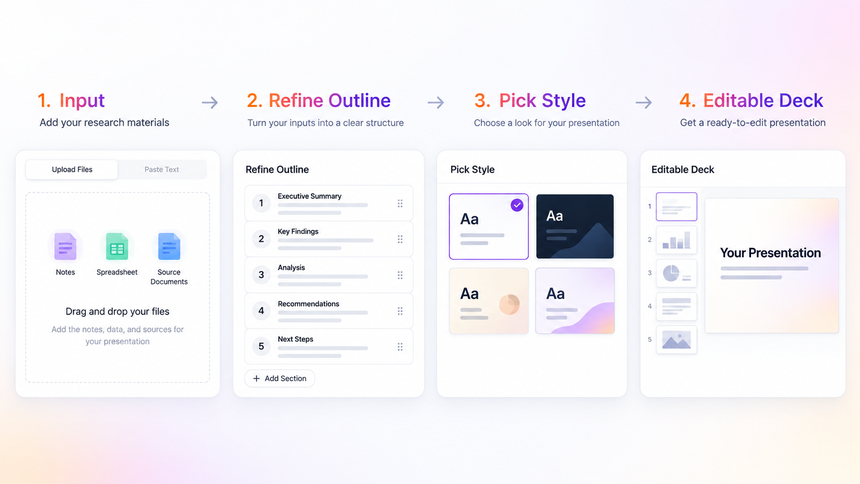
Once the team has agreed on the segment, channel roles, pipeline assumptions, and review gates, Presenti can organize the brief into an editable first draft. Start with a free Presenti account, use text to presentation when the plan is already written, then choose a relevant business style from the presentation template library after the outline is correct. This gives the team a topic-specific template rather than a generic file it must rebuild.
Use the draft to explain the plan, then ask marketing, sales, and finance to check the assumptions that affect their work. In particular, confirm pipeline calculations, available budget, and partner commitments against the source documents.
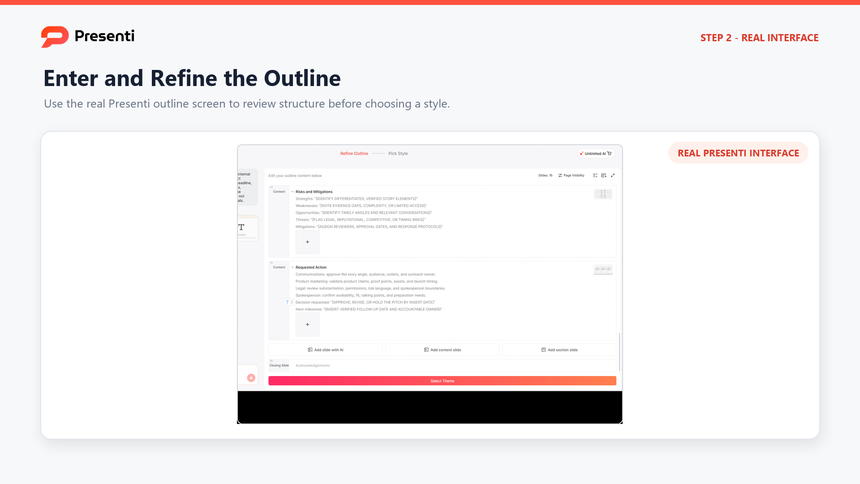
Step 1: Enter the brief and inspect the generated outline
Include the target segment, account tiers, buying roles, positioning, channel jobs, pipeline assumptions, owners, dependencies, budget, KPIs, risks, and review gates. Remove confidential customer, pricing, and partner details that are not approved for the working file.
Use a constrained prompt such as:
Create a 10-slide B2B marketing plan presentation for an executive planning review. Audience: marketing, sales, product, finance, and leadership. Include the plan headline, market context, account tiers, positioning, channel roles, content and demand plan, pipeline math, 90-day roadmap, KPIs, risks, and review gates. Use placeholders for unverified assumptions. Do not invent market size, conversion rates, customer results, or budget commitments.
Check that the generated outline moves from market choice to route, pipeline math, execution, measurement, and risk. Remove generic slides, combine repeated channel sections, and make the approval request explicit before styling.
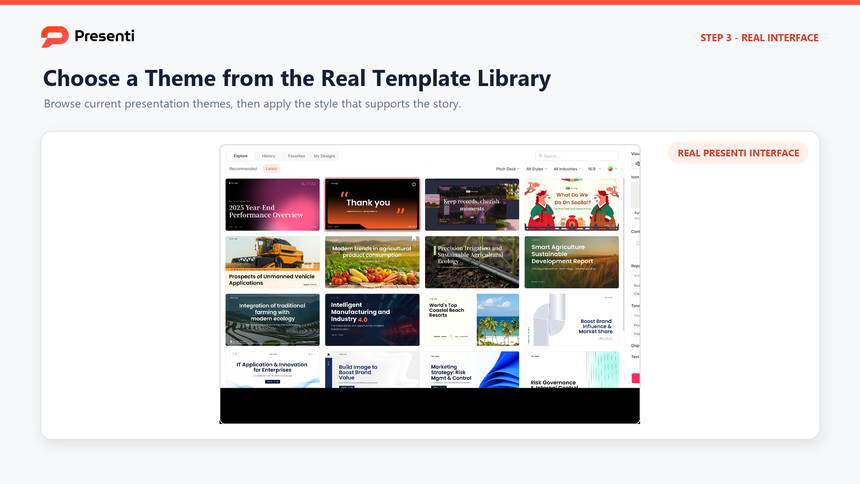
Step 2: Choose a template after the story is correct
Preview a business or strategy theme and check the title hierarchy, chart space, contrast, and content density. The template should support the plan’s logic rather than force the evidence into decorative layouts.
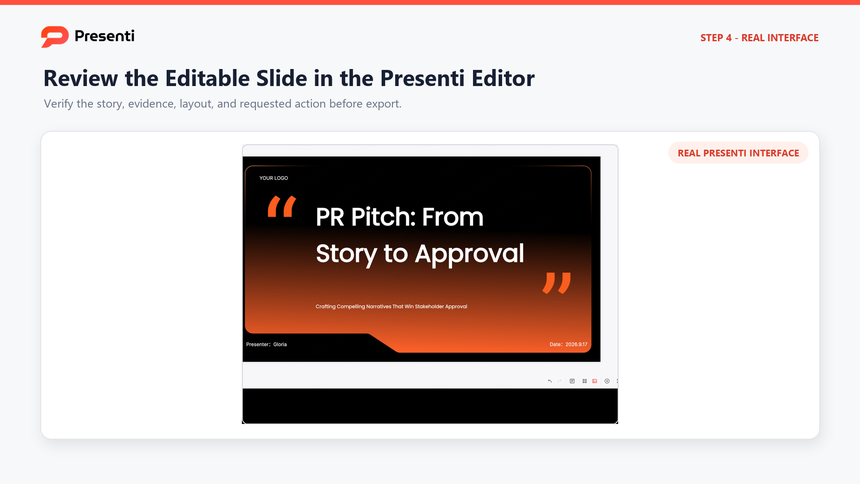
Step 3: Review the editable slides against the approved source
Compare every number, owner, date, assumption, and dependency with the approved plan. Replace generic claims, label placeholders, simplify crowded slides, and rehearse the decision ask with marketing and sales leadership.
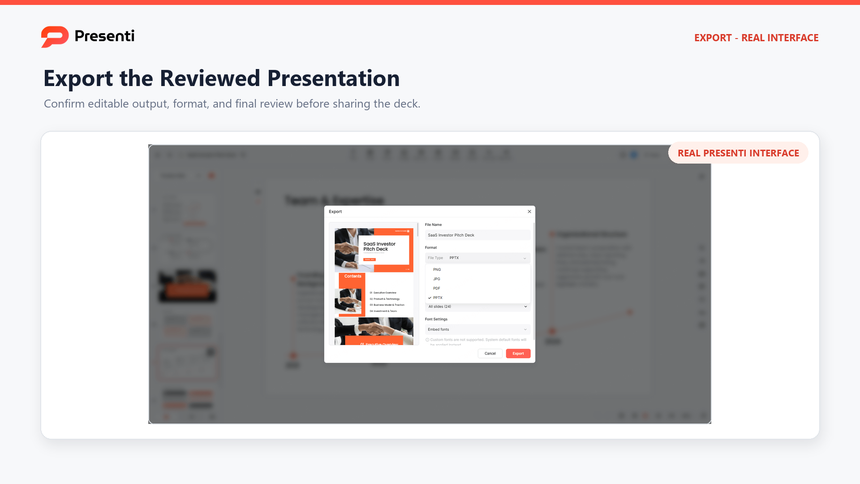
Step 4: Export only after the final checks pass
Remove internal notes, placeholders, and customer details that should not be shared. PowerPoint and PDF exports require an eligible paid plan. Open the exported file and check charts, links, fonts, and slide order before the meeting.
The finished deck should make the plan easier to approve and easier to revisit once real pipeline evidence arrives.
Frequently Asked Questions
What should a B2B marketing plan presentation include?
Include the plan headline, market context, target segments and account tiers, positioning, channel roles, content and demand plan, pipeline math, 90-day roadmap, KPIs, risks, and review gates.
How is a B2B marketing plan different from a demand generation plan?
A B2B marketing plan covers the market choice, positioning, channel system, resources, ownership, and measurement. A demand generation plan is one component focused on creating and converting qualified demand.
How many slides should the core deck have?
Start with about ten core slides for an executive review, then adjust for the decision and audience. Put campaign calendars, detailed budgets, measurement definitions, and scenario models in an appendix.
How should pipeline targets be set?
Show the assumptions behind the target: account count, reach, engagement, meetings, qualification, conversion, deal size, and cycle time. Separate observed, planned, and assumed values.
How often should the plan be reviewed?
Set a cadence that lets the team correct the plan before the next major spend or resourcing decision. Review leading signals before outcome metrics have matured, and do not treat early activity as revenue evidence.
Keep the Plan Within the Team’s Capacity
A B2B marketing plan presentation should explain which accounts deserve attention and how marketing will help sales reach them. Connect account tiers to channel roles, budget, and pipeline assumptions. A focused 90-day plan with realistic capacity is easier to act on than a long list of campaigns.