Some questions about thesis statements come up so often that they deserve their own dedicated answers. This article addresses the most common points of confusion — the kind students search for at midnight before a paper is due, or that researchers quietly wonder about years into their academic careers.
No filler. Just the answers.
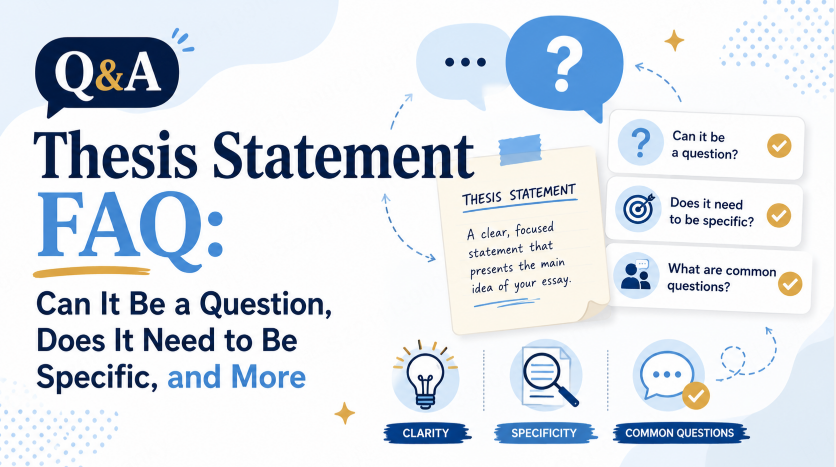
Can a Thesis Be a Question?
For an argumentative essay, the thesis normally states your answer or claim. A research question introduces the inquiry; check the assignment if it asks for an exploratory rather than argumentative paper.
This is probably the most frequently misunderstood point about thesis writing. The question you’re asking is the research question — the problem you’re investigating. The thesis is your response to that question. It’s the conclusion you’ve reached, the position you’re defending, the claim your paper will spend its length supporting.
Writing a question at the end of your introduction and calling it a thesis means you’ve done the first half of the intellectual work but skipped the second half. You’ve identified what you’re curious about. You haven’t yet committed to what you actually think.
Research question: Should the campus library extend its evening hours during exams?
Illustrative thesis: The campus library should pilot longer evening hours during exams because students need quiet study space after classes; usage records and student feedback should determine whether the change continues. A paper would need evidence for the need and feasibility.
See the shift? The question opens the inquiry. The thesis closes it with a position. Your paper then defends that position.
So — should a thesis be a question? No. It should be the answer you’ve worked hard enough to be willing to defend.
Why Should a Thesis Statement Be Specific Rather Than Vague?
Because vague thesis statements produce vague papers. It’s that direct.
When your thesis is broad — “technology has changed how we communicate” — your paper has no real direction. Any evidence could support it because the claim is so general that nothing could refute it. There’s nothing to argue. You end up summarizing instead of analyzing, listing examples instead of building a case.
Specificity is what gives a thesis teeth. It forces you to narrow your focus, choose your evidence deliberately, and make a claim someone could actually push back against.
Compare these two versions on the same topic:
Vague: Remote work has both advantages and disadvantages for employees.
Illustrative specific claim requiring evidence: Remote work improves productivity and job satisfaction for knowledge workers in structured roles, but increases professional isolation and career stagnation risk for entry-level employees who rely on informal mentorship and in-person visibility for advancement.
The vague version is impossible to argue about. The specific version has a real claim — and a counterargument already built in. That tension is what generates a paper worth reading.
Specificity also signals to your reader — and your professor — that you’ve actually thought about the topic. A specific thesis is evidence of intellectual engagement. A vague one suggests you’re still circling the subject rather than diving into it.
What Is a Thesis in College vs. High School?
The mechanics are the same. The expectations are not.
In high school, a thesis statement is often a formulaic sentence at the end of your first paragraph. You might be taught a specific structure: “In [work], [author] shows that [claim] through [element 1], [element 2], and [element 3].” That’s a useful scaffold when you’re learning.
In college, that formula becomes a ceiling, not a floor. College professors want to see genuine intellectual engagement. They want a thesis that does something with the material — not one that just announces you’ve read it. The claim needs to be more nuanced, the argument more developed, the evidence more sophisticated.
What is a thesis in college, then? It’s a position you’ve earned through research and careful thinking, expressed with precision and a clear sense of what you’re arguing against as much as what you’re arguing for.
What Is a Thesis Paper?
A thesis paper is an extended academic document in which a student — typically at the graduate level — presents an original argument, reviews the relevant scholarly literature, and defends a central claim through original research.
A thesis project is usually broader than an ordinary course essay, but length varies substantially by institution, degree, and discipline. Use the department’s requirements rather than a universal page range.
The thesis paper contains a thesis statement, but the two aren’t the same thing. The thesis statement is a sentence or two. The thesis paper is the entire research document built around that claim. You’re not just stating your argument — you’re constructing the full intellectual case for it over the course of months or years of work.
Is It Okay to Change Your Thesis After You Start Writing?
Not only is it okay — it’s expected, and often a sign that you’re doing the work properly.
A working thesis is a starting point. It represents your best thinking at the beginning of the writing process, before you’ve fully worked through your evidence, encountered counterarguments, or refined your logic. As you write, your argument gets clearer. Sometimes it changes direction entirely.
The key is alignment: your final, submitted thesis must match what you actually argue in the paper. If the paper goes one way and the thesis points another, readers will notice the disconnect. Revise until they sync up.
What Does “Thesis Statement Defined” Mean in Practice?
You’ll sometimes see the phrase “thesis statement defined” in academic writing guides, and it can sound more technical than it is. Defining a thesis statement just means articulating what it is and what it does within a specific context.
In practice, it means the following: a thesis statement is a statement of the paper’s central claim or organizing idea. It is a specific, arguable claim that controls the direction and structure of your argument. Everything in your paper should be traceable back to it.
That’s the thesis statement defined — not as a rule to follow, but as a function to understand.
A Quick Reference: Thesis Dos and Don’ts
Do:
- State a clear, specific, arguable position
- Place the thesis where the assignment and argument require it, often near the end of the introduction
- Revise it as your argument develops
- Make sure every body paragraph connects back to it
Don’t:
- Write a question and call it a thesis
- Announce your intentions instead of stating your claim
- Use vague language that avoids committing to a position
- Try to cover too much — narrow the scope to what the paper can actually defend
When Your Thesis Becomes a Slide
These questions matter beyond the paper itself. Once you’ve worked through your argument — answered the questions, refined the claim, aligned the thesis with the body of your work — you’ll often need to present that argument to an audience.
In a thesis defense, a seminar presentation, or a conference panel, your thesis statement becomes the anchor of your opening slide. The same qualities that make it work on the page — specificity, arguability, clarity — make it work on screen.
Presenti AI can help turn a reviewed outline into slides. Choose source and export options included in your plan, then check that the draft preserves the claim, supporting evidence, and limits of your argument.
The questions above have answers. The writing has a structure. Now all that’s left is to make the argument — clearly, specifically, and with something worth defending.