A business model slide should make the money flow easy to explain: who pays, what they buy, how the charge is calculated and what the business must deliver in return. Put those relationships on one slide before adding growth projections. An audience cannot assess a revenue forecast clearly if the unit being sold is still ambiguous.
Start with the commercial terms and a small worked example. Once they are clear, you can build an editable pitch draft from your business material. Keep the facts in the input: a presentation tool can arrange the explanation, but it cannot decide your pricing or confirm that customers will accept it.
Follow one purchase from buyer to delivery
Imagine explaining the business to someone who might become a customer. “We monetize through a scalable platform” gives them little to work with. “An independent repair business pays a monthly subscription for scheduling and job coordination” identifies a buyer, a payment and a service.
Four questions provide the core of the slide:
- Who pays? Name the paying customer, which may differ from the person using the service.
- What is the billing unit? An account, seat, transaction, project or another clearly defined unit.
- When is the charge made? Monthly, annually, per completed order or at agreed project stages.
- What must be delivered? Identify the product or service and the main work or costs required to provide it.
Sequoia's business-plan outline includes the business model as a distinct part of the explanation. Keep it distinct in your deck too: market size describes an opportunity, traction describes what has happened, and the business model describes how the proposed or existing exchange works.
A subscription slide with a checkable example
Consider a fictional service that helps independent repair businesses coordinate customer appointments. A business account costs $150 per month and covers up to five staff users. Additional seats are outside this example. These terms and figures are invented to demonstrate the slide, not reported customer results.
The paying customer is the repair business. Staff members use the software, but five users do not create five subscriptions. The unit is one business account per month.
| Part of the model | Example term |
|---|---|
| Buyer | Independent repair business |
| What the buyer receives | Scheduling and job-coordination software for up to five staff users |
| Charge | $150 per business account per month |
| Billing | Monthly, with no setup fee in this example |
| Illustrative direct delivery cost | $30 per active account per month |
| Amount remaining before other costs | $120 per account per month |
At 20 active accounts, the monthly subscription charges would be 20 × $150 = $3,000. At the assumed delivery cost, 20 × $30 = $600 would be associated with serving those accounts, leaving $2,400 before the other costs of running the business.
That $2,400 is not net profit. The example has not included product development, sales, administration, taxes or other expenses. Nor has it demonstrated that $30 is a reliable delivery cost at every scale. On the slide, label it “Remaining before other costs,” and keep the cost assumptions in the supporting material.
The 20-account calculation explains the model's mechanics. If the business has not acquired 20 customers, label it an illustration rather than a current result. A hypothetical multiplication should never appear under a heading such as “Revenue achieved.”
Draw value and payment in opposite directions
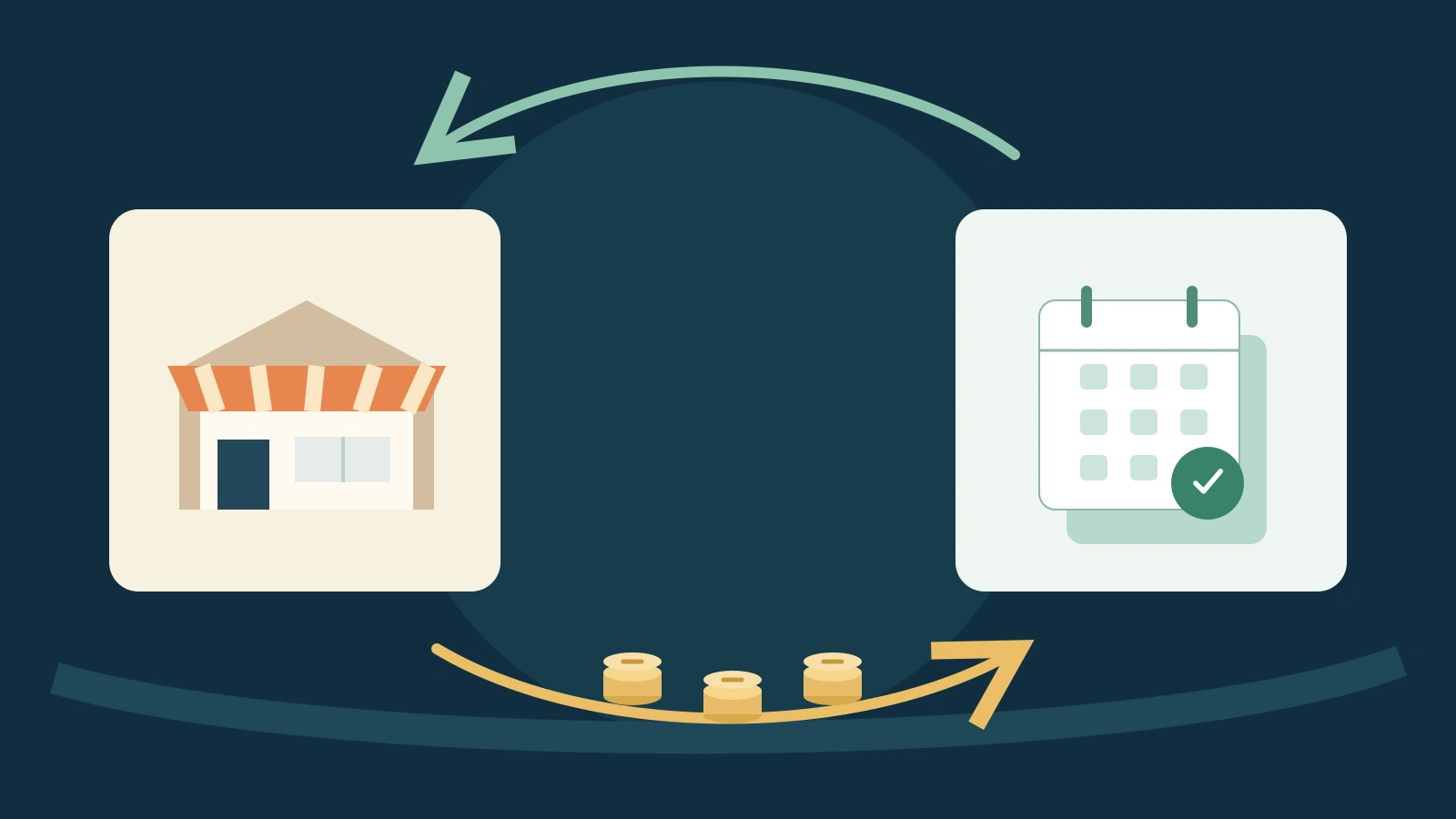
A useful layout for the subscription example has two main nodes: the repair business and the scheduling service. One arrow carries the service toward the buyer. A second arrow carries the $150 monthly account payment back toward the provider.
Underneath, add a small calculation strip: “$150 charge − $30 illustrative delivery cost = $120 before other costs.” Keep the billing unit beside the price. A large $150 without “per business account per month” invites the wrong interpretation.
The slide headline could be “Repair businesses pay a monthly account subscription.” The service description, price and calculation should fit beneath that headline without requiring a second chart. Put future pricing options and a detailed expense model in supporting slides.
When speaking, explain the transaction in plain language: “The business pays, and up to five staff members use the account. In this illustration the monthly charge is $150. We have allowed $30 per account for direct delivery, leaving $120 before development, sales and other operating costs. The next question is whether our customer and cost evidence supports those assumptions.”
This format also reveals missing information. If you cannot label the payment arrow, the payer or the unit may be unclear. If delivery requires substantial human work, a diagram showing only “software access” may hide an important part of the model.
Change the example when the revenue mechanism changes
A transaction-fee business needs a different diagram. Suppose a fictional marketplace facilitates 30 completed bookings at $200 each in one month. The customer payments total $6,000. Under the stated arrangement, providers receive 85%, or $5,100, and the marketplace retains 15%, or $900.
The audience needs to see both the total value passing through the marketplace and the portion retained by it. Calling all $6,000 “our revenue” without explaining the arrangement would obscure the model. Use “Booking value” and “Marketplace fee retained” as the two labels; the company's actual financial reporting must follow its own accounting treatment.
If payment and coordination costs total $7 per booking in the illustration, they amount to $210. The remaining $690 is before other business costs. A small split-flow diagram can communicate the $6,000 → $5,100 + $900 relationship more clearly than three unrelated headline figures.
A project-based service has another unit again. A $2,400 fixed-price project is one contracted deliverable, not a monthly recurring subscription. Explain what is included, when payment is due, and which changes require a separate quote. If delivery uses 20 specialist hours, those hours belong in the cost and capacity discussion even though the customer pays a fixed price.
Choose the example that matches the business. Do not add subscription, advertising and licensing revenue streams simply to make the model look diversified. An untested option should be labeled as such and kept separate from the mechanism currently in use.

Show the conditions that could change the model
Every compact explanation leaves detail out. Bring back the detail that could change the audience's interpretation. A subscription sold annually has different billing timing from one paid monthly. A project price may depend on scope. A transaction fee may apply only to completed, nonrefunded bookings.
For the subscription example, ask whether the $30 delivery assumption includes support, hosting and any third-party usage costs. If support varies greatly by customer, a single average can hide a costly segment. A separate supporting table can show the assumptions without crowding the main slide.
Also distinguish a price from evidence of willingness to pay. “Our proposed monthly price is $150” and “20 customers currently pay $150 monthly” are different claims. Use the first for a proposal and the second only when it is supported by actual customer records.
Price changes, discounts and free periods can make account counts an unreliable shortcut for revenue. Use the actual terms when presenting a real business. A simple illustration is useful because the arithmetic can be followed; it is not a substitute for the company's records.
Give the slide a place in the pitch
Place the business model where the audience has enough context to understand the exchange. They should already know the customer problem and the proposed product or service. Then the payment mechanism can lead naturally into evidence of adoption and the resources needed to deliver.
In a company profile presentation, the same explanation may be shorter and more operational: what the company provides and how customers buy it. In a fundraising pitch, the audience may ask for more detail about the relationship between revenue, delivery costs and expansion. The core transaction should stay understandable in both settings.
To prepare the slide draft, supply the payer, billing unit, included service, payment timing, example calculation and unresolved assumptions as separate fields. Request two labeled flows and one calculation rather than a page of sales language. After drafting, check that the unit appears beside every price and that hypothetical figures remain clearly identified. A reader should be able to explain the business model back to you after seeing the slide once.