A company profile presentation explains what your business does, whom it serves, and why a prospective customer should consider working with it. Give the audience enough evidence to understand your capabilities and decide whether a further conversation makes sense. A long company history or a list of services cannot do that on its own.
For an introductory meeting, start with the customer's situation, explain the work you can take on, and show a relevant example. If the meeting has already moved toward a specific purchase, a sales presentation can develop the offer and the customer's decision in more detail. The company profile remains a reusable introduction; it should not pretend to be a priced proposal.
The nine-slide example below follows a fictional engineering consultancy that helps small manufacturers plan production-line changes. Its team, services, and project example are illustrative. Replace them with information your own company can support.

Decide what the introduction must achieve
Before collecting slides, finish this sentence: “After this presentation, the audience should know whether we can help with _____.” That blank determines what belongs in the deck.
For the example consultancy, the answer is: “planning a production-line change before the customer commits to equipment and installation work.” A facilities manager needs to understand the scope, the work produced, and the responsibilities that remain with the customer's team. That is a more useful starting point than “show that we are innovative.”
Keep three common presentations separate:
- Company profile: who you serve, what you can do, and evidence of how you work.
- Project proposal: the specific scope, deliverables, schedule, commercial terms, and decision for one opportunity.
- Investor presentation: the business, market, economics, funding request, and risks relevant to an investment decision.
They may reuse material, but their endings differ. An introductory profile might ask for a discovery meeting. A proposal might ask the customer to approve a scope. Avoid putting a funding request or a detailed quotation into a general introduction merely because those slides already exist.
Gather company facts before designing slides
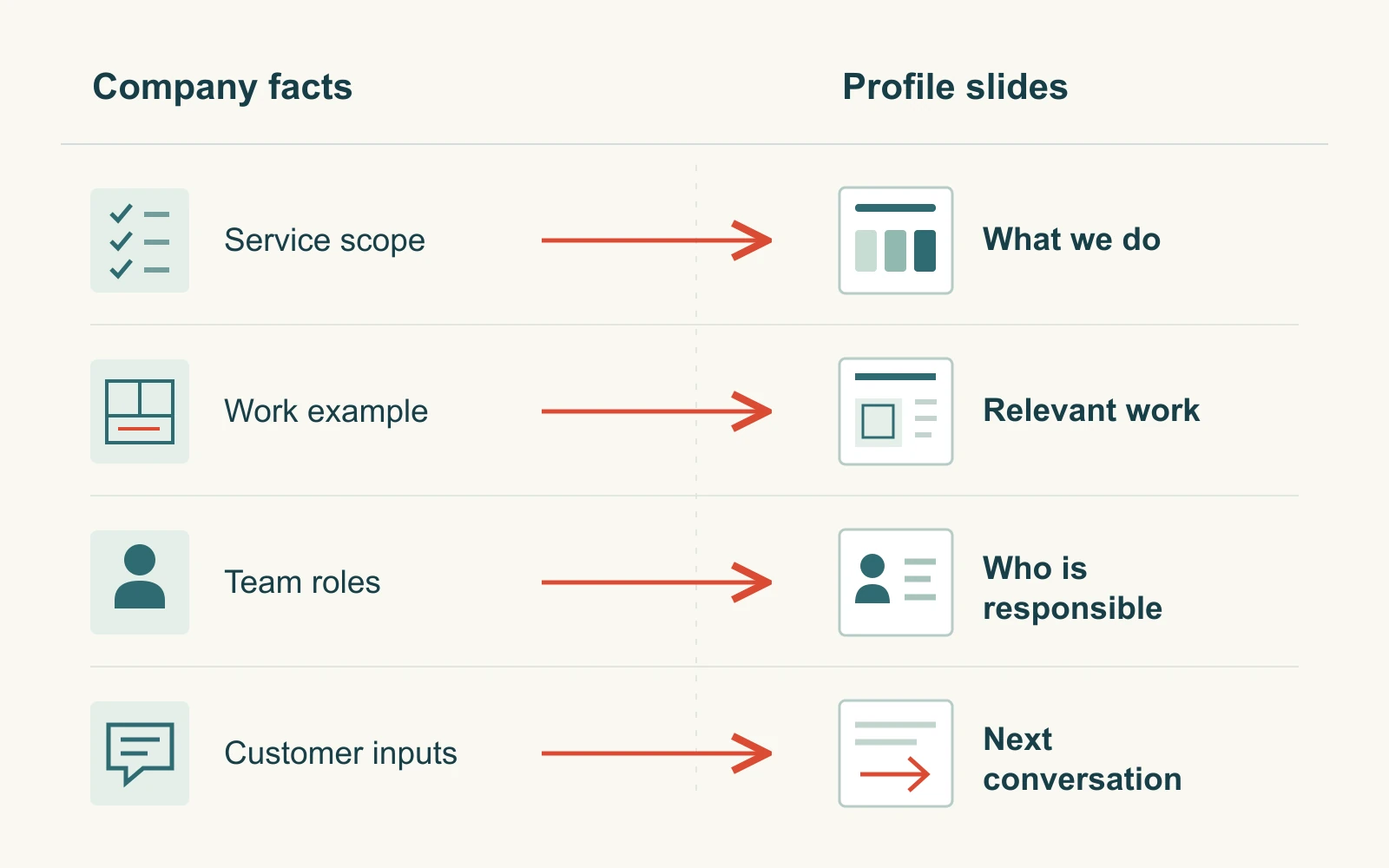
Start with your current service descriptions, team responsibilities, an approved project example, and contact details. For each statement, ask what the audience could inspect if it wanted to know more.
| Statement you want to make | Useful supporting material | What the slide should avoid |
|---|---|---|
| We help manufacturers plan line changes. | A defined service scope and an example of the planning output. | A claim to handle every stage of factory transformation. |
| Our team brings relevant experience. | Named responsibilities and approved, relevant background. | Unverified credentials or a logo wall with no explanation. |
| Customers receive a clear handover. | A redacted deliverable or a representative example with its purpose explained. | A promised business result that the deliverable alone cannot establish. |
Use customer names, quotations, logos, and project details only where you have permission to publish them. If an example must remain confidential, describe the situation and your contribution without exposing identifying details. Do not make an anonymized case sound like a public endorsement.
A nine-slide company profile example
This sequence gives the fictional consultancy a coherent introduction. It is a starting structure, not a requirement to produce nine slides for every meeting.
1. State who you are and what you help people do
Example headline: “Engineering planning for production-line changes.” Add the company name and a short explanation: “We help small manufacturing teams compare layout options and prepare an agreed brief before installation work begins.”
A reader should understand the business without interpreting a slogan. Keep the founding story for a later conversation unless it explains a capability the audience needs.
2. Show the customer situation you understand
Example headline: “A new machine changes more than the space it occupies.” Show the connected questions: material movement, operator access, maintenance access, and the changeover plan.
This slide explains why the service exists. It does not need an invented market statistic. A recognizable situation can make the problem concrete without claiming that every manufacturer faces the same constraints.
3. Define the work you offer
For the consultancy, use three service groups: document the current layout and constraints; compare proposed arrangements; prepare the planning package for the customer's next decision. Name the output under each group, such as a constraints map, an options comparison, or a handover brief.
Make the boundary visible. In this example, equipment supply and installation are outside the profile's stated service. Clear scope helps a buyer ask the right questions; vague breadth makes the next conversation harder.
4. Explain how an engagement works
Show a short sequence: agree on the question, gather the site information, compare options, and review the recommendation. Under each step, identify something the customer provides or decides.
“Collaborative process” becomes concrete when the slide says, “The operations lead confirms access constraints before the team compares layouts.” Do not add a standard delivery duration unless your team can support it for the work being described.
5. Show one relevant piece of work
The fictional example is a packaging line that needs space for a new inspection station. The consultancy prepares two layout options. One retains the existing material route; the other relocates a staging area to improve access.
Show the question, the two options, and the reason for the recommendation. State that the customer must still confirm equipment specifications and installation requirements. This demonstrates how the team approaches a decision without inventing a reduction in downtime, cost, or defects.
6. Make the deliverables tangible
Show what the customer receives: an annotated layout, a comparison of the options, unresolved questions, and an agreed handover brief. Explain what each item helps the next team do.
A sample output is often more informative than another paragraph of adjectives. If the visual is a representative example rather than client work, label it as an example and keep that distinction clear in the spoken explanation.
7. Introduce the people responsible
Connect each person to a job in the engagement. The project lead coordinates decisions; the engineer develops the layout options; the customer contact arranges access and reviews. Use the roles your company actually has.
Select relevant experience rather than reproducing full biographies. A four-person team should look like a clear four-person team, not a collection of stock portraits implying a larger organization.
8. Explain how customers work with you
Cover the practical information that affects fit: where you work, the kinds of input you need, the usual review participants, and how scope is agreed. Include approved certifications or accreditations only if they apply to the service and entity being presented.
For the fictional consultancy, the useful message is: “Bring your current layout, equipment requirements, and operating constraints. We will use an initial discussion to define the planning question and the information still needed.”
9. Offer a specific next conversation
End with the contact person and a practical request: “Discuss your planned line change and the decision you need to make.” Briefly name what would make that discussion useful, such as a current layout and the proposed equipment brief.
A generic “Thank you” can sit below the request. It should not replace the next step.
Adapt the profile without rebuilding it
Keep the service scope, company identity, and current contact details consistent. Adapt the customer situation, project example, and depth of explanation to the audience.
An operations manager may want to understand access and changeover decisions. A procurement colleague may need clearer responsibilities and the information used to define scope. Those versions should describe the same capability; changing audiences is not a reason to quietly enlarge what you offer.
For a short first meeting, use the company purpose, customer situation, service scope, example, and next step. Keep the method, deliverables, team, and working arrangements available for questions or the follow-up copy.
Turn approved company information into slides
Once the facts and sequence are ready, you can use Presenti to turn your company outline into an editable presentation draft. Provide the intended audience, the purpose of each slide, and the approved information that belongs on it.
A useful instruction is: “Create an introductory company profile for a facilities manager considering a production-line change. Use the nine-slide outline below. Keep the stated service boundaries. Do not add customer names, qualifications, performance results, or services that are not in the supplied material.”
Read the resulting deck as a potential customer. Can you tell what the company does, what evidence supports its capabilities, and what to discuss next? Correct anything that overstates the source material. The finished profile should make your business easier to understand, with enough substance for the next conversation.