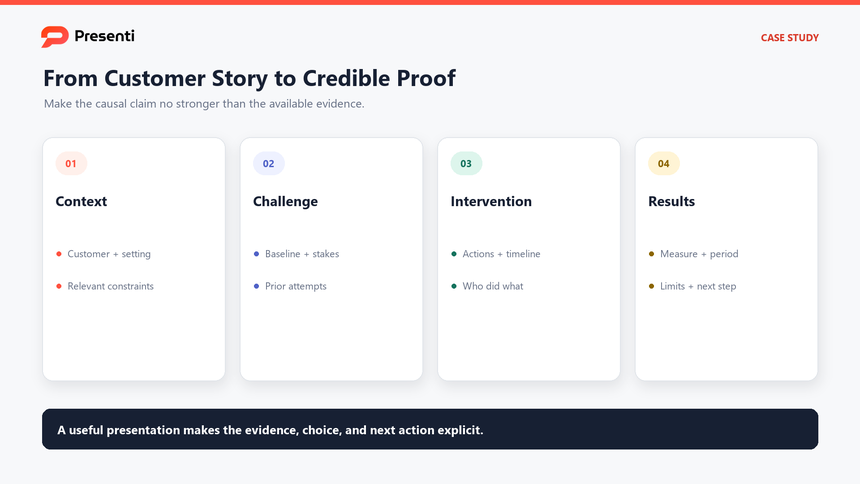
A case study presentation explains a customer’s problem, what the team changed, and what happened afterwards. The audience needs enough context to judge whether the experience is relevant to them: the starting point, the work involved, the results, and any other factors that may have influenced them.
This template fits customer proof, sales enablement, agency portfolios, implementation reviews, nonprofit programs, research applications, and internal transformation stories. Adapt the level of detail to the audience, but do not make the causal claim stronger than the evidence.
What Should a Case Study Presentation Prove?
The deck should help the audience judge relevance and credibility. Relevance asks whether the featured situation resembles the audience's own constraints. Credibility asks whether the result is defined, traceable, and reasonably connected to the intervention.
Start with the main finding. In a fictional example: “A regional service team’s median approval time fell from nine to five business days during an eight-week pilot of standardized intake and parallel review.” State that the pilot involved one team, and that a longer follow-up would be needed to see whether the improvement lasted.
| Question | Evidence to include | Credibility risk |
|---|---|---|
| Was the challenge real? | Baseline, source, period, affected users, and business consequence | Using a vague pain point with no starting measure |
| What changed? | Intervention, timeline, participants, scope, and important decisions | Presenting a product list instead of the implemented change |
| Did the result matter? | Outcome definition, comparison, absolute values, and stakeholder perspective | Using percentages without denominators or context |
| Can the result transfer? | Conditions, constraints, limitations, and next test | Claiming the same result for every customer |
Confirm the intended use and customer permission before drafting. Approval to publish a logo is not automatically approval to publish metrics, quotes, screenshots, or employee names. Record which facts can appear publicly, which require anonymization, and who gives final signoff.
Which Slides Belong in a Case Study Deck?
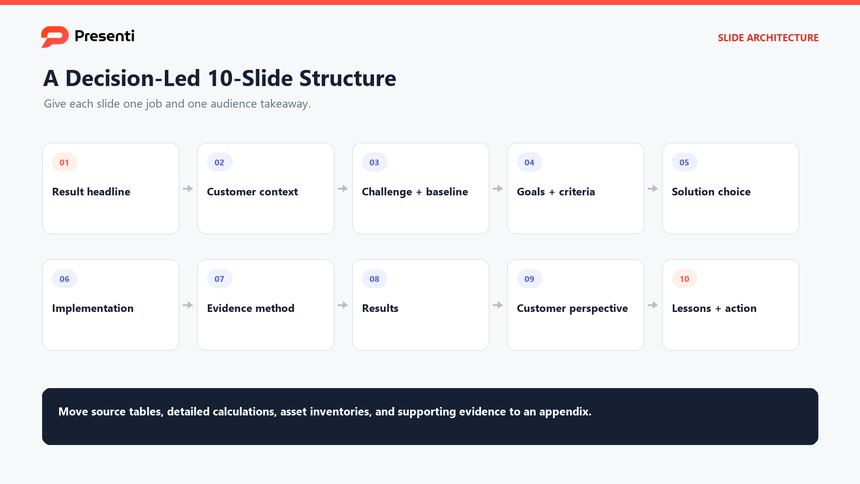
A focused case study usually needs eight to twelve core slides. A short sales conversation may use six; a technical or executive review may add implementation detail and an appendix. Organize the deck around the proof, not around your company's history.
- Result headline. State the verified change, context, period, and important boundary.
- Customer context. Give only the industry, scale, process, and constraints needed to understand the case.
- Challenge and baseline. Define the starting condition, consequence, measure, and source.
- Goals and success criteria. Show what the customer intended to change and how success would be judged.
- Solution choice. Explain why the selected approach fit the constraints.
- Implementation. Show actions, sequence, participants, timeline, and course corrections.
- Evidence method. Define data sources, comparison, period, denominator, and limitations.
- Results. Present outcomes, leading indicators, and relevant qualitative evidence.
- Customer perspective. Use an approved quote or observation with role and context.
- Lessons and next action. State what the evidence supports, what remains uncertain, and the appropriate next step.
Place company background in one compact slide unless it directly affects the result. Long product tours and feature lists weaken the case because they interrupt the evidence chain. The audience needs to see the relevant change and its outcome, not every available capability.
How Do You Frame the Challenge and Baseline?
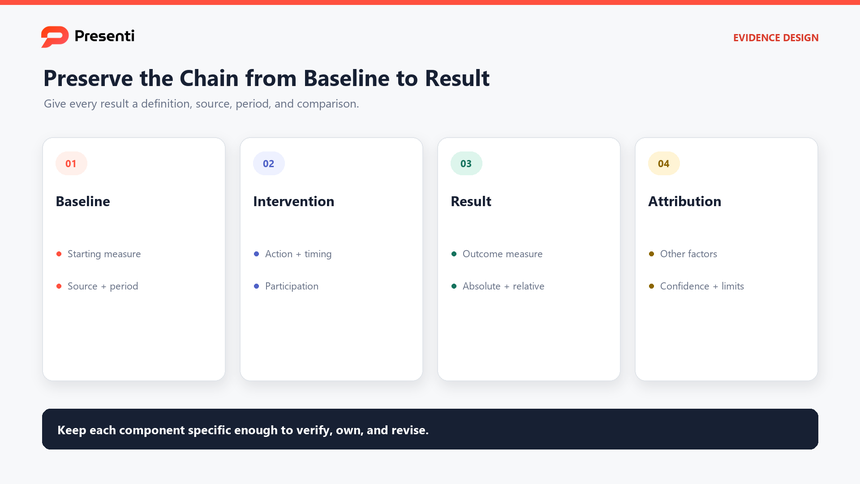
Define the challenge in observable terms. "The process was inefficient" is not a baseline. "Median approval time was nine business days across 146 requests in the prior quarter, and 22% were returned for missing information" gives the audience a measurable starting point.
Include enough context to explain why the problem was difficult. Relevant context might include the number of teams, systems, locations, user types, regulatory constraints, seasonal demand, legacy process, or available resources. Exclude details that do not affect the interpretation.
- Metric definition: explain exactly what starts and stops the measure.
- Source: name the system, survey, interview set, or approved record.
- Period: state the dates and why they are comparable.
- Population: provide the denominator, exclusions, and sample size.
- Business consequence: connect the baseline to cost, risk, experience, quality, or opportunity.
When the original baseline is incomplete, say so. You may use a reconstructed baseline if the method is documented and the limitations are visible. Do not compare a carefully cleaned post-intervention measure with an informal estimate from before the project.
Separate the customer's stated goal from the metric the team can measure. A customer may want "faster service," while the case tracks median response time and repeat contacts. Explain why those indicators are useful and what they do not capture.
How Should You Present the Solution and Evidence?
Describe the solution as an intervention, not a catalog. Show what changed in the workflow, who changed it, what resources were required, and how the implementation evolved. A timeline with decision points is often more useful than a page of features.
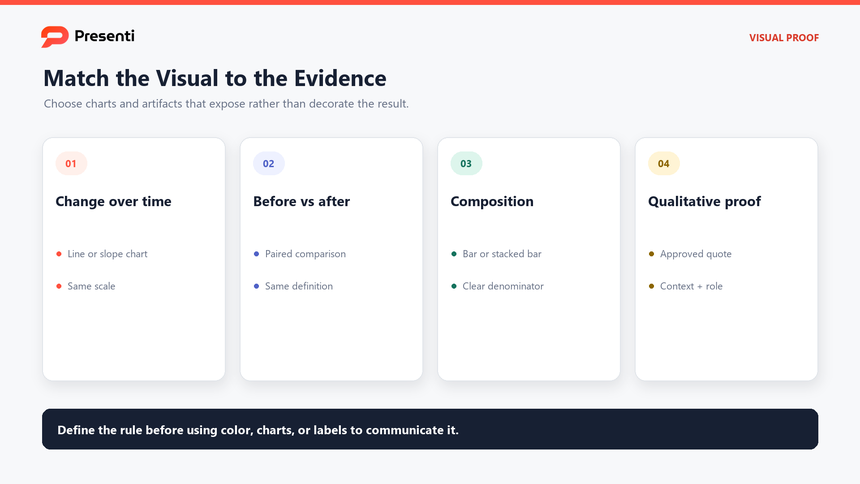
Then match each result to the visual that best exposes the comparison. Use a line or slope chart for change over time, paired bars for a clear before-and-after comparison, a stacked bar for composition with a defined denominator, and an annotated process view for cycle-time changes. Preserve the same scale and definition across compared values.
| Claim | Useful visual | Required context |
|---|---|---|
| Approval time fell | Before-and-after bar or distribution | Median or mean, period, sample, exclusions, and units |
| Adoption increased | Time series or cohort table | Eligible population, active definition, and cutoff |
| Error composition changed | Stacked bars or small multiples | Same categories, denominator, and collection method |
| Experience improved | Score trend plus approved quote | Survey question, response count, period, and quote context |
Show absolute and relative change when the difference matters. An increase from 2% to 4% is a two-percentage-point increase and a 100% relative increase; either figure alone can distort the audience's impression. Use the form that helps the decision and give the starting value.
Customer quotes should add interpretation, not replace measurement. Record who said the words, the person's role, interview date, editing approval, and whether the quote describes a personal experience or a broader organizational outcome.
What Does a Credible Case Study Example Look Like?
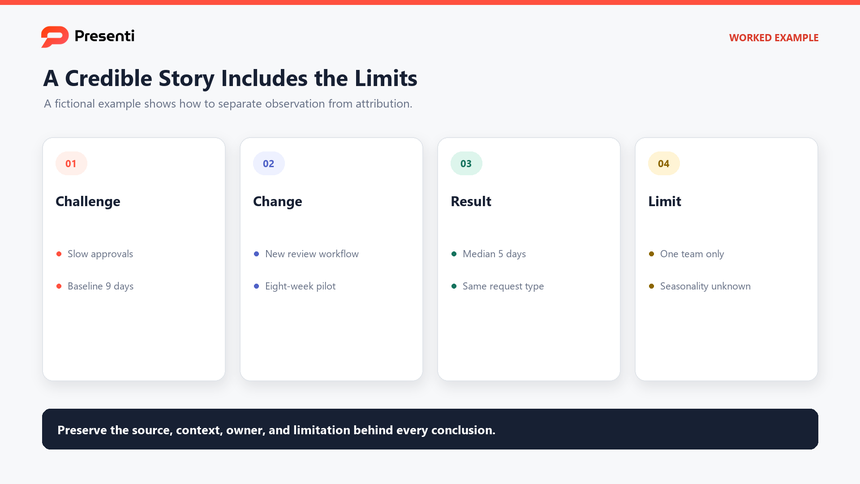
Consider a fictional regional service team that handles approval requests. The team wants to reduce delay without lowering review quality. The case follows an eight-week pilot in one business unit.
| Stage | Example evidence | Interpretation |
|---|---|---|
| Baseline | Median approval time was 9 business days across 146 comparable requests | Missing intake fields caused repeated clarification |
| Intervention | Standardized intake, parallel review, and a named escalation owner | The process changed as well as the supporting tool |
| Result | Median approval time was 5 days across 61 pilot requests; return rate fell from 22% to 11% | Both measures improved during the pilot; other contributing factors remain possible |
| Limit | One team, eight weeks, lower seasonal volume, no long-term follow-up | The result supports a larger test, not a universal claim |
| Next action | Extend the pilot to two teams and monitor cycle time, returns, and reviewer workload | Test whether the result transfers without shifting cost |
A responsible headline is: "One service team reduced median approval time from nine to five business days during an eight-week pilot." An irresponsible headline is: "The solution makes approvals 44% faster for every organization." The second version removes context, overstates attribution, and generalizes beyond the evidence.
Add one human observation if approved: for example, a reviewer may explain that standardized intake reduced clarification work. Keep it beside the measured result and label it as perspective. Do not use a polished quote to imply a result that the data does not show.
In this fictional case, approval times and return rates improved during the pilot. A larger trial could help determine whether those changes continue with higher volumes and different teams. Track reviewer workload as well, so a faster process does not simply move the burden elsewhere.
How Can Presenti Turn Source Material into an Editable Case Study?
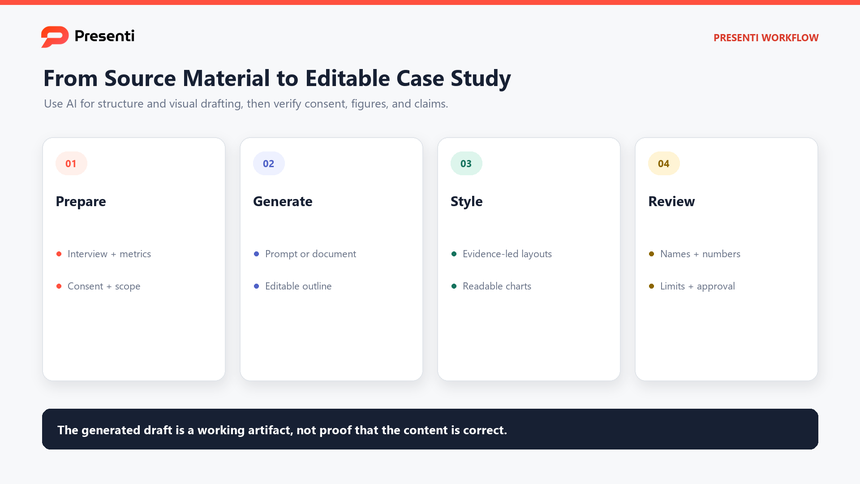
Presenti can help organize approved interview notes, project summaries, and metric definitions into an editable presentation draft. Use Word to presentation when the case narrative and evidence table already live in a document. Clean the source first and remove private customer information that is not approved for the deck.
You can try a draft with the limited AI use included in a free Presenti account. Paste the approved case outline and choose a layout from the Presenti template center. Word input and PowerPoint or PDF export require an eligible paid plan.
The tool is useful for structuring the story and creating a visual starting point. It cannot confirm customer consent, validate the source query, determine causality, or approve a quote. Keep those review gates outside the generation step.
Step 1: Prepare an evidence packet
Include the approved customer context, challenge, baseline, intervention, timeline, metric definitions, source periods, results, quote permissions, limitations, and intended call to action. Mark all missing or disputed facts.
Step 2: Enter a prompt with evidence boundaries
Use a prompt such as:
Create a 10-slide customer case study presentation for a sales conversation. Audience: operations leaders evaluating process improvement. Include the result headline, customer context, baseline, goal, intervention, implementation timeline, evidence method, results, one approved quote placeholder, limitations, and next step. Preserve all supplied units and periods. Use placeholders for unsupported facts. Do not invent customer names, metrics, quotes, or attribution.
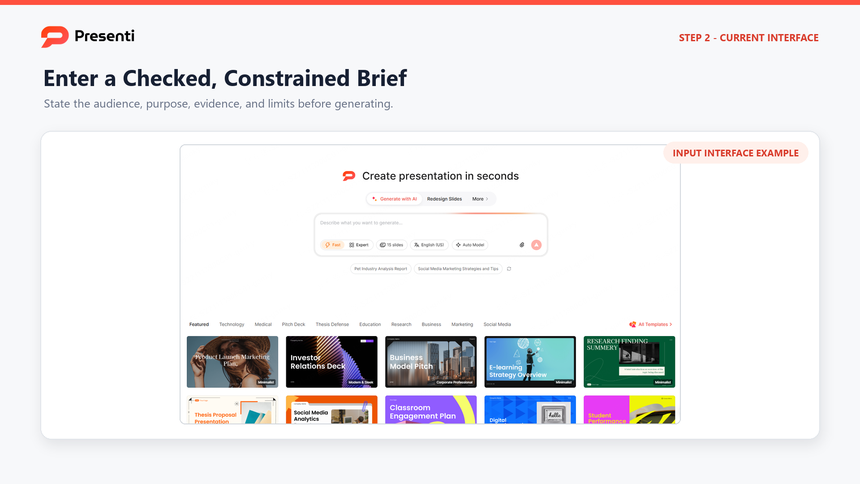
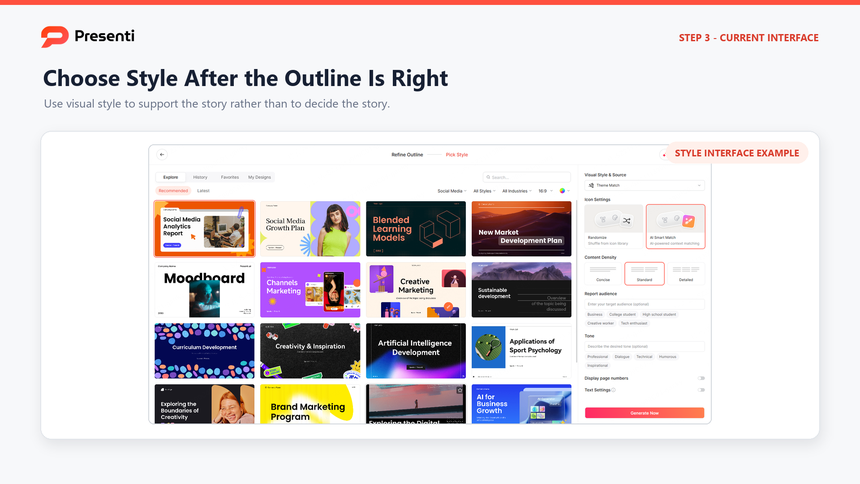
Step 3: Review the evidence, then choose a case-study template
Check that the outline moves from result to context, baseline, intervention, measurement, result, limit, and next action. Remove generic company slides and feature catalogs. Give every chart one claim and keep source detail in the appendix. Preview a template whose results and comparison layouts let readers inspect the evidence, then apply it only after the narrative sequence is sound.
Step 4: Verify and obtain final approval
Compare every name, number, date, chart, and quote with the approved source. Check absolute and relative changes, denominators, period labels, and attribution language. Confirm the customer signoff and remove internal notes before sharing.
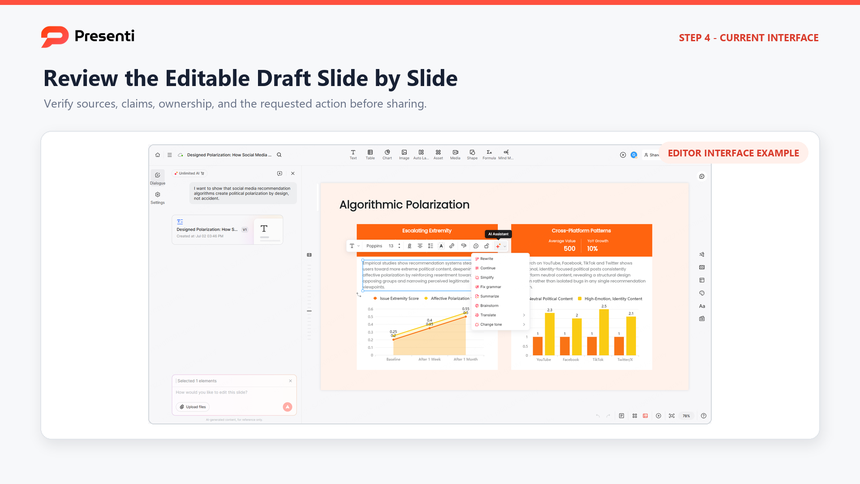
The finished presentation should make the proof easier to inspect. Design cannot repair a missing baseline or unsupported claim.
Frequently Asked Questions
What is a case study presentation?
It is a slide-based account of a real customer, project, or program that explains the context, challenge, intervention, implementation, evidence, results, limitations, and next action.
How long should a case study presentation be?
Eight to twelve core slides usually fit a focused business case. Use fewer for a short sales conversation and an appendix for methods, source tables, implementation detail, and approvals.
Should a case study lead with the result?
Usually yes, when the result is verified and relevant. State the context, period, and boundary in the headline, then use the remaining slides to show how the result was measured and achieved.
Can a case study be anonymous?
Yes. An anonymized case can still be useful when it preserves the industry, scale, constraints, baseline, intervention, evidence, and limitations needed to judge relevance. Do not leave enough detail to identify a customer who has not approved disclosure.
What if the result cannot be attributed to one solution?
Describe the contributing factors and narrow the conclusion. Say the change was associated with or occurred during the intervention when the design cannot establish causality. A credible limitation is stronger than an inflated claim.
Let the Specific Result Carry the Story
Choose a case that your audience can recognize, explain what changed, and show the result alongside its starting point. Keep the customer’s words and the measurements distinct. A specific, well-supported account is more persuasive than a sweeping promise about what every customer can achieve.