A competitive analysis presentation should help a team make a choice. It is not a catalog of competitor features or a slide full of logos. A useful deck defines the decision, compares alternatives against the same buyer job, shows the evidence behind the comparison, and ends with an action that someone can own.
Use the template below for a strategy review, product launch, sales enablement meeting, or quarterly planning session. Keep the scope narrow enough to research honestly, label what is observed versus inferred, and treat the matrix as a decision aid rather than a permanent ranking.
Define the Decision, Scope, and Competitor Set
What the presentation should decide
Start the deck by stating which decision the comparison will inform and which buyer you are considering. A product that fits a small team may be unsuitable for a large organization. Make that perspective clear before scoring either one.
HubSpot describes competitive analysis as a way to identify competitors, understand their strengths and weaknesses, and use that information to make better strategic decisions. In a presentation, that work needs an explicit claim trail. For every important statement, keep a small ledger:
| Evidence label | Meaning | Example |
|---|---|---|
| Observed | Directly checked in the product or its published documentation | Competitor A lists an export to PDF |
| Reported | Published by a customer, analyst, or the competitor | Customers report faster setup |
| Inferred | A reasonable interpretation of several observations | The workflow may suit small teams |
| Hypothesis | A claim that still needs validation | Switching cost is the main objection |
This distinction keeps a confident visual from making an unverified claim look like a fact.
Define the question, scope, and audience
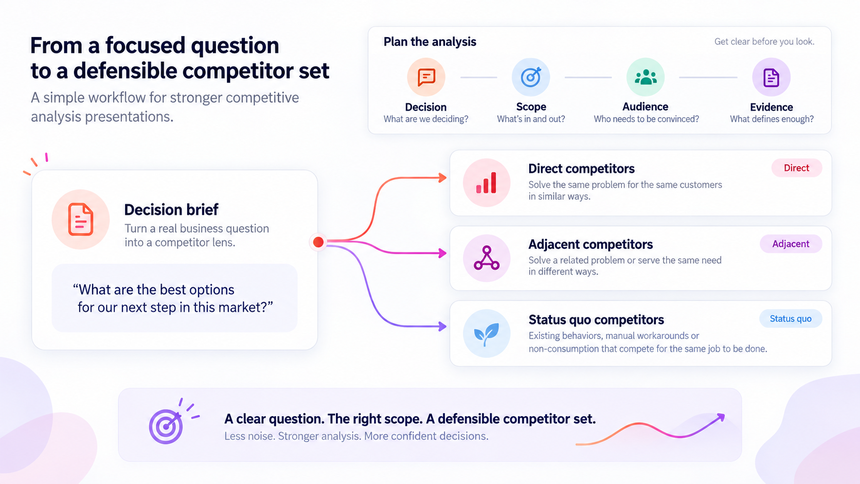
Start with the decision, not the competitor list. “Who is best?” is too broad for a useful meeting. Ask what the team needs to decide and by when.
- Which alternatives should a buyer consider for this specific job?
- Where should the next product investment close a meaningful gap?
- Which segment can we win without matching every incumbent feature?
- What should sales emphasize when a prospect names a competitor?
- Should the launch be positioned around speed, control, collaboration, or another outcome?
Write the scope on the second slide. Name the market or use case, the buyer segment, the geography if it matters, the date of the research, and what is out of scope. A focused scope makes a later update possible because another researcher can reproduce the boundaries.
Match the evidence depth to the audience. Executives need the decision and the few facts that could change it. Product teams need criteria definitions and gap details. Sales teams need buyer language, proof points, and safe responses to objections. One deck can serve all three, but the opening summary should still have one primary reader.
Choose competitors that teach you something
A useful set usually includes more than the two brands everyone already knows. Select competitors by the lesson they provide, then explain why each one is in the frame.
| Competitor type | Why include it | Question to test |
|---|---|---|
| Direct | Targets the same buyer and job | Where do buyers see a meaningful difference? |
| Adjacent | Solves part of the job through another workflow | What substitute could remove the need for us? |
| Lightweight or budget | Sets a low-friction expectation | Which “good enough” promise is hard to ignore? |
| Premium or specialist | Represents the high end of the category | Which capability justifies a higher commitment? |
| Status quo | Represents spreadsheets, agencies, or doing nothing | What keeps the buyer from changing? |
Limit the main matrix to the competitors that can change the decision. Put the long list in an appendix. Confirm that each name is actually available to the buyer in the market and that the products were evaluated in comparable versions or time windows.
Build a Defensible Competitive Matrix
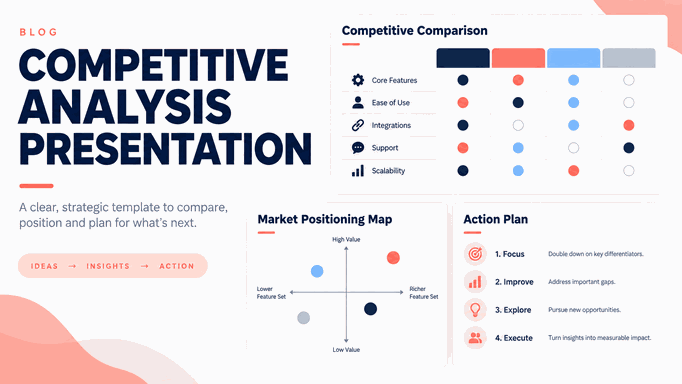
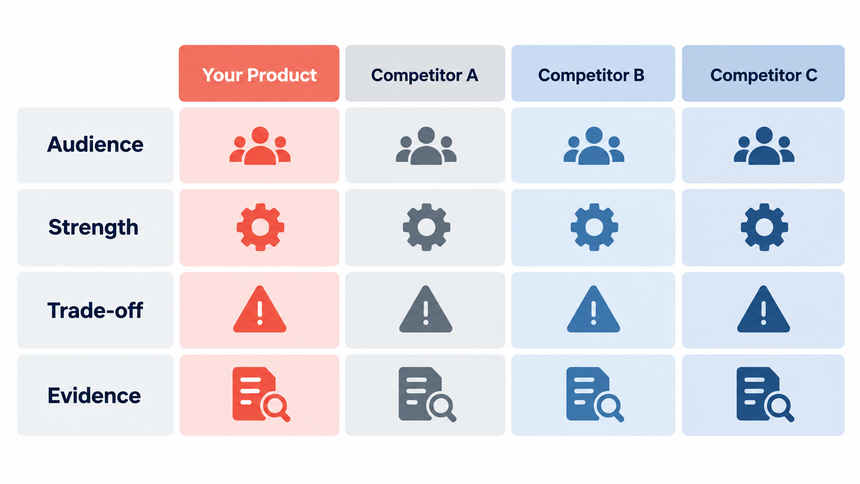
The matrix is the center of the deck, so define the rows before collecting scores. Each criterion should describe a buyer-relevant job, have a clear evidence rule, and use the same scale for every product.
| Criterion | Definition | Evidence to collect |
|---|---|---|
| Core workflow coverage | How completely the product supports the target job | Documented steps, tested workflow, or a verified limitation |
| Output control | How much the user can edit, brand, export, or reuse the result | Demo, help documentation, or product test |
| Time to useful result | Effort from first input to a result the buyer can share | Repeatable task test with the same starting conditions |
| Collaboration | How easily a team reviews, comments, and hands off work | Permission model, review flow, and export behavior |
| Segment fit | How well the workflow matches the chosen buyer and constraints | Customer evidence, pricing context, and required skills |
| Risk or limitation | What could block adoption or create rework | Known gaps, dependencies, uncertainty, or support burden |
Choose a simple scale such as “strong fit,” “partial fit,” and “weak fit” when the evidence is qualitative. A numeric score can be useful when weights and definitions are visible, but decimal precision does not make subjective evidence more accurate. Add a note for every non-obvious score and mark unknowns instead of guessing.
Keep the matrix readable. Use short row labels, one visual emphasis color for the focal product, and a footnote for the research date. If the full evidence table is too dense, show the decision rows on the main slide and link each row to an appendix note or source record.
Use a Positioning Map Without Oversimplifying
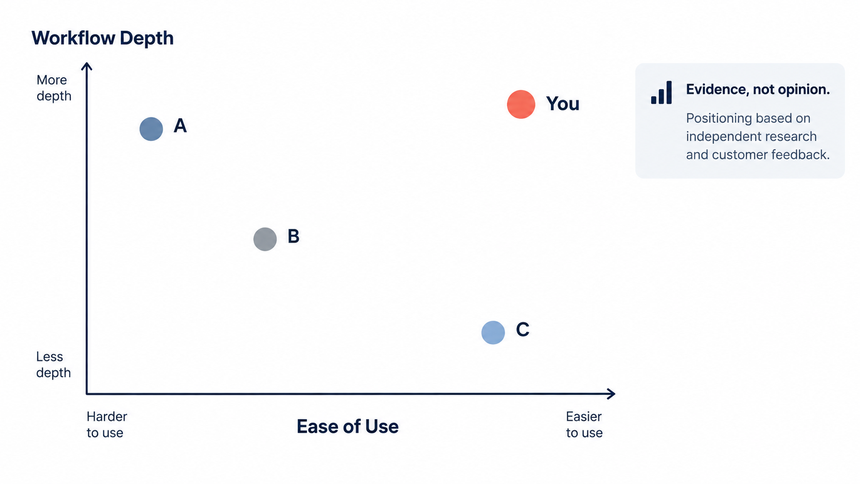
A positioning map is useful when its two axes represent a meaningful trade-off. “Cheap versus expensive” and “simple versus complex” are familiar, but they can hide the reason a buyer actually chooses a product. Ask which two dimensions explain the decision you are trying to make.
- Speed to a usable deliverable versus depth of control
- Self-serve workflow versus guided service
- Individual productivity versus team governance
- Standardized output versus flexible customization
State the unit of analysis and the source for each placement. A product can sit in different positions for a startup buyer and an enterprise buyer. If the map is based on your team’s interpretation, label it as a working hypothesis and list the interview or usage evidence that would confirm it.
Do not use a positioning map as a verdict that one brand is universally better. Use it to identify an open space, a crowded promise, or a mismatch between a competitor’s message and the experience buyers report. Give the map a conclusion such as “the fastest route to a branded first draft is under-served” rather than “we are the winner.”
Turn Research into an Action Plan
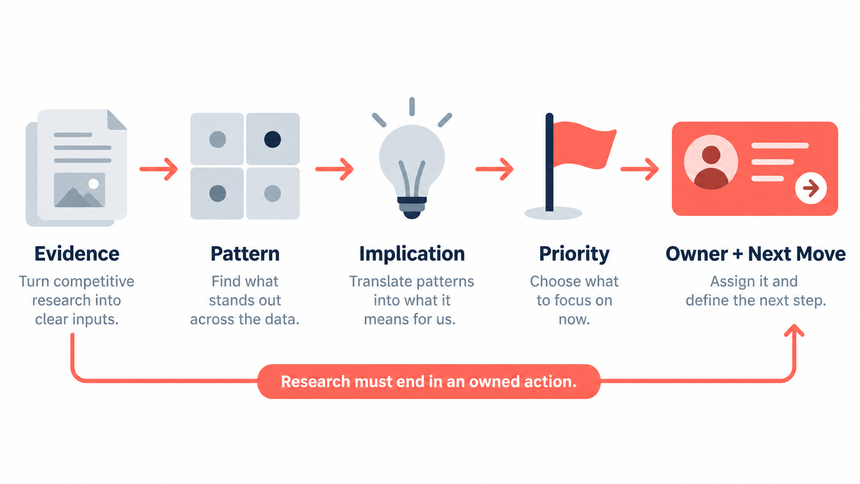
The final analysis should change what the team does. Translate each meaningful gap or advantage into an action type, an owner, a signal, and a review date.
| Action type | When to use it | Example next step |
|---|---|---|
| Differentiate | A buyer job is important and competitors are weak | Build proof and messaging around the job |
| Close a gap | The gap blocks a high-value segment | Validate the smallest workflow improvement |
| Reposition | The product is strong but the message is generic | Test a sharper promise on a focused page |
| Defend | A strength is easy for competitors to copy | Document proof, retention, or switching value |
| Investigate | The evidence is mixed or incomplete | Run interviews, trials, or a pricing test |
Write recommendations as decisions, not observations. “Competitor B has more integrations” describes the market. “Prioritize the two integrations named in lost-deal notes and review activation after one release” creates work that can be measured.
Structure and Present the Competitive Analysis Deck
Build a reusable competitive analysis slide sequence
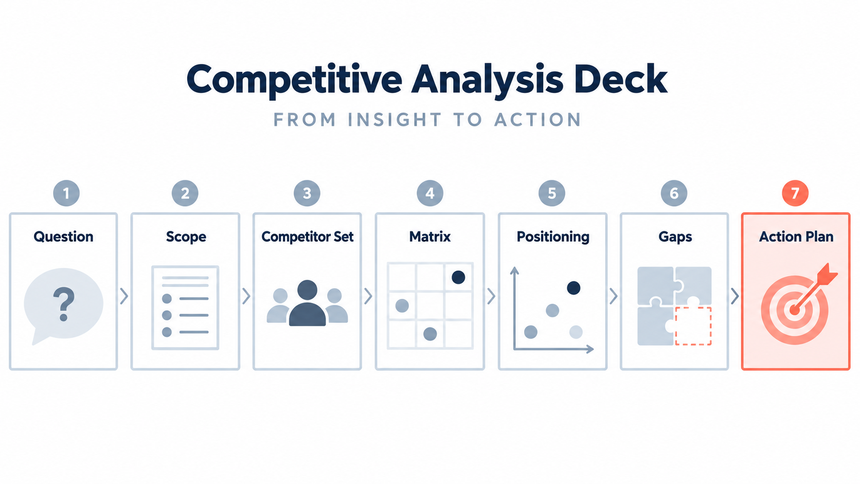
A reusable deck should preserve the reasoning path while allowing the market facts to be refreshed. This 10-slide sequence works for a product review or a go-to-market decision:
| Slide | Purpose | Essential content |
|---|---|---|
| 1. Decision | State the choice | Recommendation, audience, and decision date |
| 2. Market frame | Define the job | Segment, use case, scope, and exclusions |
| 3. Competitor set | Explain the comparison | Direct, adjacent, status quo, and selection logic |
| 4. Matrix | Compare the same criteria | Definitions, scores or fit labels, and evidence notes |
| 5. Positioning map | Show the trade-off | Axes, unit of analysis, placements, and uncertainty |
| 6. Buyer evidence | Ground the interpretation | Reviews, interviews, win-loss notes, or product tests |
| 7. Win and lose | Prioritize the insight | Where we win, where we lose, and why it matters |
| 8. Strategic options | Make alternatives visible | Differentiate, close, reposition, defend, or investigate |
| 9. Action plan | Assign the next move | Owner, timing, expected signal, and review date |
| 10. Appendix | Support scrutiny | Sources, test conditions, scoring notes, and full matrix |
Keep slide titles assertive. “The fastest workflow is under-served for small marketing teams” is more useful than “Positioning.” The assertion tells the audience how to read the evidence and makes a later update easier: the team can confirm, revise, or reject the claim.
Present the matrix clearly
When a matrix or map is dense, reduce the number of ideas on the main slide. Use a short headline, five to seven rows, and a clear visual hierarchy. Keep the explanation close to the chart so the audience does not have to remember which shade means “unknown.” For additional guidance on choosing and labeling comparison visuals, see Presenti’s comparison charts in presentations guide.
Use the appendix for detailed feature notes, but do not hide the scoring logic there. The decision-maker should be able to understand what a strong fit means without opening another document. If a row is not relevant to the stated buyer, remove it instead of allowing it to distort the visual balance.
Build and Review the Deck with Presenti AI
Build the draft with Presenti AI
Once you have the comparison question, evidence, and recommendation, use Presenti to draft the slides. Include the competitor definitions, criteria, evidence labels, map axes, and proposed actions in your outline. In Text to Presentation, specify the audience, competitors, and slide order so the draft follows your research.
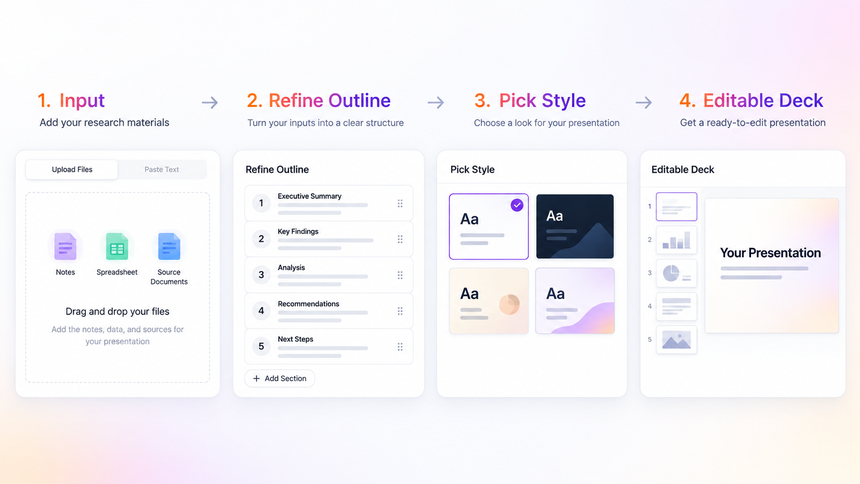
Use Presenti presentation templates when the deck needs a consistent visual system. A comparison slide should make differences easy to scan, not add decorative complexity. If the analysis contains a long evidence chain, the data storytelling workflow can help you move from context to claim to decision.
Review every generated slide against the research ledger. Confirm that a score has not become a factual claim, that a map axis still means what the analysis says, and that a competitor limitation is not presented as permanent. AI can accelerate layout and wording; it cannot replace product testing, source checks, or the final strategic judgment.
Common competitive analysis mistakes
Listing features without a buyer job
A longer feature list does not prove a better choice. Connect each criterion to a task, risk, or outcome that matters to the selected segment.
Scoring from memory
Memory favors familiar brands and recent demos. Record the test conditions and source for every meaningful comparison, and mark an unknown as unknown.
Treating a price-quality map as a verdict
Price and quality are not single universal dimensions. Explain which buyer and job define the axes, then test whether the map predicts a real choice.
Letting a snapshot become permanent
Pricing, features, messaging, and product experience change. Put a research date on the slide and assign an owner for the next refresh.
Ending with a winner
A market rarely has one universal winner. End with the segment, promise, and action your team can realistically pursue.
Resolve Disagreements Before the Meeting
If two reviewers give a product different scores, compare what they tested. They may have used different plans, versions, or buyer scenarios. Record those conditions beside the result. If the evidence is still incomplete, mark the criterion as unknown and explain whether it could change the recommendation.
Frequently Asked Questions
What is a competitive analysis presentation?
It is a structured visual comparison that supports a strategic decision. It defines the buyer job, competitor set, criteria, evidence, positioning, and next action instead of presenting an unranked list of features.
How many competitors should a deck include?
Include the smallest set that can change the decision. Three to five products often fit a main matrix; place additional names and the selection logic in the appendix. Add the status quo when doing nothing is a realistic alternative.
What should a competitive matrix measure?
Measure the jobs and constraints that matter to the selected buyer: workflow coverage, output control, time to useful result, collaboration, segment fit, and adoption risk are common starting points. Define every row before assigning a score.
When should I use a positioning map?
Use one when two meaningful dimensions explain a trade-off in the decision. Label the buyer, unit of analysis, evidence, and uncertainty. Avoid a map that only repeats familiar price and quality assumptions.
Can AI create a competitive analysis deck?
AI can turn a verified outline into a first draft, suggest slide titles, and improve consistency. It should not invent competitor facts, hide uncertainty, or select a strategy without human review of the evidence and the decision context.
Make the Decision Clear
A useful competitive analysis helps the team choose between realistic options. Keep the main deck focused on the buyer, the most consequential differences, and your recommendation. Put detailed tests and sources in the appendix so colleagues can examine the comparison without losing the thread of the meeting.
When your evidence and recommendation are ready, try Presenti AI for free, then review every generated slide against your research before sharing it.