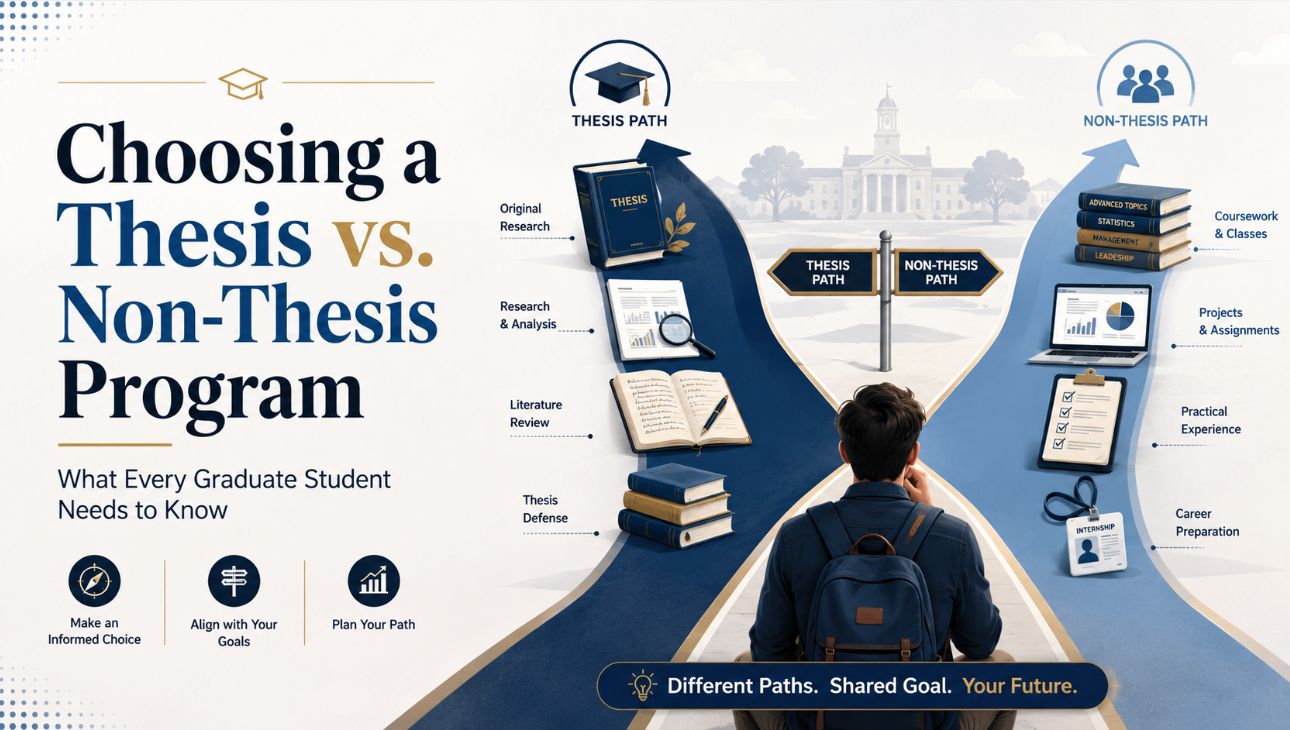
If you’re applying to graduate school, one decision will shape your entire experience more than any other: choosing a thesis vs. non-thesis program. It affects how you spend your time, what skills you build, and where your degree takes you. Yet most applicants spend more energy picking a school than thinking through this fundamental fork in the road.
This guide cuts through the noise. Whether you’re a mid-career professional eyeing an MBA, a scientist considering research, or a teacher looking to advance, here’s everything you need to make a confident, well-informed choice.
What Is a Thesis Program?
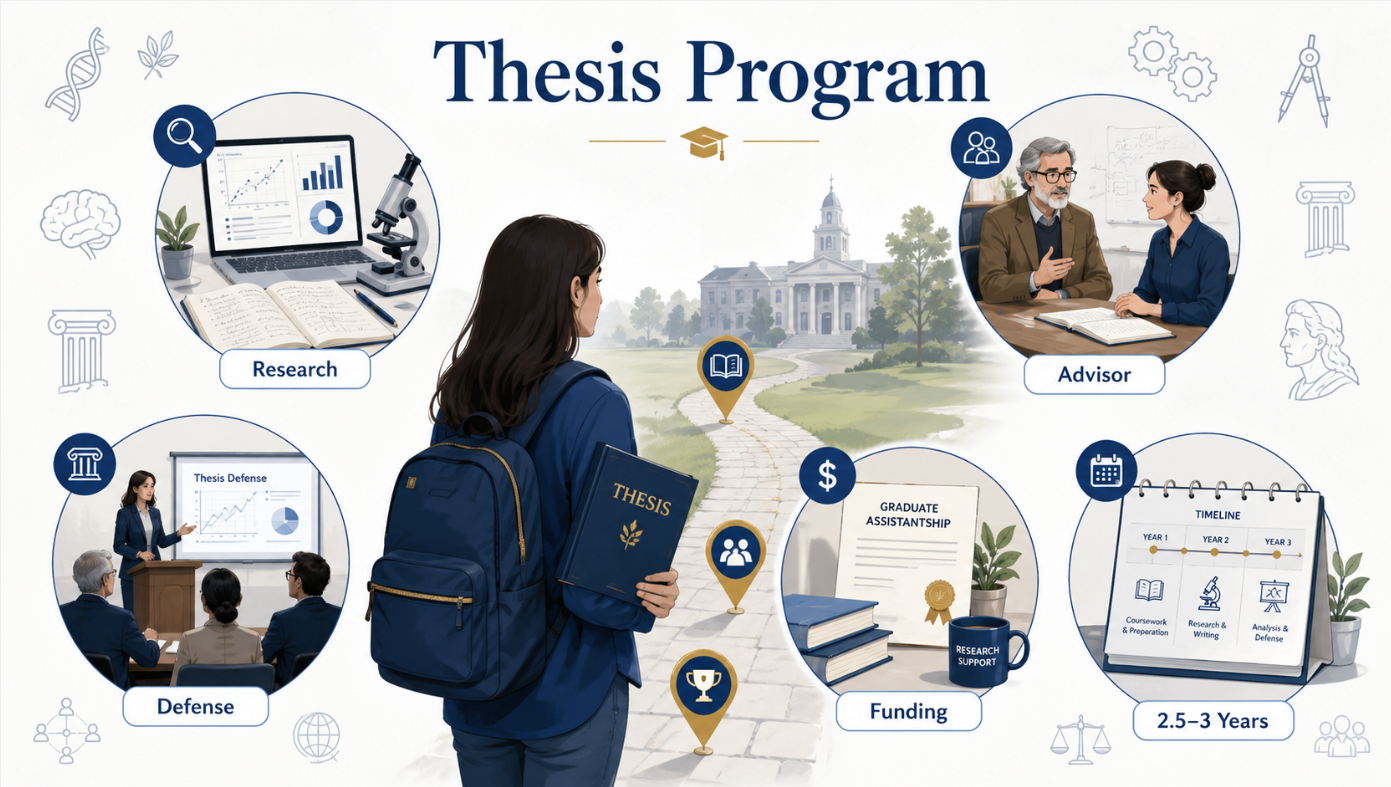
A thesis program is a graduate degree track that requires students to conduct original, independent research and present their findings in a formal written document — the thesis. The document length and defense requirement are set by the program.
Thesis programs are common in research-heavy fields: biology, psychology, history, engineering, and the social sciences, among others. They’re designed to train students in scholarly inquiry, critical analysis, and the production of new knowledge.
Key characteristics of thesis programs:
- Original research requirement: You identify a research gap, design a study, gather data, and draw conclusions.
- Faculty advisor relationship: A professor guides your work closely over months or years.
- Public defense: You present and defend your findings to a committee.
- Funding opportunities: Many thesis students receive stipends, teaching assistantships, or research grants.
- Research milestones: Completion depends on the program schedule and progress of the project.
The Council of Graduate Schools provides resources on graduate education. For doctoral preparation, check the research experience expected by your target programs.
What Is a Non-Thesis Program?
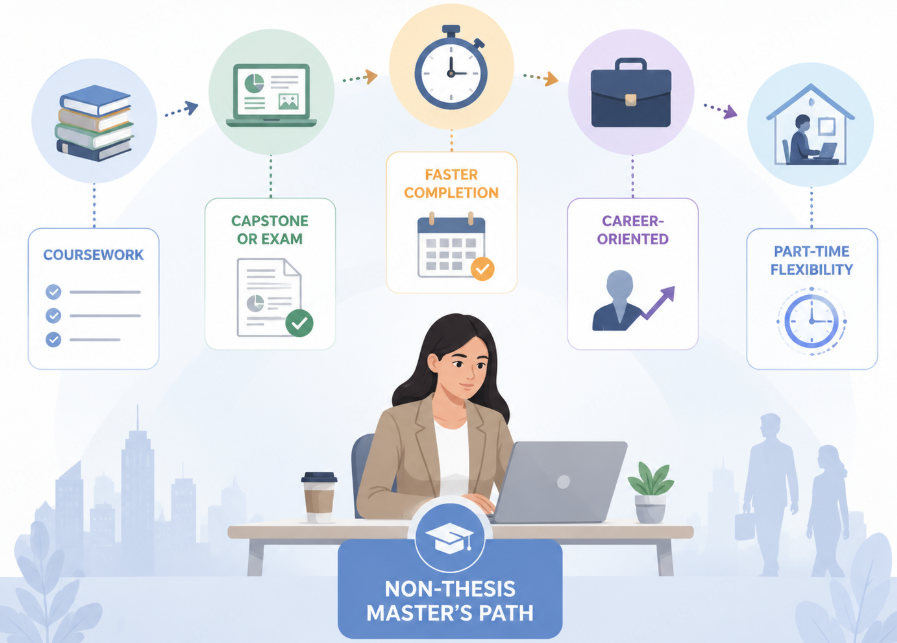
A non-thesis program is a graduate degree track focused on coursework, applied skills, and professional practice rather than original research. Instead of a thesis, students typically complete a capstone project, comprehensive exam, portfolio, or professional practicum.
Non-thesis programs dominate fields like business, education, public health, social work, and information technology. They’re built for professionals who want advanced knowledge and credentials without the long runway of academic research.
Key characteristics of non-thesis programs:
- Coursework-intensive: You take a prescribed set of courses, often with some elective flexibility.
- Capstone or exam: A final integrative project or exam demonstrates mastery.
- Defined milestones: Check the coursework, placement, exam, or capstone schedule.
- Career-oriented: Curriculum maps directly to professional roles and industry needs.
- Part-time options: Many non-thesis programs accommodate working professionals.
Thesis Program vs. Non-Thesis Program: Key Differences
Understanding the thesis program vs. non-thesis program distinction becomes clearer with a side-by-side comparison.
| Factor | Thesis Program | Non-Thesis Program |
|---|---|---|
| Primary focus | Original research | Applied coursework |
| Final requirement | Written thesis + defense | Capstone, exam, or portfolio |
| Typical duration | Check the published research-track duration | Check the published coursework/capstone duration |
| Ideal for | Future PhD students, researchers | Working professionals, career changers |
| Cost | Funding depends on the offer and eligibility | Check scholarships, employer support, and tuition |
| Class structure | Fewer courses, more independent work | More structured courses |
| Workload type | Self-directed, research-driven | Structured, deadline-driven |
| Industry recognition | Strong in academia and R&D | Strong in business, healthcare, tech, education |
| Flexibility | Check advisor, research, and enrollment requirements | Check delivery mode and required attendance |
| PhD pathway | Highly recommended | Check the target doctoral program’s entry criteria |
Factors to Consider When Choosing a Thesis vs. Non-Thesis Program
There’s no universally “better” option. The right choice depends on several personal and professional factors. Work through each one honestly.
1. Your Career Goals
This is the single most important factor. Ask yourself: where do you want to be in five years?
If you’re aiming for a PhD program, academic research, or a role in R&D, a thesis is almost always the stronger choice. Research experience signals intellectual capability to doctoral admissions committees and hiring managers in labs and universities.
If you’re targeting corporate management, healthcare administration, technology leadership, or education administration, a non-thesis degree typically carries equal or greater weight. Employers in these sectors care about applied skills, not academic publications.
2. Your Learning Style
Thesis programs reward independent thinkers who can tolerate ambiguity, manage long-horizon projects, and stay motivated without daily structure. If you thrive on open-ended inquiry, the thesis track will feel energizing.
Non-thesis programs suit people who learn best through structured instruction, collaborative projects, and clear deadlines. If you’re re-entering academia after years in the workforce, this environment often feels more natural.
3. Time and Financial Constraints
Compare published completion times, required credits, course scheduling, research milestones, and placement requirements. Part-time options may matter more to your schedule than the thesis label.
Compare the full funding offer: tuition, fees, stipend, assistantship workload, duration, and renewal conditions. Funding varies by institution and program; neither track guarantees support. Check employer reimbursement separately.
4. Field Norms
Expectations vary within each field. Look at the research experience or professional accreditation required by your target role, then compare programs against those requirements.
Do your research. Look at job postings in your target field. Talk to alumni from both tracks. Resources such as LinkedIn’s Workforce Insights can provide labor-market context. For a program comparison, examine its reported graduate outcomes and how they were measured.
5. Your Appetite for the Research Process
This is underrated. The thesis isn’t just a long paper — it’s a 1 to 2-year relationship with a single question. You’ll hit dead ends, revise your methodology, and rewrite sections your advisor marks up in red. It’s deeply rewarding for some people. It’s deeply frustrating for others.
Be honest with yourself. If your excitement about graduate school is about gaining expertise quickly and applying it professionally, the non-thesis track respects that goal entirely.
Which Option Is Right for You?
Here’s a practical decision framework for thesis vs non-thesis master’s degree selection:
Choose a thesis program if you:
- Plan to apply to PhD programs after graduation
- Want a career in academic research, university teaching, or scientific R&D
- Are in a field where research experience is expected (biology, psychology, engineering, social sciences)
- Have secured funding and can commit to a longer timeline
- Thrive in self-directed, open-ended work environments
Choose a non-thesis program if you:
- Are a working professional who needs to balance studies with a current job
- Want to re-enter or advance in industry roles quickly
- Are in business, healthcare, education, technology, or public administration
- Want a structured curriculum with clear milestones
- Need flexibility — online, part-time, or evening formats
Some programs offer both tracks. Ask when the choice must be made, whether switching is allowed, and how it affects supervision, credits, funding, and the completion date.
If you’re presenting your graduate school research and decision process to mentors, admissions consultants, or colleagues, organizing your thinking visually can sharpen your reasoning. Tools like Presenti let you turn complex comparisons and decision frameworks into clear, professional presentations — useful when you’re walking someone through your rationale.
Graduate Program Options: Common Misconceptions
When exploring graduate program options, a few persistent myths cloud judgment.
Myth 1: “A thesis automatically makes your degree more prestigious.”
Not true in most fields. Prestige comes from the institution, your GPA, your professional experience, and what you do after graduation — not the format of your final requirement.
Myth 2: “Non-thesis programs are easier.”
Many non-thesis programs are academically rigorous. Capstone projects in MBA or public health programs can be intensive, real-world consulting engagements. “No thesis” does not mean “less work.”
Myth 3: “You can’t do a PhD without a thesis master’s.”
Some doctoral programs accept non-thesis master’s graduates, particularly if those applicants can demonstrate research aptitude through other means — research projects, a writing sample, or research assistantships. Requirements vary; test scores alone do not demonstrate research experience.
A Note on Presenting Your Decision
Graduate school involves a lot of communication: interviews, personal statements, scholarship applications, and conversations with potential advisors. Whether you’re explaining why you chose a thesis track to a PhD committee or presenting a capstone project to industry sponsors, how you communicate your thinking matters.
Strong presentation skills complement strong academic work. Presenti’s AI presentation tool helps you structure complex arguments, visualize data, and deliver polished decks — whether you’re in graduate school or advancing your career beyond it. You can also explore Academic Research Presentation Template Guide that translates dense academic content into clear, audience-ready slides.
Conclusion
Choosing a thesis vs. non-thesis program isn’t a question of which is better — it’s a question of which is better for you. The thesis track is the right path for aspiring researchers, future doctoral students, and those who want deep engagement with a single scholarly question. The non-thesis track is the right path for professionals who want advanced credentials, applied skills, and a faster return to their careers.
Know your goals. Understand your field’s norms. Be honest about your learning style and financial situation. And talk to people who’ve walked both paths before committing.
Compare the actual curriculum, supervision, funding, and completion requirements before committing.
Looking to organize your graduate school research or present your findings professionally? Try Presenti to create clear, compelling presentations in minutes.