Anyone who's run a classroom debate has seen both failure modes: the room that goes dead silent, and the room that gets so worked up over an objectively ridiculous topic that you can't get people to stop talking when time's up.
The difference almost always comes down to topic selection. Topics that ask "which do you prefer" instead of "which is correct," topics rooted in everyday experience, topics without one obvious right answer — these get people talking without any extra effort from the facilitator. Topics with an obvious answer, or where one side is left defending the indefensible, kill the energy no matter how well you run the session. When turning this material into slides for a class, Presenti’s education presentation workflow provides a starting point for the draft.
This guide doesn't just list 100 topics — it walks through the actual structure behind why certain topics spark better debates than others, so you can build your own list once you've seen the pattern. After the topic lists, we'll also cover how to actually run the debate itself, and how to generate the discussion slides using Presenti AI.

Why "Fun" Topics Spark Better Debates

A debate is a structured argument between two sides on a given topic — used everywhere from competitive debate leagues to classroom exercises built to strengthen critical thinking and public speaking. Whether it's a graded academic activity, a mock job interview group discussion, or a corporate training session, the underlying goal is the same: practice turning your opinion into a case you can defend, and practice actually listening to someone else's.
Most debates fail in one of two ways.
The topic is too heavy. Something like capital punishment or nuclear energy policy carries enough weight and knowledge disparity between participants that the group burns most of its time just establishing shared context — and because these topics connect directly to personal values, the room can turn tense fast.
The topic has an obvious answer. A prompt like "should bullying be allowed" leaves no real opposing case to build. Someone gets stuck defending a position that doesn't hold up, and nobody actually enjoys the exercise.
A topic that actually generates energy tends to satisfy three conditions:
- Both sides have a legitimate case. Each side can list multiple genuinely persuasive reasons, not just one weak talking point propped up against a strong one.
- It connects to everyday experience. Something like "cats or dogs, which is the easier pet" lets everyone speak from their own life instead of researched facts alone.
- There's a bit of humor built in. A little absurdity lowers the stakes enough that people stop overthinking whether their point sounds "smart" and just start talking.
Topics that hit all three tend to work for total beginners and experienced debaters alike.
A Quick Note on Psychological Safety
From a behavioral standpoint, people speak up more freely in an environment where being "wrong" just gets a laugh instead of a real consequence. A lighter topic is, in that sense, a deliberate design choice rather than a lack of seriousness.
Weak logic gets carried by humor instead of embarrassment. Getting rebutted doesn't sting. Getting assigned the "wrong" side of an argument is still fun rather than frustrating. That sense of safety increases how much everyone talks, which in turn raises the quality of the whole session. If you're running debates for teaching purposes, establishing this safety net first — starting light and raising the difficulty gradually — is a well-supported approach.
3 Rules for Picking a Great Debate Topic
If you're stuck choosing a topic, running it through these three checks will save you from most bad picks.
Rule 1: Check That It's Actually Arguable
Before locking in a topic, try writing three reasons for each side yourself. If one side can't produce at least three real reasons, the topic is probably lopsided.
For: allows more choice in independent study, protects sleep time, removes inequality caused by differing home environments.
Against: reinforces daily learning habits, provides review opportunities, ensures a baseline amount of practice.
When both sides can produce concrete, specific reasons, the discussion has real room to develop.
Rule 2: Lower the "Empathy Cost"
Empathy cost is the mental effort it takes someone to form an opinion on a topic at all. Topics requiring specialized knowledge or deep familiarity with a social issue carry a high empathy cost. Everyday topics carry a low one — everyone can weigh in immediately.
High cost: "Does AI violate copyright law?" (requires background knowledge). Low cost: "Cereal or eggs — what's the better breakfast?" (everyone already has an opinion).
For groups with a lot of beginners, classroom settings, or people meeting for the first time, sticking to low empathy-cost topics makes it much easier for everyone to jump in.
Rule 3: Balance Humor and Seriousness
The best topics carry both humor and genuine stakes — leaning too far in either direction throws off the balance.
- Too silly: "Does air taste good?" — runs out of steam almost immediately.
- Too serious: "Should the country accept more immigration?" — tends to make the room tense.
- Well balanced: "Remote work or the office — which is actually more productive?" — playful enough to stay fun, substantial enough to argue seriously.
Exactly where that balance point sits shifts depending on the age and setting of your group — which is what the scenario-based lists below are built around.
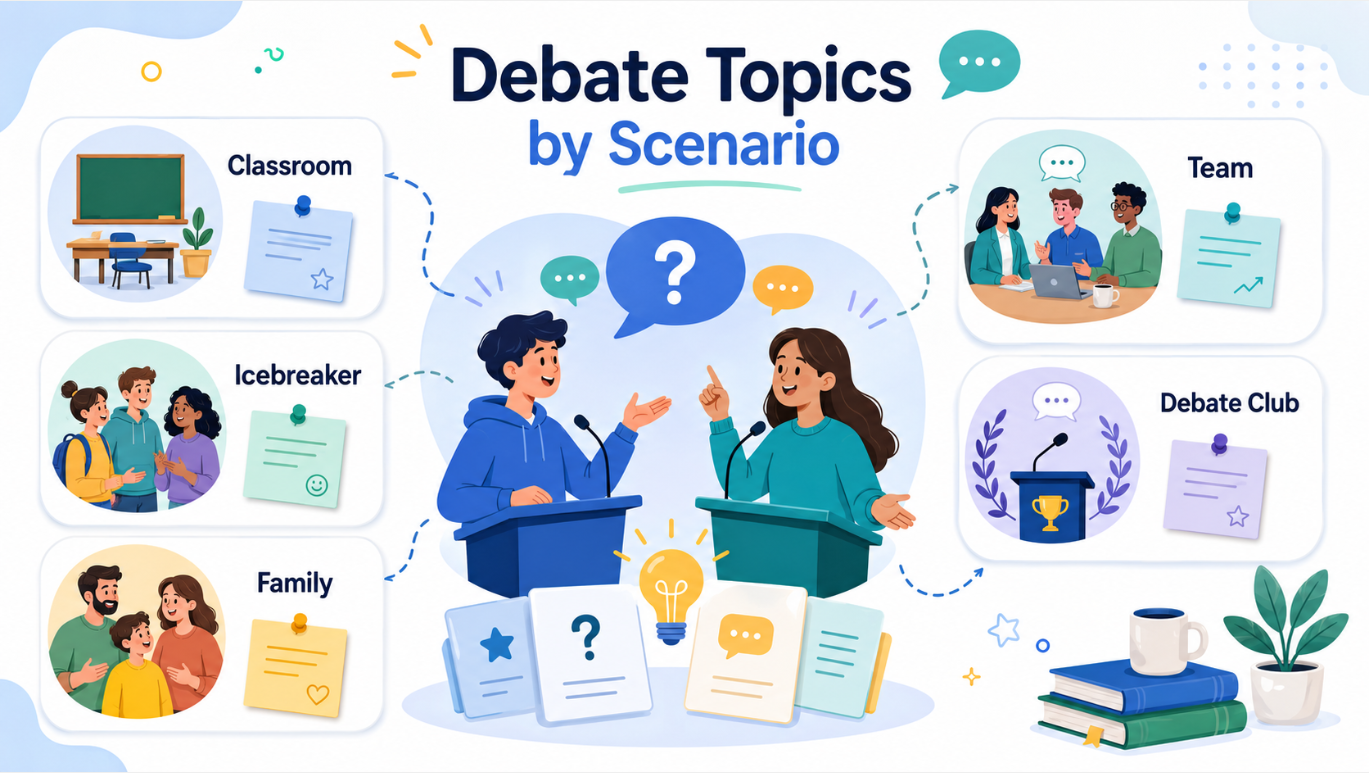
100 Fun Debate Topics by Scenario
Each topic below includes a short note on why it tends to spark good discussion — useful if you're building your own list beyond what's here.
🏫 20 Debate Topics for High School Classrooms
High school topics land best when they connect directly to students' own school life — they also double as a soft entry point into bigger social issues.
| # | Topic | Why it works |
|---|---|---|
| 1 | School uniforms should be required rather than free dress | Directly affects every student, so everyone has a stake |
| 2 | Phones should be allowed in school | Already a lived, concrete issue for students |
| 3 | Participation in sports or clubs should be mandatory | Allows discussion of choice, access, and school priorities |
| 4 | Homework should be abolished | Rich, specific reasons on both sides |
| 5 | Tests should be graded by AI instead of teachers | Mixes interest in technology with fairness concerns |
| 6 | PE class time should be reduced | Allows discussion of time, health, and curriculum priorities |
| 7 | Cafeteria lunch vs. packed lunch — which is better for schools | Varies by region, giving multiple angles to argue |
| 8 | Grades should include class participation, not just test scores | Pits fairness against recognizing different strengths |
| 9 | The minimum age for social media should be raised | Directly affects students, so it gets emotional fast |
| 10 | School trips: in-country vs. abroad — which is better | Everyone has an opinion and a concrete proposal |
| 11 | High schoolers should be allowed to hold part-time jobs | Ties into the real tension between school and work |
| 12 | Textbooks should be fully replaced by tablets | Convenience vs. learning effectiveness, a live modern debate |
| 13 | Subjects with no obvious future use should be optional | Forces a deeper debate over what "useful" even means |
| 14 | Student government actually accomplishes anything | A close-to-home question about school democracy |
| 15 | Group chats with classmates help more than they hurt studying | Produces specific personal stories on both sides |
| 16 | Dating should be banned in school | Emotion vs. rules makes for a lively exchange |
| 17 | Students should get a say in writing school rules | A deep question about autonomy vs. oversight |
| 18 | Teams should field everyone equally instead of only starters | Competition vs. fairness, a genuine values clash |
| 19 | Using AI to help with homework counts as cheating | A core ethics-vs-efficiency question for this generation |
| 20 | The voting age should be lowered below 18 | Political engagement and youth voice, a substantial topic |
🎓 20 Debate Topics for College Students & Career-Prep Discussions
College-level topics work well when they touch on social issues and the world of work — they also double directly as practice for job-interview group discussions.
| # | Topic | Why it works |
|---|---|---|
| 21 | A four-day workweek should become standard | A clean tradeoff between output and rest |
| 22 | Remote work vs. the office — which is better for companies | Allows comparison of different jobs and working arrangements |
| 23 | Guaranteed long-term employment should make a comeback | Surfaces real differences in career values and risk appetite |
| 24 | Big companies vs. startups — which is better for new grads | Directly relevant to anyone job hunting |
| 25 | All employees should be allowed to take on side work | A modern clash between freedom and company loyalty |
| 26 | AI will destroy more jobs than it creates | Mixes real anxiety with real optimism |
| 27 | College credit should be based on output, not attendance | A topic students genuinely care about |
| 28 | Online interviews vs. in-person — which is fairer | Pits equal access against how well it captures a candidate |
| 29 | Anonymous posting on social media should be restricted | A hard modern tension between free speech and harassment |
| 30 | College tuition should be free | Balances equal access against how it gets funded |
| 31 | Universities should train specialists rather than generalists | A deep question about the purpose of a degree |
| 32 | Promotions should go by merit rather than seniority | Splits opinion between fairness and experience |
| 33 | Changing jobs often is "ambition," not "disloyalty" | Reflects a real generational shift in career norms |
| 34 | AI-driven hiring decisions are fair | Pits trust in technology against trust in human judgment |
| 35 | Extracurriculars matter more to employers than GPA | Lets students argue from real activity experience |
| 36 | Starting a business beats getting a job in your 20s | The classic risk-vs-stability debate |
| 37 | Remote work will drive more people to relocate to smaller cities | A live question about urban concentration and revival |
| 38 | Internships should be fully separated from hiring decisions | Close to home for students, with a clear split of opinion |
| 39 | Equal pay for equal work is actually achievable | Pits ideals against entrenched practice |
| 40 | Filtering candidates by which school they attended should stop | Hits a nerve almost every job seeker has felt |
👶 15 Debate Topics for Elementary & Middle School
The trick with younger students is picking topics grounded in things they already live through daily — challenging enough to think about, but never over their heads.
| # | Topic | Why it works |
|---|---|---|
| 41 | Summer break should be longer, not shorter | Everyone already has a clear opinion |
| 42 | Dogs or cats — the better pet | Even fellow animal lovers split on this one |
| 43 | Video games should be capped at one hour a day | Tied directly to kids' own daily lives |
| 44 | It's okay to leave food on your plate at lunch | A close-to-home question of rules vs. personal freedom |
| 45 | It's okay to stay home on days you don't feel like going to school | Simple on the surface, surprisingly deep underneath |
| 46 | Pizza or tacos — America's favorite comfort food | Food preferences split people fast |
| 47 | Pancakes are a better breakfast than cereal | Often reflects each kid's home habits |
| 48 | Staying up late to study before a test actually helps | Everyone has a specific personal story to share |
| 49 | Studying with friends is more effective than studying alone | Lets kids describe their own study style |
| 50 | Swim class should still be required at school | Opinions split clearly and energetically |
| 51 | Kids should get as much allowance as they want | Mixes money management with parenting philosophy |
| 52 | Reading books trains your brain better than video games | A familiar media comparison with easy opinions on both sides |
| 53 | Every runner in a race should finish in a tie | Gets kids thinking about competition vs. fairness |
| 54 | It's fine to call teachers by their first name | Pits respect against a more relaxed relationship |
| 55 | Homework should be replaced with a free choice activity | Balances independence against structure |
💕 15 Debate Topics for Parties, Icebreakers & Dating
These work especially well when a group is meeting for the first time or just starting to loosen up — differences in values naturally become conversation material.
| # | Topic | Why it works |
|---|---|---|
| 56 | One person should always initiate the first date | Value differences surface immediately |
| 57 | Anniversaries should be celebrated monthly, not once a year | Splits cleanly between detail-oriented and easygoing types |
| 58 | Fast texting back is better than taking your time | Communication style differences come out clearly |
| 59 | Dates should be carefully planned rather than spontaneous | Reveals personality and leads to natural conversation |
| 60 | Splitting the bill before dating vs. after — what's more natural | Mixes gender norms and money attitudes |
| 61 | Long-distance relationships can actually last | People with real experience bring strong opinions |
| 62 | Friends or a partner — who takes priority | A simple question that still tests real values |
| 63 | It's fine to stay close with opposite-sex friends after marriage | Splits between rules-based and trust-based views |
| 64 | Following your crush's social media is acceptable | Tests modern dating etiquette |
| 65 | Couples should live together before marriage | Surfaces genuinely personal values |
| 66 | Looks or personality — which matters more at first | Nearly everyone already has an opinion |
| 67 | Experience gifts beat physical gifts for birthdays | Prompts specific, fun personal stories |
| 68 | You should be close friends with your partner's friends too | Boundaries differ a lot person to person |
| 69 | Marrying someone in the same profession is a good idea | Gets people thinking about lifestyle overlap |
| 70 | Meeting online will become the normal way to date | A live conversation about how dating is changing |
😂 15 Playful and Absurd Debate Topics
The whole point of these is the absurdity — the more seriously people argue them, the funnier they get. Great as icebreakers or warm-ups before a heavier debate.
| # | Topic | Why it works |
|---|---|---|
| 71 | Ketchup or hot sauce on scrambled eggs | A near-universal condiment debate |
| 72 | You should always finish the broth in your ramen or soup | Health concerns vs. the satisfaction of finishing |
| 73 | The pizza crust should be eaten, not left on the plate | Individual eating habits become surprisingly heated |
| 74 | A firm mattress beats a soft one | Directly reflects everyone's daily habits |
| 75 | Cereal should stay crunchy, not go soggy | So small it somehow gets everyone fired up |
| 76 | Escalators should have a dedicated walking side | Splits along city vs. regional habits |
| 77 | Spicy food beats mild food, no contest | A spice-tolerance debate that reveals surprising values |
| 78 | Showering in the morning beats showering at night | A fun window into everyone's routine |
| 79 | A house feels better with a dog than a cat | Even pet lovers will fight for their side |
| 80 | Over-ear headphones look cooler than earbuds | Looks vs. function, endlessly arguable |
| 81 | Summer is a better season than winter | A gut-feeling topic everyone can join instantly |
| 82 | A rugged phone case beats a stylish one | The eternal function-vs-form question |
| 83 | You should get up at the very first alarm, no snoozing | A universally lived experience, guaranteed to get laughs |
| 84 | "Just a minute" should mean, at most, how many actual minutes | Everyone's internal clock runs differently |
| 85 | Cats or octopuses — which animal is actually smarter | The reasoning process itself becomes the joke |
🌍 15 Advanced Debate Topics on Ethics, Technology & Society
A step up in difficulty from the categories above — well suited to more experienced debaters, upper-level classes, or international and multilingual groups looking for topics everyone can engage with regardless of background.
| # | Topic | Why it works |
|---|---|---|
| 86 | Social media does more harm than good | Everyone has direct personal experience with it |
| 87 | AI will eventually replace most human jobs | Directly relevant to career planning |
| 88 | A second language should be mandatory in schools | Personally meaningful for most students |
| 89 | Online education beats traditional classroom learning | Post-pandemic experience fuels strong opinions on both sides |
| 90 | Zoos should be banned for limiting animal freedom | Animal welfare vs. education and conservation |
| 91 | Fast food should be taxed more heavily | Health policy vs. affordability and personal freedom |
| 92 | Everyone should learn to code, regardless of major | A tech-literacy debate relevant to every student |
| 93 | Space exploration is a waste of money | Big-picture vision vs. practical near-term priorities |
| 94 | Video games are good for mental health | Gamers and non-gamers both hold strong opinions |
| 95 | Remote work is the future of every industry | Real post-pandemic experience backs both sides |
| 96 | The voting age should be lowered to 16 | Political engagement and youth perspective |
| 97 | Celebrities have a responsibility to be role models | Fame, freedom, and public expectations collide |
| 98 | Pineapple belongs on pizza | Deliberately silly, great as a warm-up topic |
| 99 | Reading books beats watching movies for learning | A classic media and learning-style debate |
| 100 | The world would be better off without smartphones | A universally felt tension around technology dependence |
How to Run a Debate: Format, Timing, and the Logic That Wins
Once your topic is set, the next piece is structure. This section covers a standard format used widely in classrooms and career-prep training, plus practical techniques for building an argument that actually persuades.
Standard Debate Format and Timing
Here's a common structure used in classrooms and job-interview group discussion practice — adjust the timing to fit your group size and available time.
| Phase | What happens | Suggested time |
|---|---|---|
| Topic reveal & side assignment | Sides are decided by draw or vote | 2–3 min |
| Prep time | Each team organizes its points and evidence | 5–10 min |
| Opening argument (Side A) | Presents the case and supporting reasons | 3–5 min |
| Opening argument (Side B) | Presents the case and supporting reasons | 3–5 min |
| Cross-examination / rebuttal | Both sides question and challenge each other | 5–8 min |
| Closing statements | Each side delivers a final summary | 2–3 min |
| Judging & debrief | A judge (or the group) decides, then everyone reflects | 5–10 min |
Short on time? Compress opening arguments to two minutes each, cross-examination to three, and closings to one — the structure still holds at a smaller scale.
Building Your Case With the PEEL Structure
A simple, reliable framework for building an opening argument is the PEEL structure:
- P (Point) — state your claim in one sentence
- E (Evidence) — back it with a specific fact or example
- E (Explanation) — explain why that evidence actually supports the claim
- L (Link) — connect back to your original point to close the loop
Illustrative PEEL argument: Replace mandatory repetitive homework with a choice of practice tasks (Point). Insert verified evidence about the students and tasks being discussed (Evidence). Explain how the evidence supports the proposed choice and address the need for sufficient practice (Explanation). Conclude with the specific homework policy you are defending (Link).
Drafting your argument in this shape ahead of time means you're not scrambling to structure your thoughts live, in front of the group.
Attacking the Premise, Not the Person
A common mistake in debate is attacking the opposing conclusion emotionally instead of logically — it rarely persuades anyone.
A far more effective move is challenging the assumption the opposing argument depends on.
Say the other side argues: "Remote work reduces productivity."
❌ Weak rebuttal: "That's just not true — remote work is actually more efficient."
✅ More precise rebuttal: “Does the evidence distinguish job type, home working conditions, and how productivity was measured? A result from one setting may not justify a claim about all remote work.”
Going after the underlying premise doesn't just sound more logical — it genuinely lands better with an audience, who tend to respond with something closer to "huh, good point" than to a flat denial.
Three Ways to Win Over the Audience
In most debate formats, what actually decides the winner is the impression left on the judge or audience — not just technical correctness. Three habits make the same content land harder:
1. Lead with your conclusion. Opening with "I believe A is stronger than B, for three reasons" gives the audience a map before you start walking them through it.
2. Use verifiable evidence. Name the source, explain the measure, and give the relevant context. Do not invent a percentage to make an argument sound authoritative.
3. Save emotional appeal for one closing line. After building your case logically, a single closing line — "and that's exactly why this issue can't be ignored" — lands well precisely because it's rare. Overusing emotional appeal throughout weakens it; saving it for one moment makes it count.
Generate Debate Slides With Presenti AI in Minutes
The part of debate prep that eats the most unexpected time is usually the slides — organizing your argument visually, especially under a tight classroom or training deadline.
This is exactly the gap Presenti AI is built to close.
What Presenti AI Does
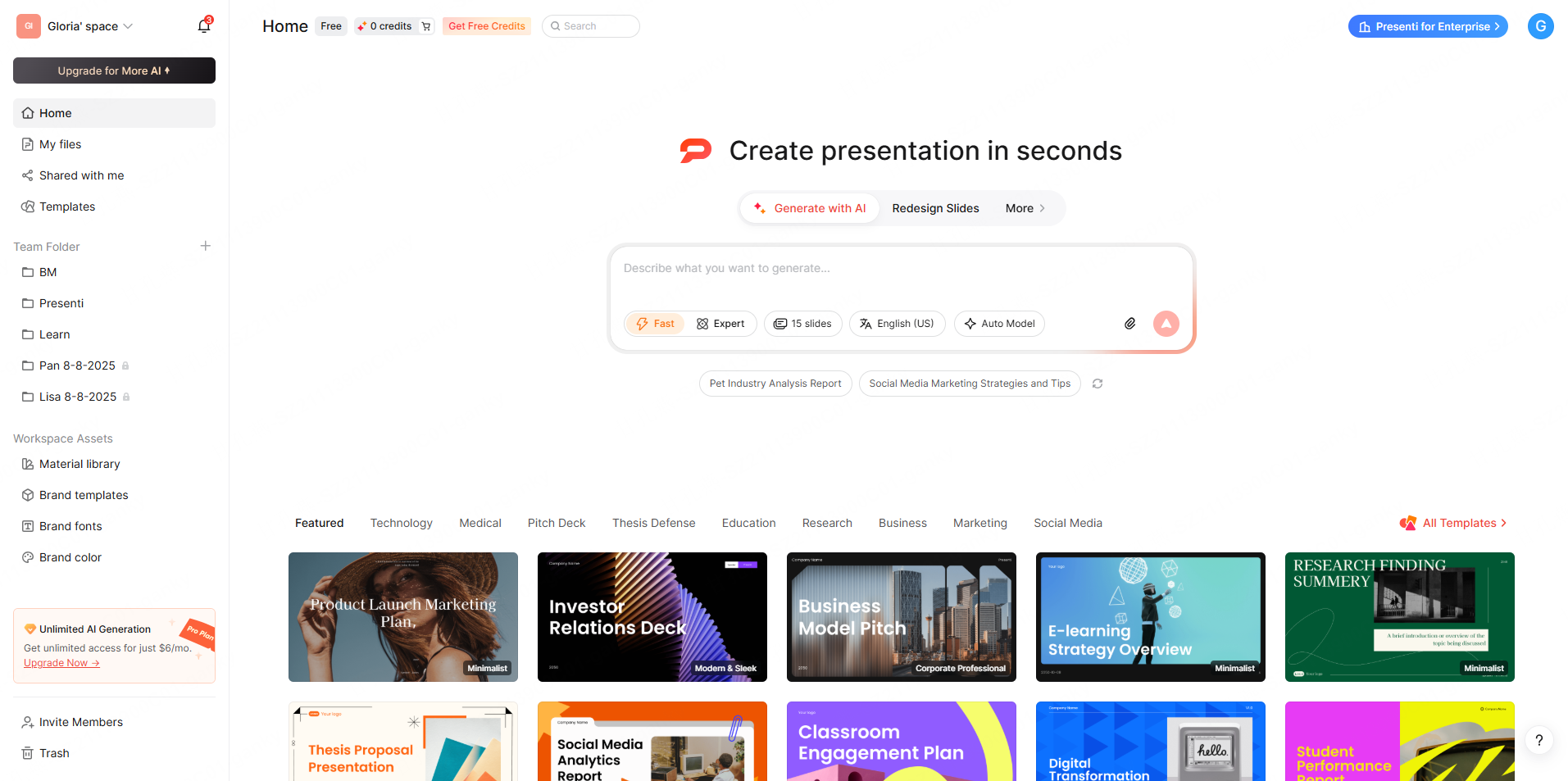
Presenti AI is an AI presentation generator that accepts a range of inputs — typed text, a pasted URL, an uploaded PDF, Word document, or Markdown file. You describe your topic and points, and it automatically builds the slide structure, layout, and design. Presenti can provide an initial layout while you review the content and design, so your prep time goes into the actual argument instead.
Why Debates Benefit From Slides at All
Visualized arguments are more persuasive. A slide laying out claim → evidence → conclusion is easier for an audience to follow than the same content delivered purely verbally.
Building the deck sharpens your thinking. The act of laying out slides forces you to check whether each piece of evidence actually supports your claim, and whether your logic flows in the right order.
It builds confidence for less experienced speakers. Having your structure visible on screen gives nervous presenters something to anchor to while they talk.
How to Generate Debate Slides With Presenti AI
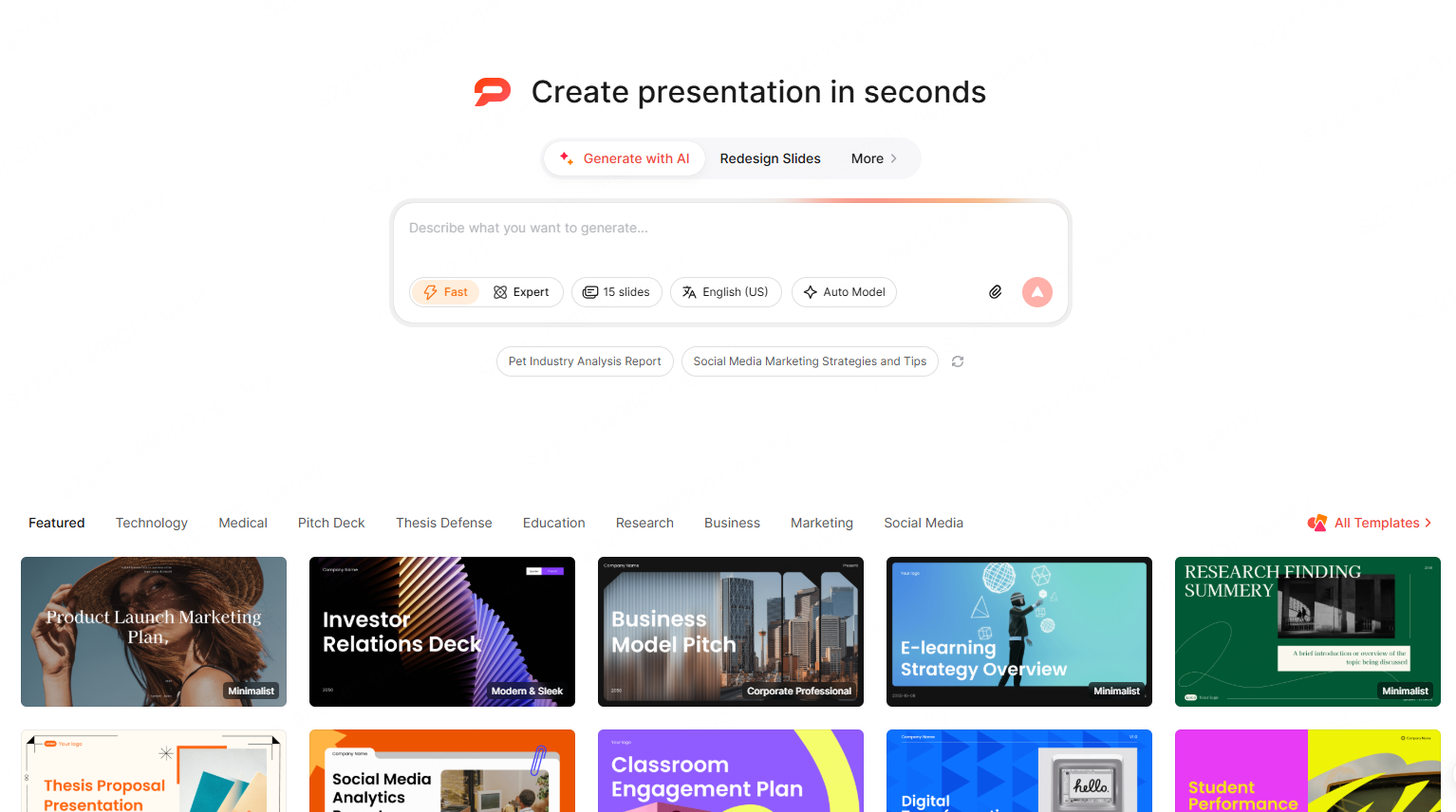
Step 1: Enter your topic and position as text. In the Presenti AI prompt box, lay out your topic, your side, and your main points:
That's it — the AI reads your topic, position, and points, and starts building a structure automatically.
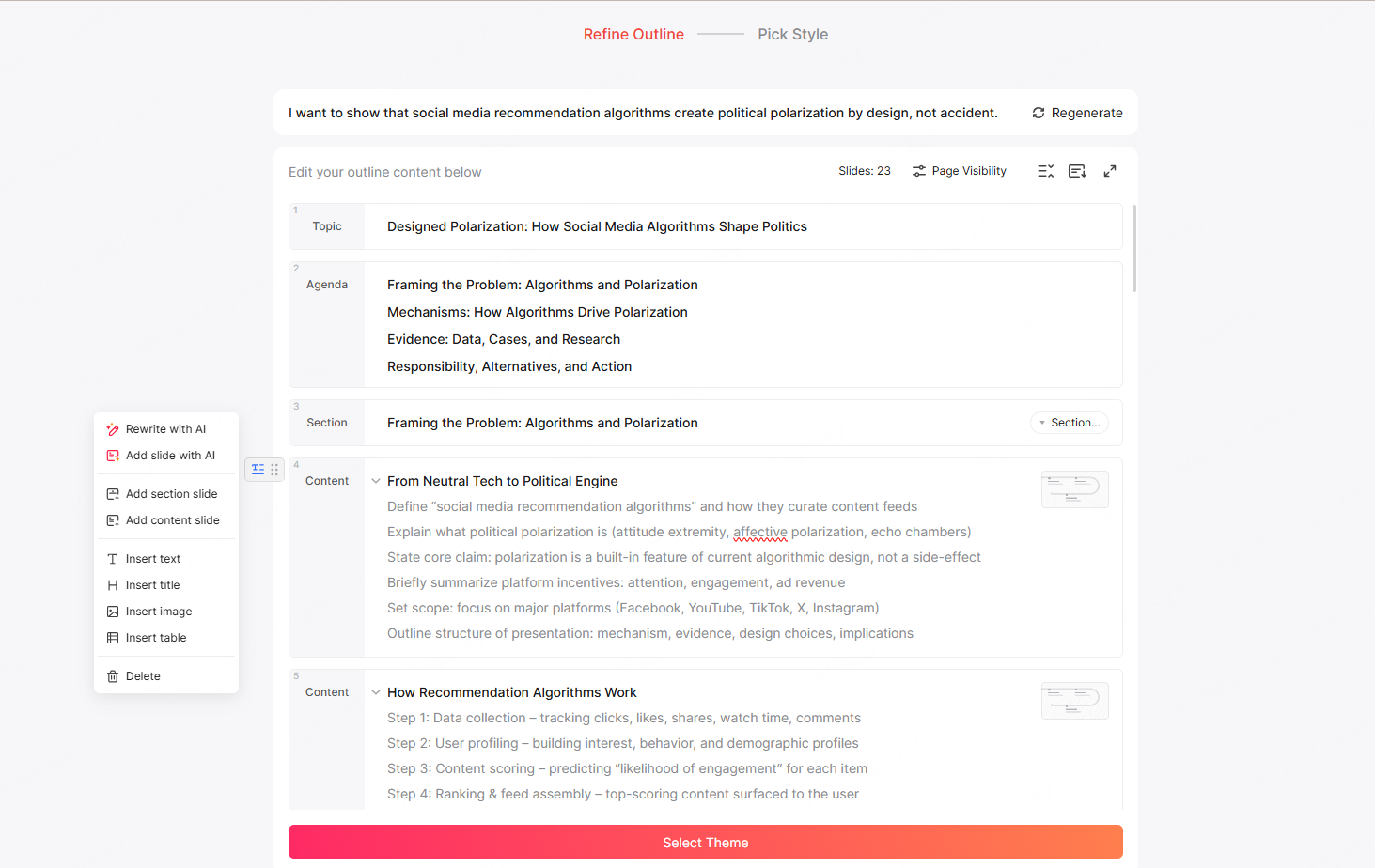
Step 2: Let the AI generate your slide structure. Ask for a draft with the following sections, then review the generated outline:
- A title slide stating your topic and position
- A claim slide stating your argument in one line
- Evidence slides for each of your points, laid out with visuals or bullet points
- A closing slide restating and reinforcing your case
- A supplemental slide prepared for anticipated Q&A
Check that each evidence slide has a source and that the conclusion follows from the argument.
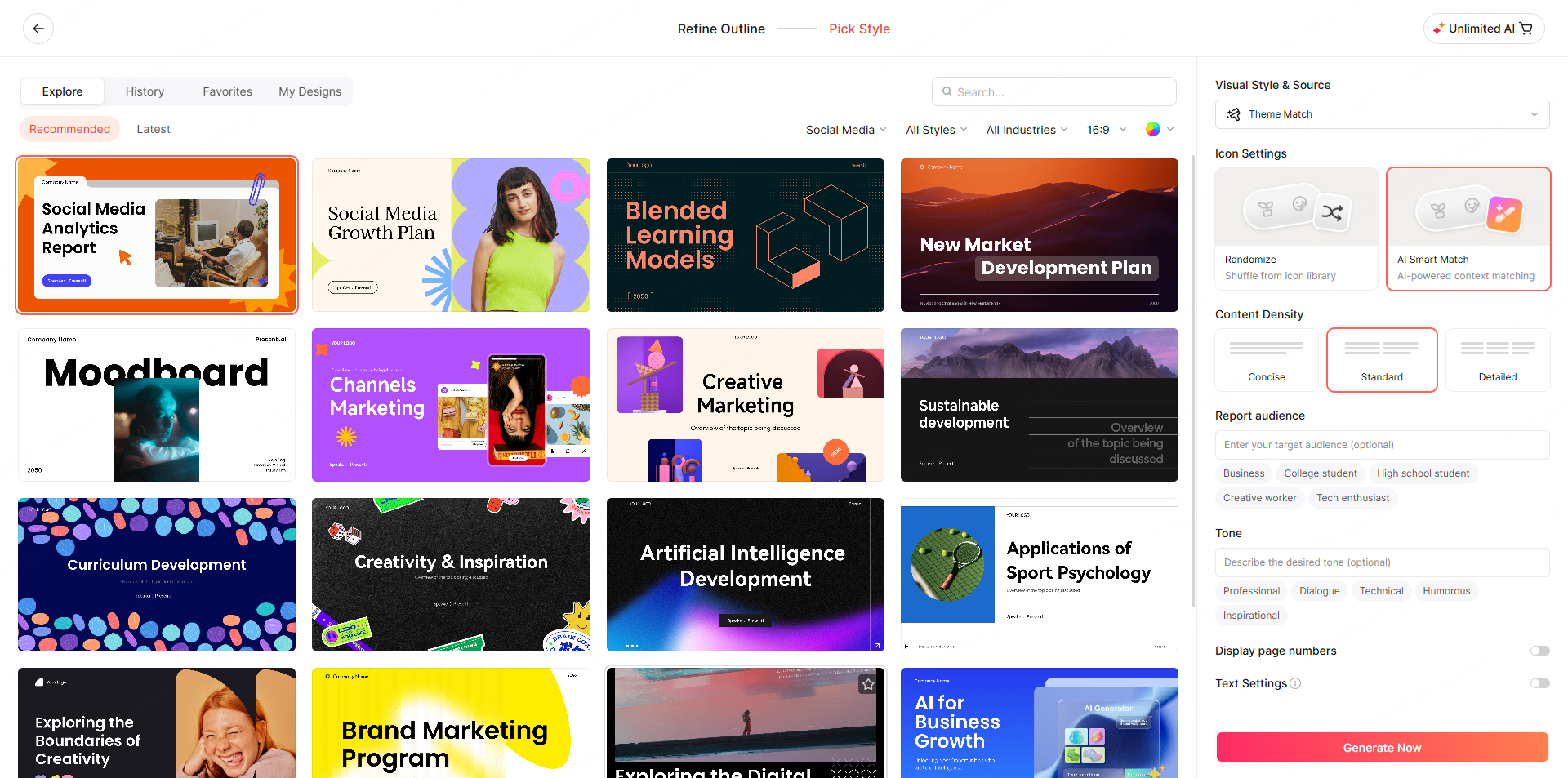
Step 3: Choose your design and layout. Presenti AI applies a professional design template automatically — layout, color palette, and font pairing are all optimized without you needing any design background. You can still edit text or adjust the design manually afterward if you want.
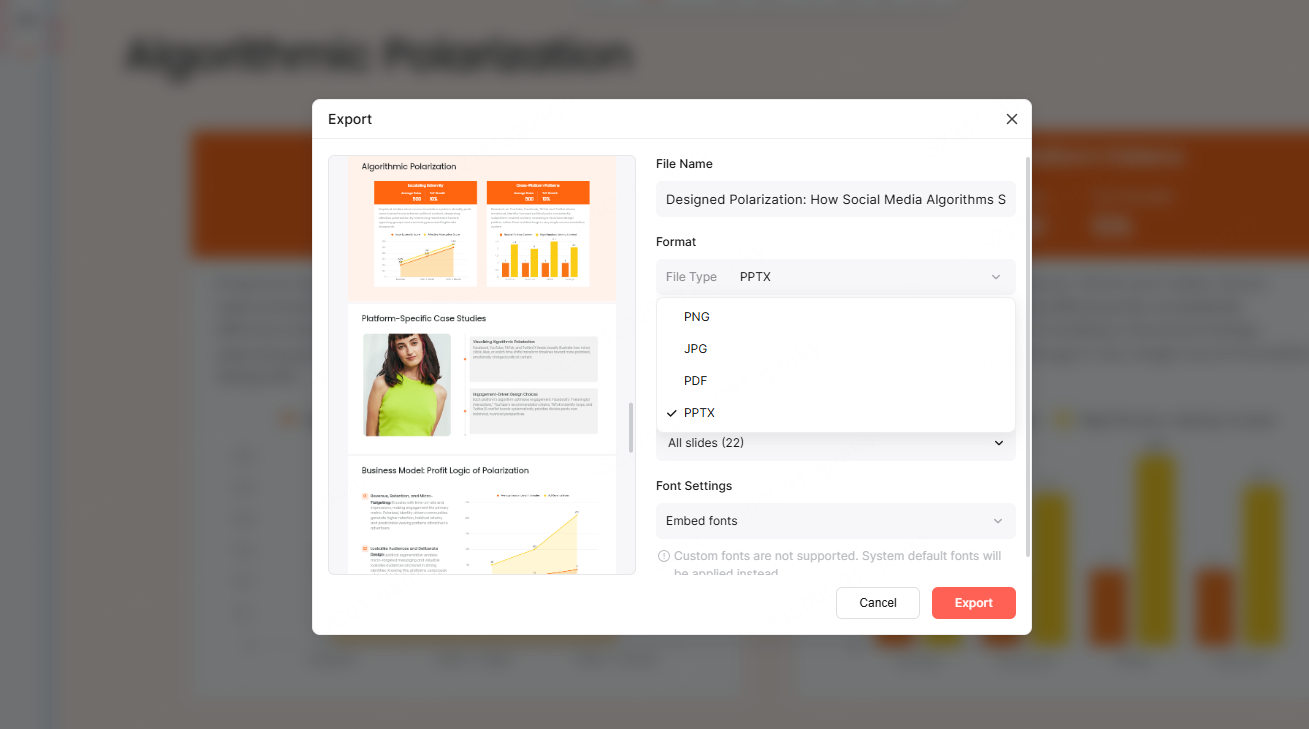
Step 4: Export as PPTX or PDF. Paid plans list editable PPTX/PDF export. Review the exported file before submitting it or sharing with the group.
Where Presenti AI Fits Best
| Scenario | How it's used |
|---|---|
| Classroom debate presentations | Each group turns its argument into slides to present |
| Job-interview group discussion practice | Practice organizing arguments visually for mock discussions |
| Corporate training | Facilitators prep debate topic slides ahead of a session |
| ESL / multilingual debate | Type your prompt in any supported language and get matching slides |
| Solo practice | Build both a "for" and "against" deck on your own topic to think it through from both sides |
One particularly useful feature: you can build separate decks for each side of the same topic. Preparing both perspectives helps you understand the opposing case fully — which also makes you far better prepared for rebuttal.
Frequently Asked Questions
Q1. What's the best way to pick a debate topic?
It depends on your group's age, interests, and goals, but the core rule is the same: pick a topic everyone can form an opinion on in their own words. For beginner-heavy groups, start close to everyday life; once the group is comfortable, move toward social or ethical topics. Running a candidate topic through the three rules above (arguability, empathy cost, humor-vs-seriousness balance) makes the choice much easier.
Q2. The topic is too hard and the group has gone quiet — what now?
Giving a bit more prep time helps immediately — even five minutes of individual note-taking lowers the barrier to speaking up. A facilitator can also help by simply asking, "What would the opposing argument look like?" which makes it easier for people to step into a position. Switching topics is always an option too, but it's worth trying to adjust the environment first.
Q3. Can you practice debate alone?
Yes, in a couple of ways. One is "solo debate": pick a topic, argue the supporting side out loud for three minutes, then switch and argue the opposing side for three minutes. Repeating this trains you to see both sides of an issue. The other is using Presenti AI to build separate "for" and "against" slide decks and comparing them side by side — putting your thinking into text and visuals tends to make it much easier to organize.
Q4. Any tips for picking topics for ESL or multilingual debate groups?
When language difficulty and topic difficulty stack on top of each other, participants tend to freeze up. The fix is picking simple, familiar topics so people can focus their energy on language practice rather than untangling a complicated argument. The "Ethics, Technology & Society" list above (items 86–100) is built with that in mind — start with something lighter, like the pineapple-on-pizza debate, before working up to heavier topics.
Q5. Does Presenti AI support multiple languages?
Choose a language supported by the current workflow and review the wording with a fluent speaker. Check topic terminology, names, and text layout; do not assume all languages receive equivalent results.
Q6. Can debates work over video call?
Absolutely — video call debates (Zoom, Google Meet, etc.) work perfectly well remotely. Since it's harder for participants to gauge natural speaking turns online, it helps for the facilitator to actively call on people by name ("go ahead, Alex"). Screen-sharing your slides also keeps everyone aligned on the argument structure, which helps a lot in a remote setting.
The Bottom Line
Debate is as much practice in listening as it is practice in speaking. No matter how convinced you are that your position is correct, you can't actually persuade anyone without first understanding their point of view.
Picking a fun topic is what lowers the barrier to that whole process. Start with something silly enough that everyone feels safe speaking up, and that comfort compounds — eventually carrying over into the confidence to take a position on genuinely difficult issues without hesitation.
Hopefully this guide is useful the next time you're prepping a class debate, a training session, or just a practice round on your own. And when it's time to turn your argument into slides, Presenti AI can take that piece off your plate — leaving more of your prep time for the part that actually matters: the argument itself.