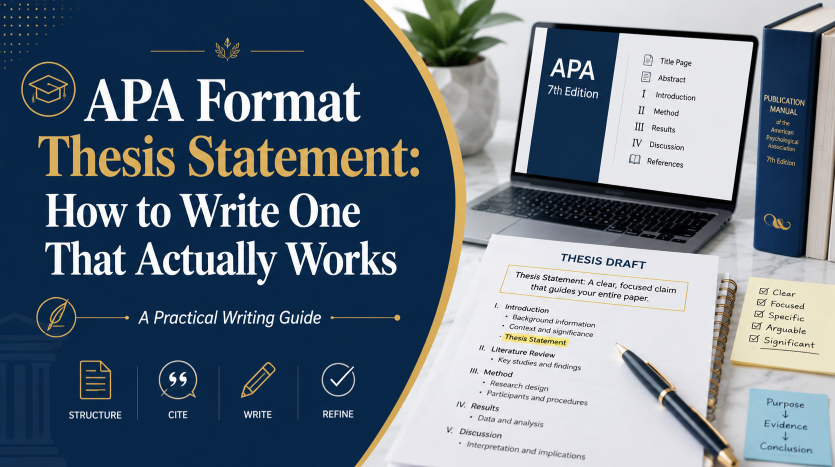
Here's the thing you need to know: there's no special "APA format" for the content of a thesis statement. APA style doesn't hand you a template with blanks to fill in. What APA does control is everything around your thesis statement — the paper’s formatting and citation conventions — and that's genuinely useful to know, because it clears up what you actually need to worry about.
This guide explains what APA style really governs near your thesis statement, where it belongs in the paper, and how to write one that holds up regardless of citation style. If you present this research in slides, the PowerPoint citation guide explains where to place source details and references.
First, What "APA Format" Actually Refers To
If you're not deep into academic writing yet, "APA" might just look like an acronym attached to a confusing set of rules your professor keeps mentioning. It's worth a quick explanation before diving into thesis statements specifically, since the confusion usually starts here.
APA (American Psychological Association) style is a set of formatting and citation rules used mainly in psychology, education, and the social sciences. It's one of three style guides you're most likely to run into in college — the other two are MLA (Modern Language Association), common in literature and humanities courses, and Chicago style, common in history and some publishing contexts. All three do roughly the same job: they standardize how a paper looks and how sources get cited, so that anyone in that field can read and reference the work consistently.
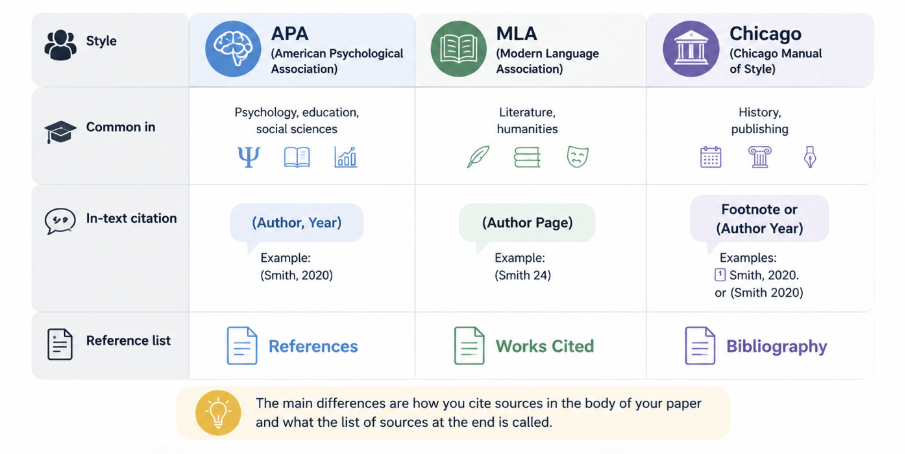
The three styles differ mainly in two places — how you cite a source in the body of your paper, and what the reference list at the end is called:
| Style | Common in | In-text citation | Reference list |
|---|---|---|---|
| APA | Psychology, education, social sciences | (Author, Year) | References |
| MLA | Literature, humanities | (Author Page) | Works Cited |
| Chicago | History, publishing | Footnote or (Author Year) | Bibliography (notes system) or References (author-date system) |
Which one you use isn't usually your choice — it's set by your instructor, department, or the journal you're submitting to. Once you know which style applies, the next question people usually have is the one this article actually answers: does that style also dictate how you write your thesis statement itself? Short answer, covered in detail below: no — but it does affect the paper around it.
The Short Answer: APA Doesn't Have a Special Thesis Statement Format
A thesis statement is a sentence (occasionally two) that states your paper's central argument. That's true whether you're writing in APA, MLA, Chicago, or no formal style at all — the sentence itself isn't an APA-specific construct. APA governs citations, references, headings, margins, fonts, and overall paper structure. It doesn't prescribe a unique sentence structure for your thesis.
So if you've been searching for an "APA thesis statement format" expecting a fill-in-the-blank template, the honest answer is that the format lives at the paper level, not the sentence level. What you're really looking for is probably two separate things: how to write a strong thesis statement (a general academic writing skill), and how APA formatting rules affect the paragraph that sentence lives in.
What APA Style Actually Controls Around Your Thesis Statement
Even though APA doesn't dictate the wording of your thesis, it does govern the mechanics of the paragraph and paper it sits inside:
- Font. APA 7th edition accepts several options — 12-point Times New Roman, 11-point Calibri, and 11-point Georgia are common choices — used consistently throughout, including in your introduction.
- Spacing. Use double spacing for the body text, including the paragraph containing the thesis statement; other paper elements can have specific exceptions.
- No special emphasis. Unlike some older style conventions you may have been taught in high school, current APA doesn't call for underlining, bolding, or italicizing your thesis statement to set it apart. It's written as a normal sentence within a normal paragraph.
- Paragraph indentation. Your introduction paragraph — and therefore your thesis statement — follows standard APA paragraph indentation, like every other paragraph in the body.
In short: your thesis statement gets no special visual treatment in APA. It's a sentence that follows the same formatting rules as every other sentence around it.
Where the Thesis Statement Belongs in an APA Paper
Placement is a writing decision, not a special APA rule. Follow the assignment and the structure your argument needs.
- In most papers, the thesis statement appears as the final sentence (or one of the final sentences) of your introduction paragraph, after you've established context and before your body paragraphs begin developing it.
- In empirical or research papers that include an abstract, a condensed version of your central claim often also appears in the abstract itself, giving readers your argument before they reach the full introduction.
- In longer papers with multiple introductory paragraphs, the thesis typically closes out the final paragraph of that introductory section, once all necessary context has been laid out.
The underlying logic is consistent across formats: readers should understand your context first, then land on your argument right as they're about to move into supporting evidence.
What Makes a Thesis Statement Strong, APA or Not
Since APA doesn't supply the content rules, the actual craft of writing a good thesis statement comes down to general academic writing principles that apply everywhere:
- It takes a position. A thesis states something that could reasonably be disagreed with — not a neutral fact everyone already accepts.
- It's specific. "Social media affects mental health" is too broad to be useful. "Adolescent social media use correlates with increased anxiety through disrupted sleep patterns" gives your paper something concrete to prove.
- It previews your paper's scope. A reader should have a rough sense of what's coming, even without a detailed roadmap.
- It's a single, clear sentence. If it needs three "and"s to hold together, it's probably covering more ground than one paper can defend well.
APA-Formatted Thesis Statement Examples
These hypothetical examples illustrate specific claims at the end of an introduction. They are not established findings; a paper using one would need appropriate supporting evidence.
[...context-setting sentences about rising remote work adoption...] This paper argues that remote work arrangements improve employee retention primarily by reducing commute-related burnout rather than by increasing job satisfaction directly.
[...context on standardized testing debates...] Standardized testing, as currently implemented in most U.S. public schools, measures test-taking proficiency more reliably than it measures actual subject mastery.
[...context on sleep and cognitive performance research...] Sleep deprivation among college students impairs working memory more significantly than it impairs long-term recall, suggesting different interventions are needed for each.
Each of these sits at the end of an introduction paragraph, uses no special formatting beyond the paper's standard font and spacing, and states a specific, arguable claim — which is really the whole formula, regardless of citation style.
Common APA Thesis Statement Mistakes
- Bolding or underlining the thesis out of habit. This was common guidance in some high school writing classes but isn't part of current APA convention — leave it formatted like a normal sentence.
- Burying it too early or too late. A thesis statement placed in the first sentence, before any context, can feel abrupt; one buried three paragraphs in makes readers work too hard to find your actual argument.
- Treating "APA format" as a content template. Searching for a fill-in-the-blank APA thesis structure usually leads to confusion, since that structure doesn't exist — the content rules come from general argumentative writing, not the style guide.
- Forgetting the abstract. In research papers, an abstract that doesn't reflect the same central claim as your introduction creates an inconsistency reviewers notice quickly.
Presenti AI: From Thesis Statement to Presentation
Once your APA paper is written, a common next step is presenting it — in a class, a conference, or a defense — which means pulling your thesis and supporting evidence back out of paragraph form and into slides.

Presenti AI can generate that presentation directly from your finished paper. Upload it as a PDF or Word document, paste it in as Markdown, or point to a web link if it's already published online, and it produces a structured slide outline built around your actual thesis and supporting points — one slide per major argument, with your evidence organized alongside it. You can also start from just a prompt describing your thesis if you'd rather build the outline before the paper is finished. Eligible paid plans support editable PPTX export, ready to open and refine in PowerPoint or Google Slides.
Write the Argument, Then Apply the Paper Style
There's no unique APA format for the words of a thesis statement — that part comes down to standard academic argument-writing skill. What APA actually contributes is consistency: consistent fonts, spacing, citations, and other paper conventions. The thesis statement’s placement depends on the argument and assignment. Get the argument itself specific and arguable, follow your paper's normal formatting, and check the assignment and applicable APA guidance for the remaining paper requirements.