A thesis statement should make the paper’s central claim easy to identify. One or two sentences often work, but clarity, scope, and the assignment matter more than a fixed count.
Let’s get into it.
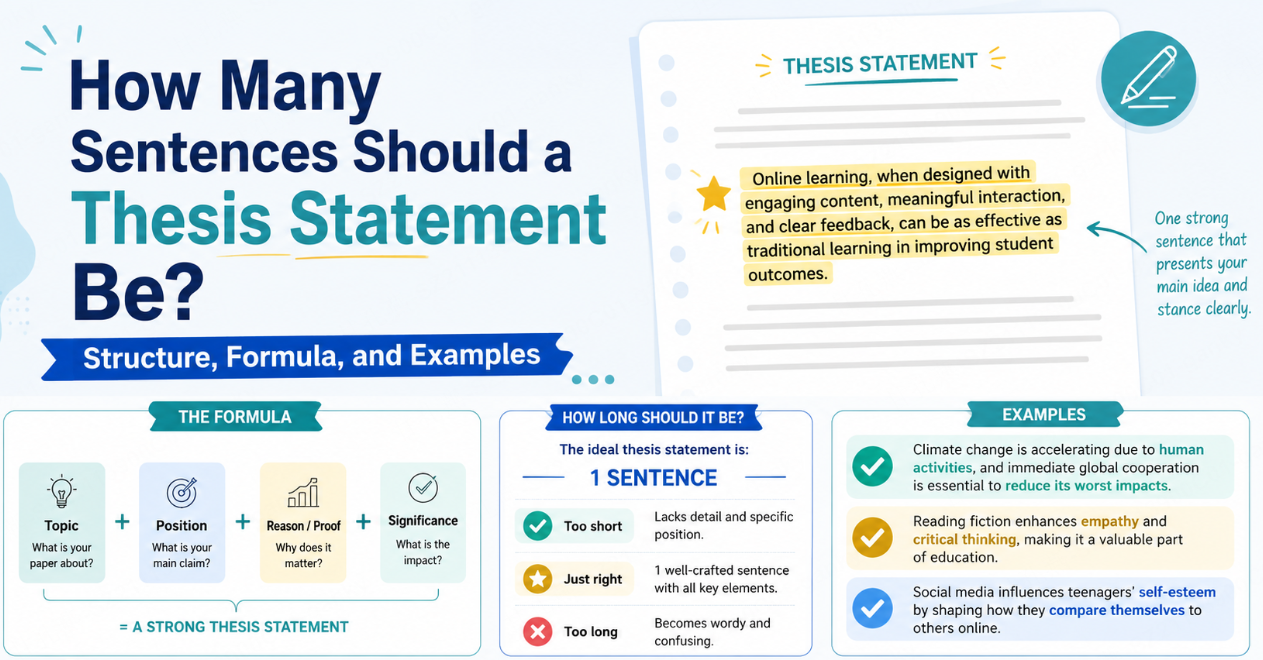
The Short Answer: One to Two Sentences
In most academic writing contexts, a thesis statement runs one to two sentences. That’s the target. Not a bullet list, not a paragraph, not a meandering three-sentence block. One focused claim — occasionally expanded into two sentences when the argument genuinely needs the space.
The reason the range exists is practical. Some arguments are complex enough that a single sentence becomes overloaded with clauses and qualifications. In those cases, splitting into two clean, connected sentences is better than forcing everything into a grammatical tangle. Use one or two sentences as a starting point, then follow the assignment and the complexity of the argument. There is no universal sentence-count ceiling.
The test isn’t sentence count — it’s focus. Can your thesis be understood in a single reading? Does it make one unified claim? If yes, the length is probably right.
Why Sentence Count Actually Matters
Here’s what often gets missed: the discipline of limiting yourself to one or two sentences forces you to actually decide what you’re arguing.
A long thesis statement may contain several competing claims or repeated qualifications. Identify the central argument first, then keep the scope and caveats needed to state it accurately.
When you force your thesis into one or two sentences, you have to choose. And choosing is the point.
The Thesis Formula: A Reliable Starting Structure
A thesis formula isn’t a rigid template, but it’s a useful scaffold when you’re not sure where to start. The most commonly used structure looks like this:
[Specific subject] + [clear claim or position] + [reason or implication]
That three-part logic covers most academic writing scenarios. You’re identifying what you’re writing about, what you’re claiming about it, and why that claim matters or how you’ll support it.
Here is a hypothetical claim using that formula; a paper would need evidence to support it:
Topic: The impact of remote learning on student performance
Formula applied: Remote learning programs, when implemented without structured peer interaction and consistent instructor feedback, produce measurable declines in student engagement and long-term knowledge retention among secondary school learners.
Notice what’s happening in that sentence. The subject is specific (remote learning programs with particular conditions). The claim is clear (they produce measurable declines). The implication is built in (this matters because engagement and retention are core learning outcomes). One sentence. Fully functional thesis.
How Many Sentences Is a Thesis in Different Paper Types?
The context of your paper shapes the appropriate length and complexity of your thesis.
Short Essays and Undergraduate Papers
For standard essays — the kind assigned in high school or introductory college courses — one sentence is almost always the right answer. The paper itself is short, the argument is contained, and the thesis needs to be tight. For a short essay, avoid adding a second sentence that merely repeats the first.
Research Papers and Literature Reviews
Longer academic papers can support a two-sentence thesis when the argument has distinct components that need to be introduced separately. The first sentence might establish the central claim; the second might clarify the scope, methodology, or the “so what” of the argument.
Example:
Sentence 1: Chronic underfunding of rural public libraries has created significant disparities in digital literacy access across socioeconomic lines.
Sentence 2: Addressing these gaps requires a combination of federal infrastructure investment and community-led programming, rather than a one-size-fits-all policy solution.
Two sentences. Two connected ideas. Still one unified argument.
Graduate Theses and Dissertations
At the graduate level, the thesis statement is often embedded within a longer problem statement or research purpose section. It may still be one or two sentences in its core formulation, but it’s surrounded by context. The statement itself remains concise — the research builds the complexity around it.
Sentences for Thesis: What Goes Wrong
There are patterns that show up repeatedly in student writing that signal a thesis isn’t quite working yet.
The list thesis. “This paper will examine causes A, B, and C of economic inequality.” You’ve created a roadmap, not an argument. A list of topics isn’t a claim.
The question thesis. Ending your thesis with a question means you haven’t answered it yet. Your thesis should be the answer, not the problem still being posed.
The overpacked single sentence. Some writers try to compensate for vagueness by cramming multiple ideas into one long sentence. The result is usually a run-on that says several things poorly instead of one thing clearly.
The repeat offender. Writing the same basic idea twice in slightly different words and calling it a two-sentence thesis. If sentences one and two are saying the same thing, cut one.
A Practical Self-Check Before You Move On
Before treating your thesis as finished, run it through these quick checkpoints:
- Read it aloud. Does it make sense in a single pass?
- Cover your name and paper title. Could someone guess what your whole paper argues from this alone?
- Count the claims. Is there one central argument, or are there two or three competing ones?
- Check for hedging. Remove vague hedging, but keep qualifications such as “may” when they accurately reflect the evidence. Precision does not require certainty.
If it clears those four checkpoints, you’re in good shape.
Using Your Thesis as a Structural Anchor
One thing that doesn’t get discussed enough: your thesis statement isn’t just an introductory sentence. It’s a structural tool for the entire paper. Every body paragraph should be able to trace a line back to it. If a paragraph can’t justify its existence by pointing to the thesis, it either needs to be reframed or cut.
This structural relationship also matters when your work moves beyond the written page. If you’re presenting research findings to a committee, a classroom, or a conference, introduce the central claim early, after any context the audience needs to understand it.
Tools like Presenti AI are particularly useful at this stage. You can feed your paper or outline into the platform and have it generate a structured slide deck where your thesis anchors the opening and your supporting evidence follows in logical sequence. The discipline of writing a tight, clear thesis pays off visually: a one-sentence argument translates into a single, powerful title slide. A muddled two-paragraph thesis turns into a confusing opening that loses the audience before the presentation really begins.
The same precision that makes a thesis statement work on paper makes it work on a screen.