A literature review presentation should explain what several sources, considered together, allow you to say about a question. Group the evidence around an argument: what the sources examine, where their findings meet, and why some findings cannot be compared directly. A sequence of one slide per paper usually leaves that synthesis to the audience.
First decide what each source contributes; then keep the claims on your slides traceable to their sources. The worked example below shows how to move from four different study designs to a short presentation without treating every source as equivalent evidence.
Define the question before choosing the slides
“Peer feedback in education” is a topic, but it gives you little help choosing evidence. A more useful presentation question is: “When does structured peer feedback help first-year students revise an argument?” It identifies a population, an activity, and an outcome.
That question excludes some tempting substitutions. Students liking feedback is not the same as their writing improving. A better final draft does not, by itself, establish which part of the course helped. Keep those distinctions visible as you read.
Write a scope sentence before preparing the deck: “This review examines feedback criteria and argument revision in first-year courses; it does not evaluate every form of peer assessment.” For an assessed presentation, match that scope to the assignment. Do not label a review “systematic” simply because you used a table; that label requires an appropriate, documented review method.
Compare the evidence before the findings
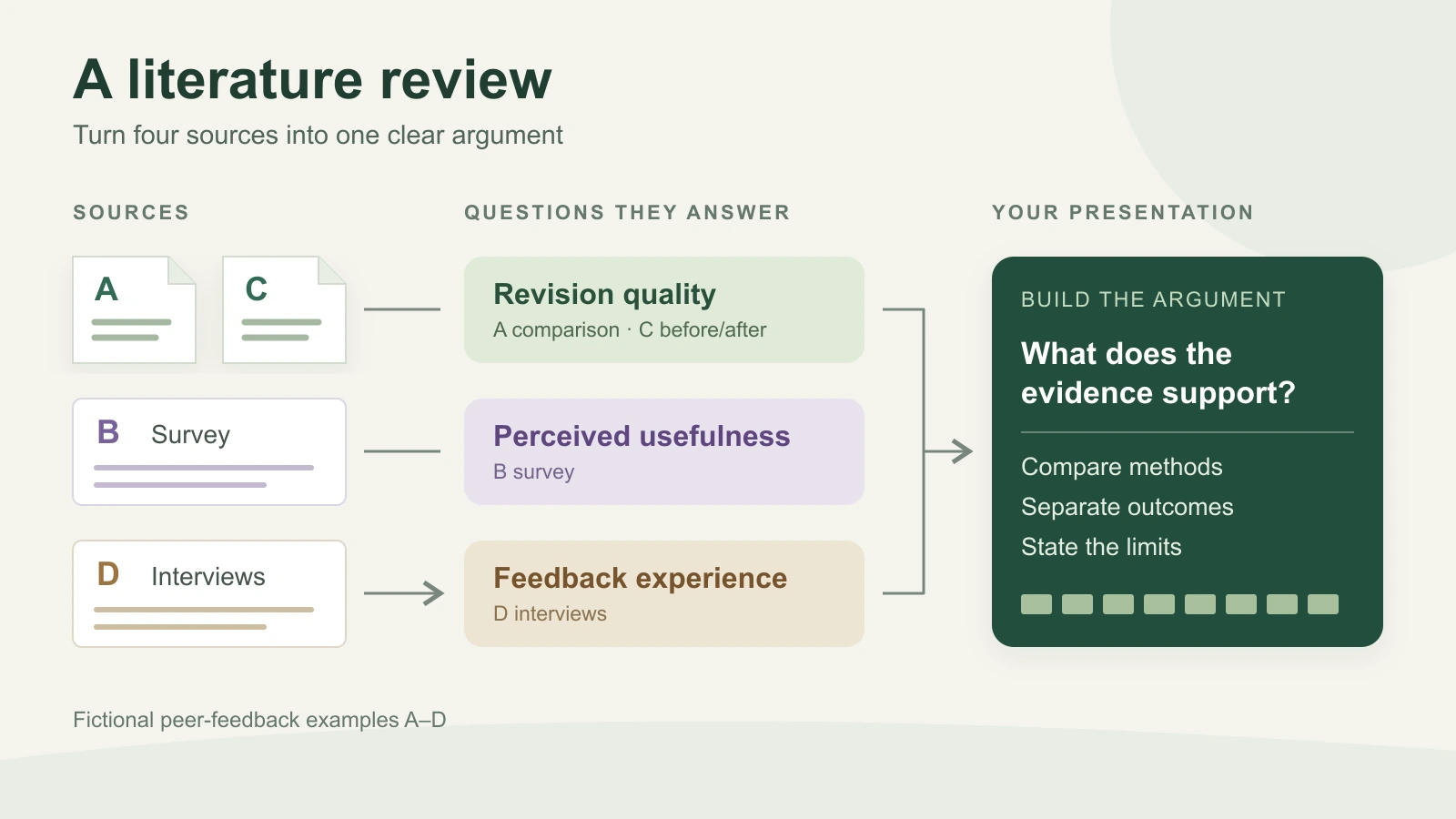
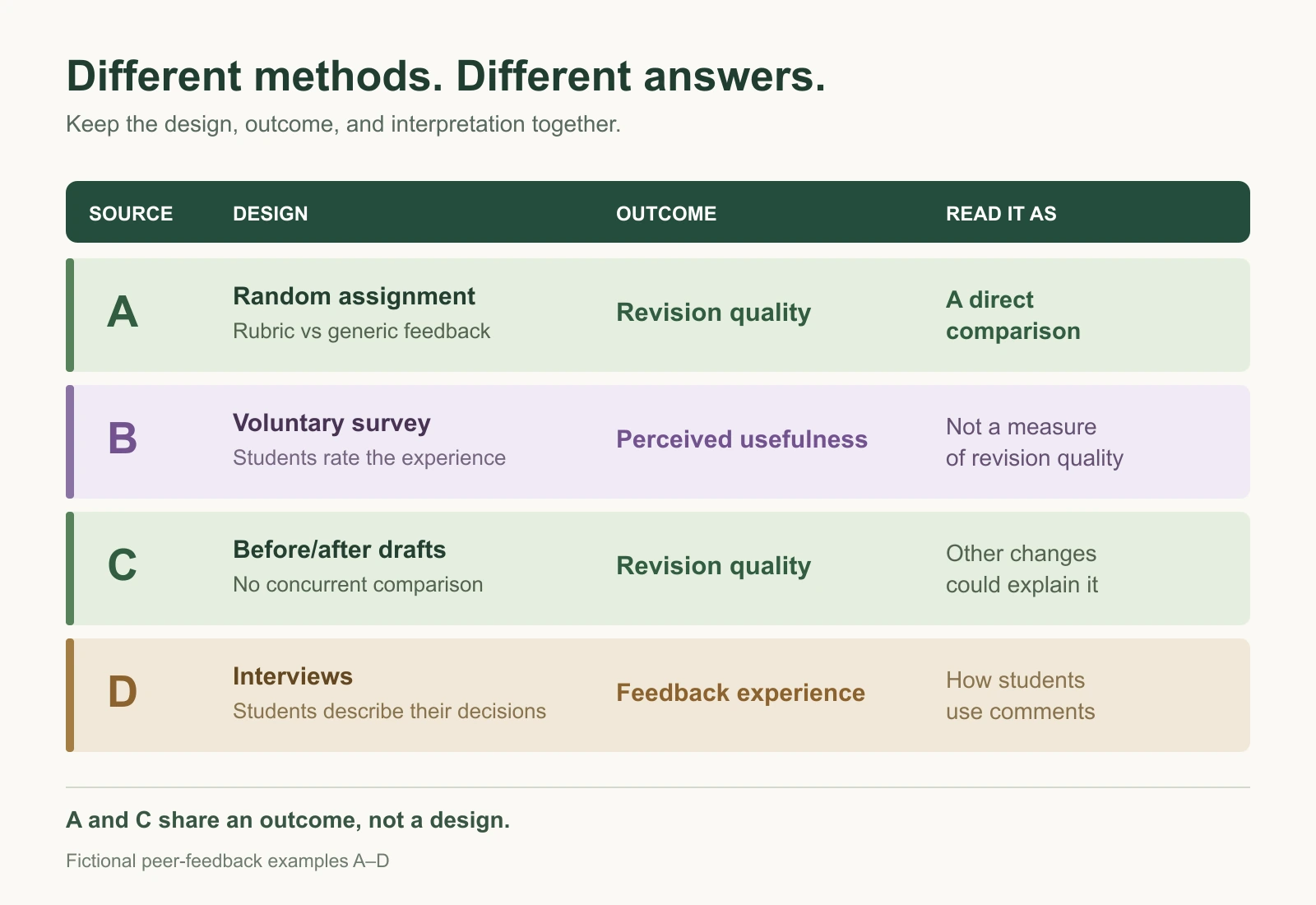
The four entries below are fictional teaching examples, not published studies. They illustrate how different methods contribute to a review. In your own matrix, replace A–D with identifiable sources and record what each source actually measured.
| Example and design | What it measures | Contribution and limit |
|---|---|---|
| A: students in one course randomly assigned to rubric-guided or generic peer feedback | Quality of argument revisions | The rubric group performs better in this example. This is a direct comparison in one course, not proof across subjects. |
| B: voluntary student survey after peer feedback | Perceived usefulness | Respondents describe feedback as helpful. The survey does not measure writing improvement; respondents may not represent the whole class. |
| C: classroom drafts compared before and after a rubric is introduced | Change in revision quality | Later drafts improve. Without a concurrent comparison group, practice and other teaching changes remain possible explanations. |
| D: interviews about how students use peer comments | Experiences and revision decisions | Students describe acting on criterion-linked comments. Interviews explain experiences, not how common an effect is. |
Notice that only A directly compares the two feedback approaches. C observes change over time; it does not reproduce A’s comparison. B and D help explain student experience, but they do not independently demonstrate improved writing.
For real sources, add the course setting, participants, timing, outcome definition, and relevant pages to your working notes. The presentation can show a smaller matrix. Keep the detail available for questions instead of squeezing the whole reading record onto a slide.
Build themes that connect the sources
The UNC Writing Center’s literature review guide describes synthesis as reorganizing source material around ideas. For a presentation, that means your section headings should express relationships, not just list authors.
Our example supports three useful themes:
- How criteria relate to revision. A compares a structured activity with a less structured one. D describes how students act on criterion-linked comments. Together they suggest a connection worth discussing, although D does not establish why A’s result occurred.
- Revision quality and perceived usefulness are different outcomes. A and C examine drafts; B asks students about their experience. Put those findings beside each other, not into one pooled “success” score.
- Transfer beyond the original setting remains open. A’s course-level comparison cannot settle whether the same approach works in another subject or with more experienced students.
This is more informative than “three of four studies support peer feedback.” Counting favorable conclusions would hide the different questions and methods. It would also give a voluntary survey the same apparent role as a direct comparison.
Plan an eight-slide argument
For this example, an eight-slide sequence gives each important distinction a place. Adjust the number to your speaking time; the argument matters more than a fixed slide count.
| Slide | What the audience should understand |
|---|---|
| 1. Question and scope | We are examining argument revision in first-year courses, not every benefit of peer assessment. |
| 2. The evidence landscape | Four designs examine different outcomes; show the compact matrix. |
| 3. Criteria and usable comments | A compares approaches; D describes how students use specific feedback. |
| 4. Evidence of improved revisions | A and C both concern revision quality, but only A supplies a concurrent comparison. |
| 5. Helpfulness is a separate question | B contributes student perceptions, which should not be relabeled as performance. |
| 6. Where the evidence stops | The example does not establish transfer to other courses or long-term retention. |
| 7. Answer and next question | Give a qualified answer and identify the comparison that would reduce the remaining uncertainty. |
| 8. References | Let readers locate the real sources used in your presentation. |
In a short talk, combine the two outcome slides while keeping their labels distinct. If your assignment requires a search-method slide, place it after the question and report the method you actually used. Do not invent databases, screening counts, or inclusion criteria to make the deck look more rigorous.
Write one synthesis slide in full
Consider slide 4. A title such as “Studies A and C” names the contents but gives no interpretation. A more useful title is: “Improved drafts are observed in two examples, but the comparisons differ.”
The slide needs only two evidence statements and the distinction between them:
- A: the rubric-guided group has stronger argument revisions than the generic-feedback group.
- C: drafts improve after the rubric is introduced, without a concurrent comparison group.
- Interpretation: both concern revision quality; C cannot isolate the rubric from other changes over time.
Your spoken explanation supplies the reasoning: “These results point in a similar direction, but they do not carry the same inference. A compares approaches within one course. C shows improvement after a change, so practice and other teaching changes could also matter.”
With real studies, attach the relevant citations to those statements and retain their actual terminology. If one study measures argument structure and another measures grammar, do not rename both outcomes “writing quality” without explaining what that broader label conceals.
Show disagreement without forcing an answer
When sources disagree, start with the comparison. Did they study similar participants, use similar feedback instructions, and measure the same outcome at a similar time? A difference in results may be meaningful, or the papers may simply be answering different questions.
Suppose survey B instead reported that students disliked peer feedback. That would matter for acceptability, but it would not directly contradict A’s revision result. The presentation should then say that an approach can improve the measured task while remaining unpopular. It should not discard the survey or claim the outcome study has been disproved.
If two genuinely comparable studies conflict and you cannot explain why, keep the conflict in your conclusion. “The evidence is mixed under these conditions” is a useful answer when you can identify the conditions. It is more precise than selecting the most convenient finding.
Turn the synthesis into an editable deck
Write the concluding answer before formatting: “In this fictional evidence set, the most direct support for rubric-guided feedback comes from one course comparison. The other examples add context about change and student experience; they do not establish the same effect across courses.” A sensible next study would test a comparable task in another course while keeping the revision measure explicit.
Once your real evidence is organized, turn the finished outline into an editable presentation draft in Presenti. Supply the question, theme headings, source-specific claims, and limits. Then compare the draft with your matrix: keep outcome labels accurate, preserve disagreement, and remove any connection the sources do not support.
The final deck should leave the audience with an answer they can explain, the evidence behind it, and a clear view of what remains unresolved.