A marketing proposal template should make a business decision easier. It connects a client's problem to a focused audience, a defensible strategy, a priced scope of work, and a measurement plan that explains what happens next. The best version is not a list of services or a collection of attractive slides; it is an editable argument that a client can inspect, question, approve, and use to guide delivery.
This guide is for agencies, independent marketers, in-house teams, and consultants preparing a proposal for a new engagement, a campaign extension, or an annual plan. It shows what to include, how to tie budget to outcomes, and how to keep assumptions visible. Examples marked hypothetical are teaching devices, not performance claims.
What Should a Marketing Proposal Decide?
A proposal is a decision document before it is a sales document. The reader should understand what choice is being requested, why the choice matters now, and what evidence would make the plan worth funding. The U.S. Small Business Administration describes a marketing plan as a way to persuade customers to buy; a proposal adds the commercial details that let another party approve the work, including scope, responsibilities, timing, cost, and review points.
Write the decision in one sentence before drafting slides. For example: "Should we fund a 90-day launch program for the new service, using paid search and lifecycle email, with a capped test budget?" The sentence prevents a common failure: promising every channel to every audience while leaving the approval question vague.
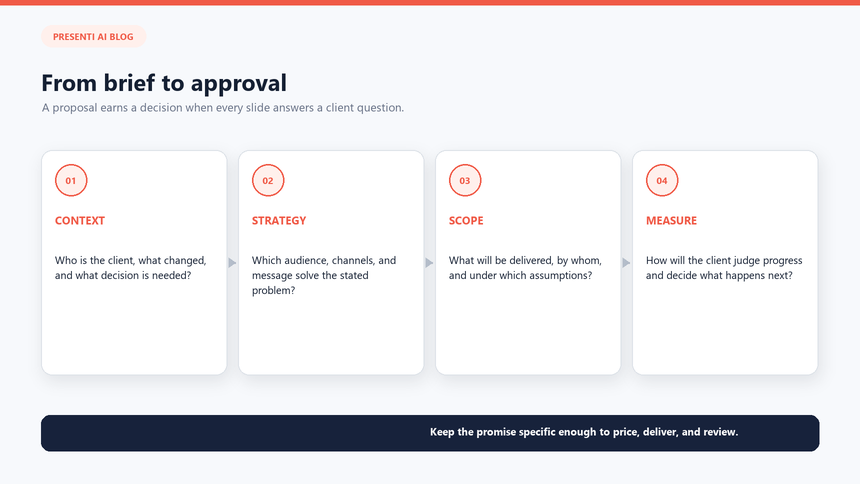
| Scope field | Question to answer | Useful evidence |
|---|---|---|
| Business problem | What is not working, or what opportunity is time-sensitive? | Baseline trend, customer feedback, funnel data, or a stated business priority |
| Audience | Who must change behavior, and who approves the work? | Segment definition, buying role, market, and decision criteria |
| Outcome | What observable result would justify the investment? | Qualified inquiries, pipeline contribution, adoption, retention, or awareness measure |
| Constraints | What limits the plan? | Budget cap, launch date, legal review, channel access, assets, or staffing |
| Approval | What exactly is the reader being asked to authorize? | Option selected, amount, term, owner, and decision date |
Use the marketing proposal template as a working brief as well as a presentation outline. That makes later scope changes easier to trace back to the original approval.
Keep assumptions beside the scope, not hidden in footnotes. If the plan depends on a landing page, a product feed, approved claims, or a client-side analyst, name that dependency and its owner. A clear boundary builds more trust than a promise that the team can "handle everything."
Which Slides Belong in a Marketing Proposal Deck?
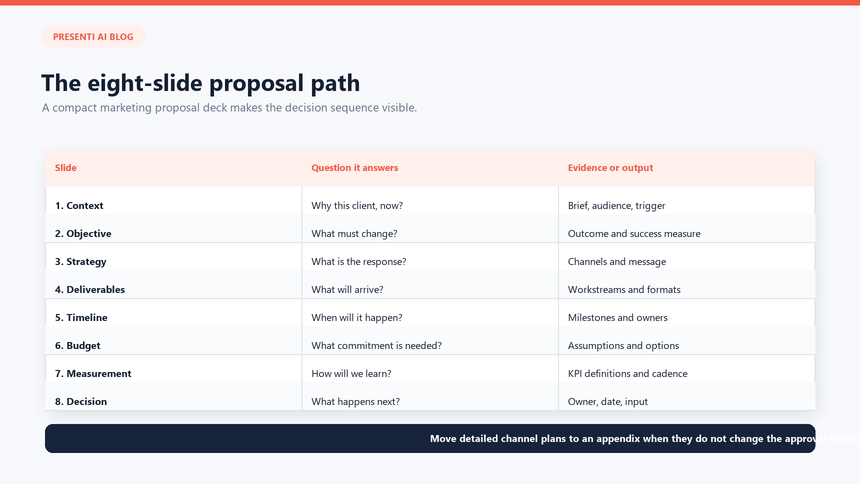
A useful marketing proposal presentation follows the reader's decision path: context, recommendation, work, investment, and proof. A short engagement may need seven slides; a complex retainer may need twelve. The sequence below gives each slide one job and leaves detailed research, channel settings, and legal language for an appendix or contract.
- Decision and executive summary. State the problem, recommended option, expected outcome, investment range, and approval requested.
- Current situation. Show the baseline, audience insight, constraints, and the cost of waiting. Separate known data from working assumptions.
- Strategic direction. Explain the positioning, message, offer, or journey that links the audience problem to the business outcome.
- Channel and tactic plan. Show the few channels that earn a place in the plan, the job each channel performs, and the handoff between them.
- Deliverables and workflow. Specify outputs, review rounds, client inputs, owners, and acceptance criteria.
- Timeline and milestones. Map discovery, production, launch, optimization, and reporting against real dependencies.
- Budget and options. Show one recommended scope plus clearly labeled alternatives, exclusions, and payment timing.
- Measurement and reporting. Tie objectives to leading and outcome metrics, data sources, cadence, and decision rules.
- Risks and assumptions. Name what could change the plan, who monitors it, and how a change request is handled.
- Approval and next step. Restate the selected option, start date, decision owner, and the smallest action needed to begin.
Use message-led slide titles such as "A focused launch test reduces approval risk" instead of labels such as "Strategy." The title should carry the conclusion, while the body shows the evidence and the caveat. This makes the proposal easier to scan when stakeholders revisit it without the presenter.
How Do You Build the Scope, Strategy, and Budget?
Scope is the bridge between an idea and a price. Start with the outcome, then work backward to the audience behavior, strategic choice, channel role, deliverable, and effort required. A digital marketing proposal becomes credible when a reader can trace one line from an objective to a specific activity and then to an accountable owner.
Write deliverables as observable outputs. "Social media support" is too broad; "12 approved short-form posts, a monthly content calendar, and one performance review" can be reviewed and priced. Mark what is included, what is optional, and what belongs to the client or another vendor.
| Planning layer | Decision prompt | Proposal detail |
|---|---|---|
| Objective | What business movement matters? | Outcome, baseline, target direction, and time window |
| Audience and insight | Whose behavior must change? | Segment, need, barrier, trigger, and proof available |
| Strategy | What choice will focus the work? | Positioning, message, offer, journey, and channel roles |
| Deliverables | What will be produced or operated? | Format, quantity, owner, review rounds, and acceptance rule |
| Investment | What will the client pay and when? | One-time fees, recurring fees, media or vendor costs, taxes, and payment terms |
Build the budget from work packages rather than an unexplained total. Separate strategy and setup, creative or production, media or distribution, tools or vendors, and reporting or optimization. State whether media spend is included or paid directly by the client. If the amount is an estimate, show the variable that would move it, such as asset count, audience size, production days, or test duration.
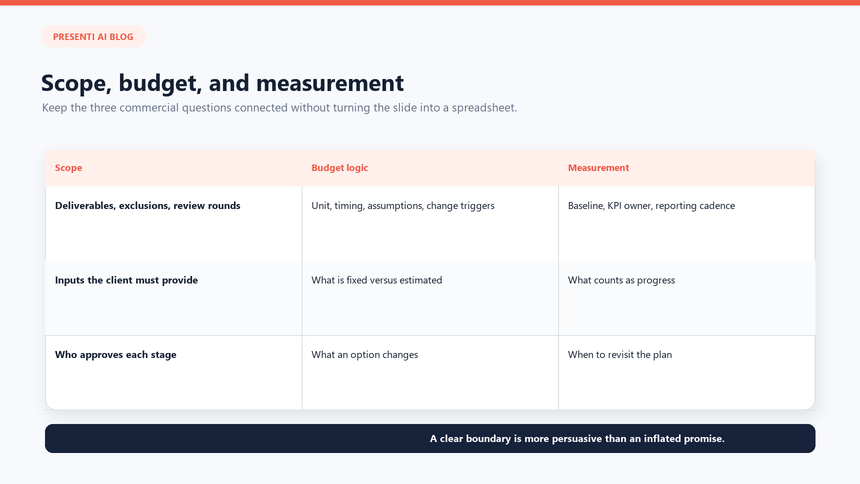
Offer options only when they represent real trade-offs. For example, a "test" option may limit channels and shorten the learning cycle; a "scale" option may add production capacity and a longer optimization period. Do not make the middle option look artificially attractive by hiding essential work in the cheaper one. Include an exclusion list so scope changes can be discussed without rewriting the entire proposal.
How Do You Connect Tactics to Measurement?
Measurement should explain how the team will learn, not decorate the last slide with a list of platform metrics. Start with the decision the report must support: continue, change, pause, or expand. Then choose a small metric chain from exposure to response to business outcome, and identify the source, owner, cadence, and interpretation rule for each link.
Google Analytics documentation describes campaign and traffic-source fields such as source, medium, campaign name, content, and term, and explains how tagged URLs become report dimensions. Use a naming convention that the delivery team can apply consistently. A tag is not proof of incrementality; it is a way to keep the observed traffic path legible.
| Objective | Leading signal | Outcome metric | Decision rule |
|---|---|---|---|
| Create qualified demand | Landing-page engagement and form starts | Qualified inquiries or pipeline accepted | Keep the channel if quality and cost are within the agreed range; revise message if volume is high but fit is weak |
| Improve conversion | Offer views, checkout starts, or demo requests | Completed purchase or booked meeting | Test the largest drop-off first and document the change before comparing periods |
| Build awareness | Reach, completed views, or branded search trend | Direct or assisted response in the defined audience | Use a time-bound pulse check and avoid treating reach alone as revenue |
| Retain customers | Activation, repeat use, or support engagement | Renewal, expansion, or reduced churn | Segment by cohort and review the result with customer-success context |
Label forecasts as forecasts. If a client asks for a guaranteed return, show the assumptions behind the scenario and the variables the team cannot control. Include a reporting calendar: launch check, weekly learning note, monthly review, and end-of-test recommendation. The report should answer "what changed and what will we do?" rather than only "how many clicks occurred?"
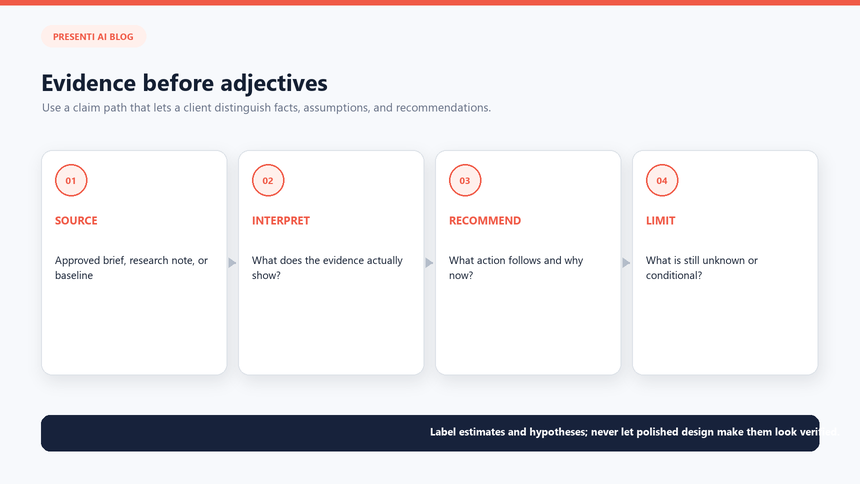
Keep the contract boundary clear. A proposal can define the measurement method and reporting service, but it cannot guarantee market response, platform delivery, or attribution certainty. The client and delivery team should agree how missing data, tracking changes, and external events will be recorded.
What Does a Practical Campaign Example Look Like?
The following example is hypothetical. Northstar Home, a fictional home-services company, wants approval for a 90-day launch of a maintenance subscription in one metro area. Its team has a modest library of product photos, a new landing page, and a sales team that can follow up on qualified requests. The proposal must show a contained experiment rather than promise a fixed revenue result.
The campaign proposal template should make the trade-offs visible. Northstar's team chooses a focused audience, two acquisition channels, a single offer, and a reporting rhythm that allows the plan to change after early learning.
| Proposal element | Illustrative choice | What the client should verify |
|---|---|---|
| Audience | Homeowners in the service area with an upcoming maintenance need | Eligibility, address coverage, seasonality, and customer-value assumption |
| Message | Predictable maintenance with a clear appointment path | Offer terms, proof, legal language, and customer support capacity |
| Channels | Paid search for active demand plus email to an approved existing list | Account access, consent, landing-page readiness, and creative approvals |
| Work packages | Strategy and setup, landing-page copy, six ad variants, email sequence, weekly review | Quantity, review rounds, dependencies, and named owners |
| Illustrative budget | $18,000 service and production plus a separately approved media cap | Currency, tax, payment schedule, media handling, and change process |
| Learning plan | Weekly quality check and a day-45 decision on message or audience changes | Lead definition, CRM fields, response time, and escalation threshold |
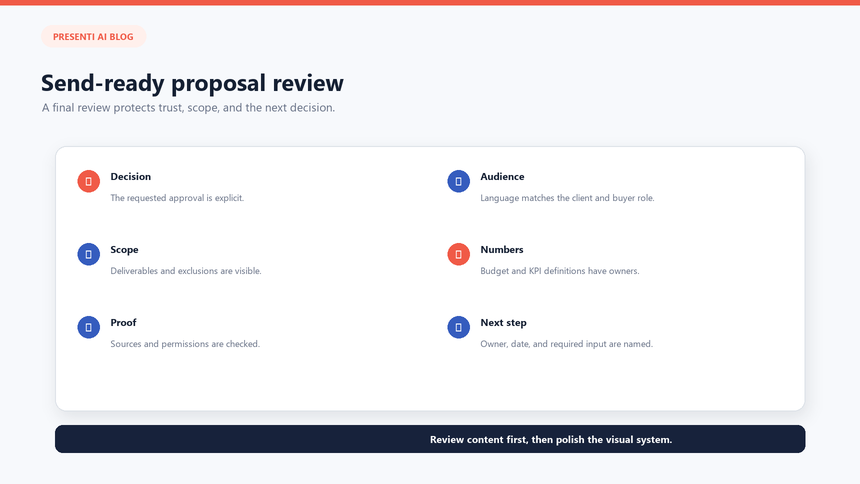
The recommended approval is conditional: fund setup and the first test period, confirm tracking and lead handling before launch, and hold the scale decision until the day-45 review. The proposal's value is the decision rule, not the invented precision of its numbers.
How Can Presenti Turn a Brief into an Editable Proposal?
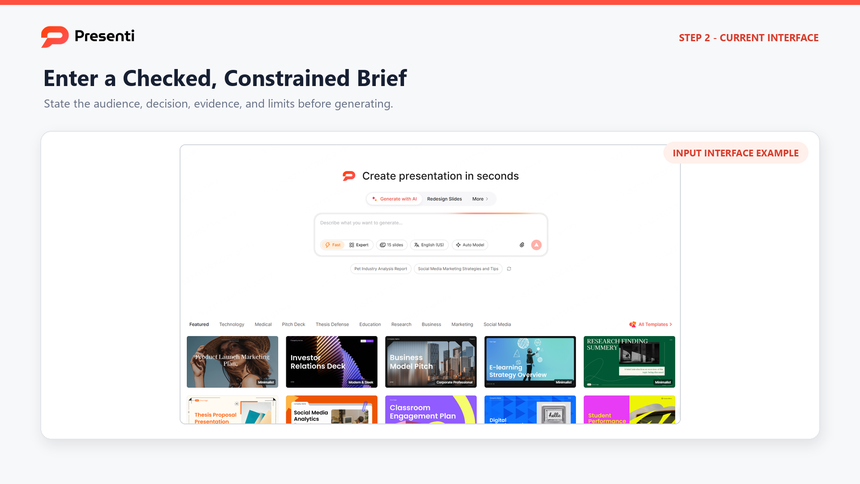
Once the scope, assumptions, budget logic, and measurement plan are written, Presenti can help turn the brief into an editable first draft. Use text to presentation when the source is already a structured brief. The tool can organize and design supplied material; it does not validate claims, pricing, legal language, tracking, or expected performance.
Write the input as instructions to a presentation editor, not as a slogan. Include the audience, decision, recommended option, slide sequence, evidence boundaries, and placeholders for missing inputs. A useful prompt is:
Create a 10-slide marketing proposal for a fictional 90-day subscription launch. Audience: the client marketing lead and finance approver. State the business problem, audience, strategy, channels, deliverables, dependencies, timeline, budget options, measurement plan, risks, and approval request. Keep assumptions labeled, separate service fees from media spend, and use placeholders for any unverified claim. Write message-led slide titles and include an appendix note for detailed terms.
Check: before generating, confirm that the prompt names the decision and the boundary of what is known. If it only asks for a "beautiful marketing deck," add the missing scope and evidence fields.
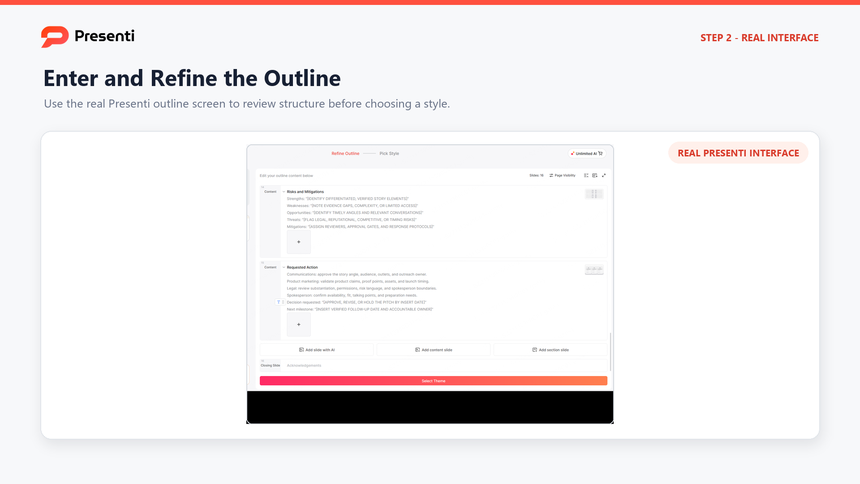
Step 1: Review the outline
Check that the outline moves from problem to recommendation, then to deliverables, investment, and proof. Remove generic marketing history and repeated service lists. Add an appendix for channel settings, source notes, or terms that would make the main story too dense. Correct any invented result while it is still an outline item.
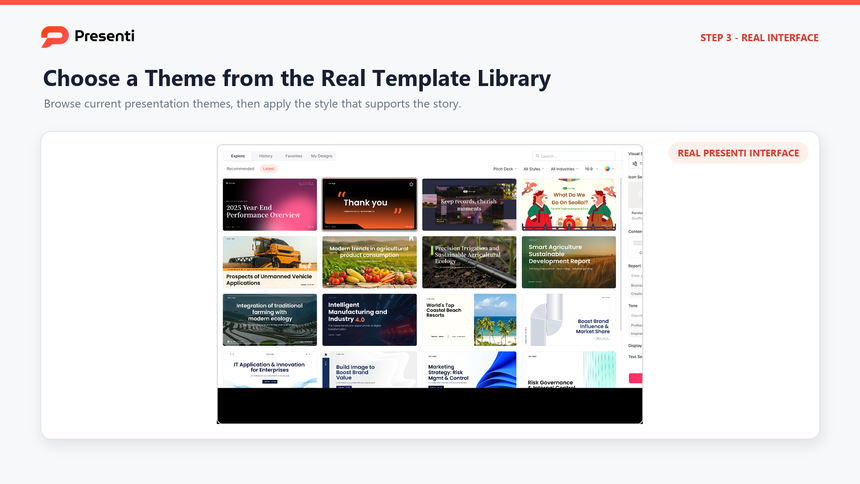
Step 2: Choose the visual system
Use Presenti's presentation templates as a starting point for hierarchy, not as a substitute for strategy. Pick layouts that can hold an option table, a timeline, a budget breakdown, and a measurement chain without shrinking the text. Keep the fictional example, client data, and assumptions visually distinct.
Step 3: Edit and verify
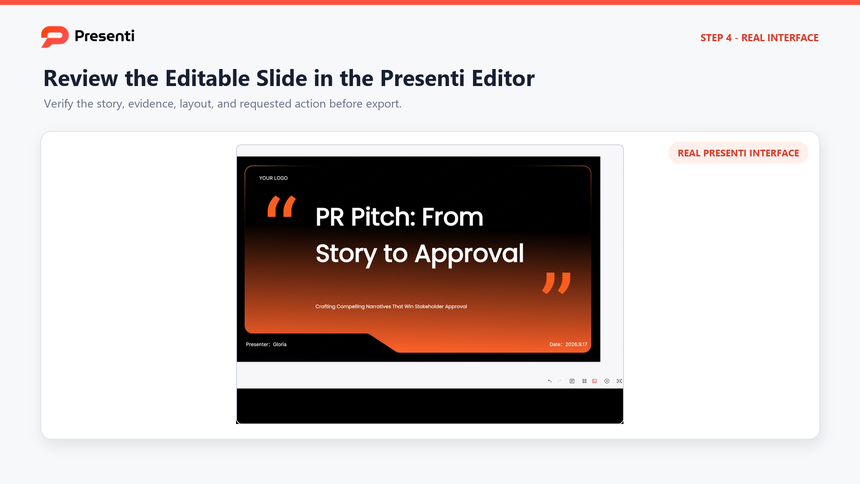
Compare every slide with the source brief and budget sheet. Check audience language, deliverable counts, dates, currencies, tax treatment, media handling, accessibility, and the definition of a qualified lead. Ask the client owner to approve claims and the measurement owner to confirm data access. Replace placeholders before the proposal is shared.
Step 4: Review the exported file
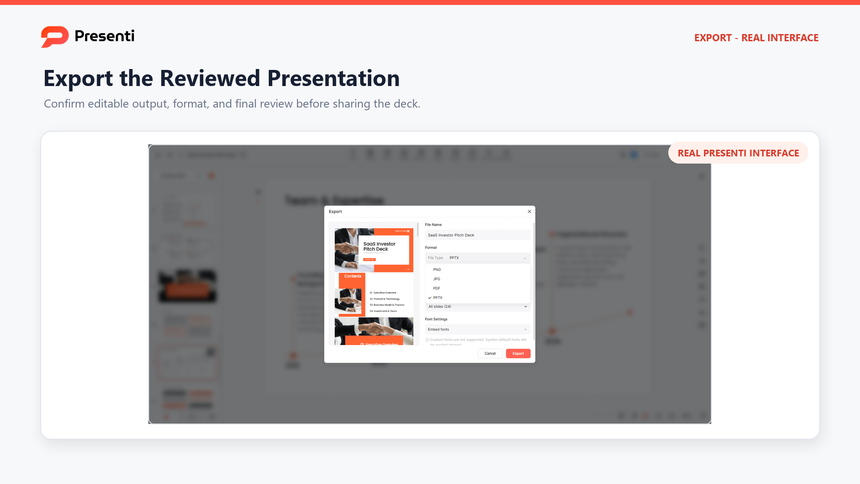
Open the exported file on the device and format the client will use. Confirm that tables, links, notes, page numbers, fonts, contrast, and confidentiality labels survive the export. Read the approval slide aloud: it should make the requested decision, amount, start date, and next action unambiguous. Presenti provides an editable draft; the proposal owner remains responsible for accuracy and judgment.
Frequently Asked Questions
What is the difference between a proposal and a marketing plan?
A plan explains how marketing will operate. A proposal asks a specific audience to approve a scoped version of that plan, with deliverables, investment, responsibilities, timing, and terms. A proposal can summarize a plan without replacing the working plan or contract.
How much detail should a proposal include?
Include enough detail to approve scope and evaluate the logic. Keep the main deck readable, then place channel settings, research notes, legal language, and detailed assumptions in an appendix or linked document. More pages do not solve an unclear decision.
Should media spend be part of the budget?
Show media spend separately from service and production fees. State who pays the platform, whether the amount is a cap or an estimate, the currency and tax treatment, and what happens if the plan changes. This prevents an attractive total from hiding a material variable.
Can a template guarantee campaign results?
No. A template improves consistency and makes assumptions easier to review; it cannot control audience response, inventory, platform delivery, competition, or attribution. Use scenarios and decision rules instead of guaranteed outcomes.
Can AI write the final proposal without review?
AI can organize supplied material and create an editable draft. A human still needs to verify facts, pricing, permissions, accessibility, client fit, and the measurement method. Treat generated copy as a starting point and keep the approval owner accountable.
Bottom Line
A marketing proposal should leave the client clear about the work, the price, and the approval needed. Connect the audience and channel choices to specific deliverables, separate service fees from media spend, and agree how results will be reviewed. Make the recommended scope and the next step easy to find.