A project handover presentation should show whether the receiving team can take responsibility for the work—not just whether the project team has finished building it. Explain what is accepted, what the receiving team has demonstrated, which issues remain open and who will respond after the transfer.
Keep three decisions separate: accepting a deliverable, authorizing operational use and formally closing the project. They may happen at different times. Once the evidence and proposed responsibilities are clear, turn the handover brief into an editable presentation draft. The slides should make those decisions easier to review; they do not make the decisions themselves.

Name exactly what is being handed over
“The project is complete” is too broad to guide the next team. State the service, process or asset being transferred, its version, the receiving owner and the intended transfer point. Identify anything explicitly outside the handover, such as a later reporting feature or an unrelated legacy process.
APM's project handover research treats handover as a transition rather than a single date. It emphasizes clear responsibilities, useful knowledge transfer and involvement of the receiving users. That is a useful basis for the presentation: show the conditions for taking ownership, not a ceremonial finish line.
For example, a project has built a new equipment-request process for an internal operations team. The scope includes an intake form, routing rules, a runbook and an exception procedure. The intended receiving owner is the operations lead. This is a fictional project used to illustrate the briefing; it is not a Presenti implementation or a claim about automated workflow features.
Its opening slide might say: “Transfer the equipment-request process after the exception procedure is accepted, the backup drill succeeds and support ownership is agreed.” That headline tells the audience what is proposed and what still prevents the transfer. It does not hide an unresolved condition behind a green “complete” label.
Separate accepted outputs from operational readiness
Prepare a short deliverable register before designing the deck. For each important output, show the version, the acceptance criterion and the evidence. “Sent to operations” records delivery; it does not prove that operations reviewed or accepted the item.
| Output | Evidence in the fictional project | What remains |
|---|---|---|
| Intake form v1.3 | Receiving lead accepted the required fields and submitted a normal test request. | No open form issue recorded. |
| Routing rules v1.2 | Normal requests reached the assigned receiving queue during the test. | Absence coverage has not passed its end-to-end drill. |
| Runbook v1.0 | Primary owner followed the standard procedure without the project lead directing each step. | Backup owner could not open the exception instructions during the drill. |
| Exception procedure v0.9 | A draft identifies the proposed escalation role. | The receiving team has not accepted the procedure or demonstrated it. |
Keep the actual acceptance record in the agreed project system, with the approver, date and version. Link or reference it from the slide. A presentation summary should not replace required contractual or organizational approval records.
Do not turn the table into “75% ready” because three rows look nearly complete. The items are not equal units of readiness, and one unresolved exception path can matter more than several completed documents. Describe the remaining condition directly.
Show what the receiving team can do without you
The most revealing handover slide often comes from a receiving-team rehearsal. Choose actions that resemble normal work and a plausible exception. The point is to discover missing knowledge, access or ownership while the project team is still available.
For the example, ask the receiving team to handle a normal request, locate the current procedure, deal with a request while the primary owner is absent and identify where to record an unresolved exception. Use permitted test data and the environment agreed for the exercise.
During the fictional rehearsal, the normal request succeeds. The absence case reaches the backup owner's queue, but the backup owner cannot open the exception instructions. That is a narrower and more useful finding than “training is incomplete.” It identifies a specific access-and-procedure gap that can be assigned and retested.
The repair is not simply to send another document. Have the responsible owner establish the approved access, confirm which procedure is current and repeat the same absence scenario. Record what happened. Attendance at a training session is not evidence that this particular task can be performed.
If a rehearsal cannot be completed before the planned transfer, state why and who may accept the resulting risk. Do not report an unperformed test as passed. Where the remaining condition prevents safe or workable use, the appropriate proposal is to defer that part of the transfer, not to lower the wording of the acceptance criterion.
Give every remaining issue a receiving owner and a boundary
A handover can contain open work, but an open item needs an explicit arrangement. Show who owns resolution, who owns day-to-day operation meanwhile, what the temporary boundary is and who is authorized to accept it. These can be different roles.
| Open item | Proposed arrangement | Evidence needed to close it |
|---|---|---|
| Backup cannot access the exception instructions | Project access owner repairs the permission; receiving lead arranges the retest. | Backup completes the absence scenario using the current runbook. |
| Exception procedure not accepted | Operations lead reviews the procedure with the project lead; no implied approval from a meeting attendance list. | Approval record identifies the accepted version and any limits. |
| Support ownership after transfer not agreed | Project sponsor and receiving lead confirm contacts, coverage period and escalation route. | Both teams know which role handles each type of request. |
For this example, the proposed transfer remains conditional on the first two items. The support arrangement must also be agreed before responsibilities change. The table describes proposals, not commitments already made by real people.
A low-impact cosmetic issue might be accepted as follow-up work in another project. That does not create a general rule that every defect can be handed over. Use the actual acceptance criteria and decision authority; make any limitation visible to the people who will operate the result.
Make the first operational week understandable
One support slide should answer what happens when somebody needs help after the transfer. Name the primary operational contact, the backup, the project contact during any agreed support window and the route for an urgent issue. State when that temporary arrangement ends or is reviewed.
Do not invent a two-week support promise because it fits the slide. If the teams have not agreed the duration or availability, label those fields as decisions required. Distinguish a request for help from authorization to change the accepted scope.
In the example, the receiving lead proposes a first-week review of unresolved exceptions. The review would confirm whether the backup route works in practice and whether the runbook needs a correction. It would not silently reopen completed project scope or guarantee that every new request will be handled by the project team.
Keep the current runbook, acceptance evidence and issue register easy to find. If this change is part of a wider operating plan, connect it to the existing operations plan's owners and review cadence rather than creating a conflicting set of responsibilities in the slides.
Use six slides to lead the handover discussion
The meeting should reach a decision about responsibility, not merely acknowledge that a deck was presented.
- Transfer proposal: the process, version, receiving owner, proposed point of transfer and any conditions.
- Accepted scope: the principal deliverables, their acceptance evidence and explicit exclusions.
- Receiving-team demonstration: the normal and exception tasks performed, actual results and gaps.
- Open items: blockers, accepted follow-up work, owners and the evidence required to resolve each item.
- Operational support: contacts, backup coverage, temporary project support and escalation boundaries.
- Decision record: proceed, proceed within approved limits or defer; record the authorized decision and next review.
Use a narrow table for the unresolved conditions and a simple transition timeline for support ownership. Avoid shrinking a whole project plan onto one slide. Detailed procedures belong in the referenced materials; the presentation carries the evidence and choices that the receiving team needs now.
Draft from the evidence, then record the real decision
Use the following brief after replacing the example with approved information. Keep the distinctions between a completed task, an accepted output and a proposed action intact.
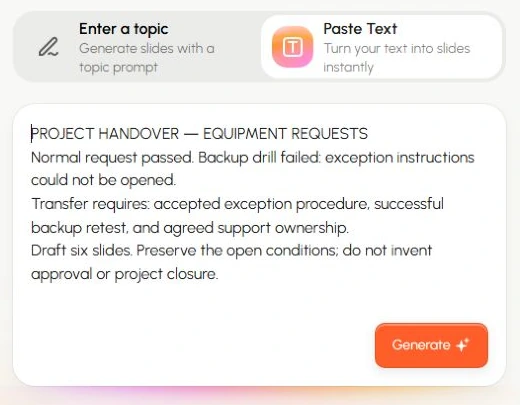
Create a six-slide project handover presentation for the fictional equipment-request process described above. The audience is the project sponsor and receiving operations team. Present the proposed transfer, accepted scope, actual rehearsal results, unresolved conditions, support arrangements and decision required. The normal request passed; the backup could not open the exception instructions during the drill, and a repeat test has not yet passed; the exception procedure is not accepted. Do not mark the project closed, invent approvals or describe proposed support as agreed. Leave unsupplied owners and dates clearly identified for completion.
Read the generated conclusion carefully. “Ready for handover” would misrepresent this source; “Ready after the stated conditions are met” preserves the proposed decision. Check the final slide against the actual meeting outcome before distributing it.
After the authorized decision, update the receiving owner, effective date, accepted limits and remaining actions in the source record as well as the deck. Project closure can then be considered through the organization's normal process. The useful handover is the one the receiving team can operate from, not the one with the most confident closing slide.