To translate a presentation well, preserve the meaning first and rebuild the layout around the translated text. A slide can be grammatically correct yet change the strength of a claim, lose a chart qualifier, or become unreadable because the new text no longer fits.
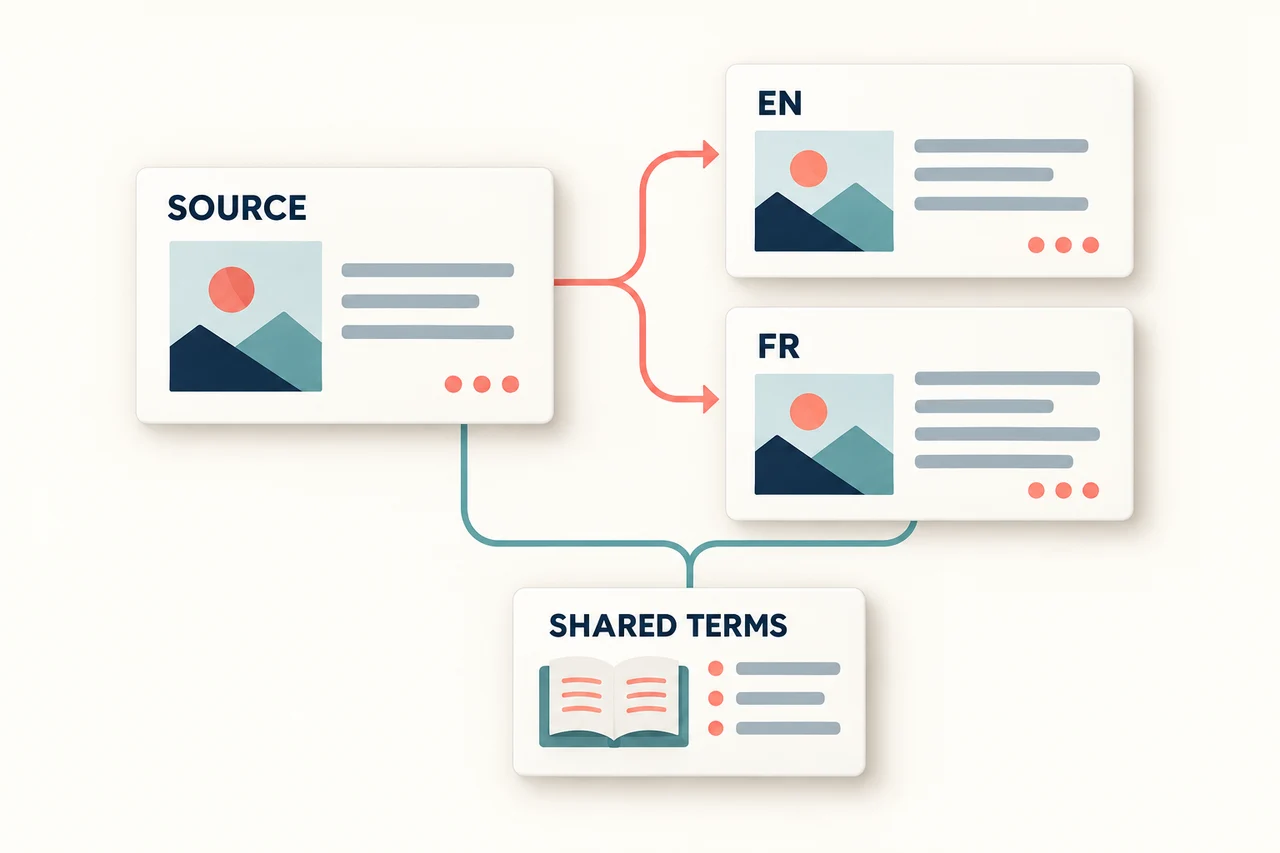
Work from one approved source deck, keep a record of important terminology, and review the translated version as a complete presentation. The English–French example below shows how to do that without turning every slide into two crowded columns. Once the translated copy has been reviewed, Presenti’s text-to-presentation workflow can turn it into a slide draft; it does not replace the translation review.
Choose how the audience will use the two languages
A bilingual presentation does not have to display both languages on every slide. Choose the delivery format before translating, because it determines how much space each version needs.
| Format | Useful when | Design consequence |
|---|---|---|
| Separate language decks | Different groups will attend different sessions or read the file independently. | Each version can use natural phrasing and its own line breaks. Keep matching slide IDs for updates. |
| Two languages on one slide | The audience needs to compare a few terms, instructions, or quotations. | Reduce the amount of content. Give each language a clear, consistent position. |
| One slide language with spoken interpretation | A mixed-language audience will attend one live session. | Agree on terminology with the interpreter and allow time for the explanation. Provide a translated reading copy where needed. |
For a detailed operational briefing, separate decks are often easier to read than a full translation placed beside every paragraph. For a vocabulary workshop, paired wording may be the point. Choose according to the task, not a rule that every bilingual deck should look the same.
Prepare a source that can survive translation
Finish substantive edits before sending the deck for translation. Give the working version a clear name, and assign stable references such as S03 for a slide and S03-chart-title for an object. A later slide insertion should not leave the reviewer guessing which chart a comment describes.
Collect text beyond the obvious headings: axis labels, legends, footnotes, diagram labels, image captions, notes, and the wording of the final action. Text baked into an image needs a separate treatment. Recreate the label as editable text when you have the source and permission, or supply a translated caption that explains what the image shows.
Specify a locale as well as a language. A French deck for France may use different terminology from one for a Canadian organization. Record the audience's preferred terms, degree of formality, product names to leave unchanged, and any wording already approved by the organization. Do not ask a translator to infer all of this from a logo.
Keep a small terminology list. An English word such as “owner” might mean a legal owner, a person accountable for a task, or an account administrator. The intended meaning determines the translation. Include a short explanation, not just a two-column list of isolated words.
Worked example: a support handoff slide in English and French
This authored example is a fictional internal support briefing. It uses separate English and French decks. The task is to explain who takes responsibility when a request moves to another team.
| Slide element | English source | French version |
|---|---|---|
| Title | Assign an owner before handing off a request | Attribuez chaque demande avant de la transférer |
| Instruction | The receiving team confirms who will handle the request. | L’équipe destinataire confirme qui prendra la demande en charge. |
| Evidence | 24 of 120 requests changed teams more than once in September (20%). | En septembre, 24 demandes sur 120 ont changé d’équipe plus d’une fois, soit 20 %. |
| Action | Start the pilot on October 7, 2026. | Lancez le pilote le 7 octobre 2026. |
The title uses a natural action in French rather than translating “owner” as property ownership. The evidence still describes requests that changed teams more than once; removing those words would change the metric. The calculation remains 24 ÷ 120 = 20%, and the month is preserved.
The reviewer should also ask whether “pilot” is the organization's usual term and whether the receiving team really confirms responsibility. Translation can reveal an ambiguity in the original. Resolve that with the subject owner, then update both versions.
Repair the layout around the explanation
Suppose the English slide has a narrow title box, three cards and a small chart. The French instruction wraps onto an extra line in its card. First widen or deepen that card and rebalance the neighboring cards. If the evidence and procedure compete for space, split them into a finding slide and an action slide, retaining the same source reference.
Do not make the French text smaller merely to reproduce the English line count. The W3C's explanation of text size in translation describes how length, compound words and character dimensions can change between languages. Its examples concern internationalized content generally; they are a useful reason to allow flexible slide layouts, not a fixed percentage by which every translated slide must expand.
Review language and layout in separate passes
In the language pass, compare the source and translation while keeping the audience's task in view. Check obligations, uncertainty, comparisons and exceptions. “May reduce delays” should not become “eliminates delays.” “Up to ten accounts” is different from “ten accounts.” A more confident translation is not necessarily a more accurate one.
For figures, compare the underlying value, unit, denominator and reporting period. Localize decimal separators and date wording without changing the quantity. Spell out a month when a numeric date could be read in two ways. Keep currencies explicit; translation does not imply currency conversion.
Then read only the target-language deck. Check that the titles form a coherent argument, diagrams have consistent labels, and instructions sound natural aloud. In the layout pass, inspect these elements at presentation size:
- Headings and labels that wrap, clip or collide with another object.
- Characters the selected font does not display correctly.
- Chart legends, source notes and units that became too small.
- Images containing untranslated words.
- Notes, captions and links that still refer to the wrong language version.
For a right-to-left script, have someone familiar with that script review text direction, mixed numbers and punctuation, diagram flow and alignment in the destination editor. Translating a string does not establish that the surrounding layout is appropriate.
Copy a brief that protects meaning
Use this brief with a translator, a colleague or a translation-assisted editor. Replace the bracketed fields before starting. The localization brief and translation register are also available as a copyable text file.
Translate the approved presentation from [source language/locale] into [target language/locale].
Audience: [role, prior knowledge and intended action].
Delivery: [separate language deck or selected paired text].
Use the attached terminology list and preserve these names: [names].
Preserve every number, unit, denominator, comparison period and source reference.
Keep obligations, uncertainty and exceptions at the same strength as the source.
Flag ambiguous wording for review instead of guessing.
Return a register with: slide/object ID, source text, target text, unresolved question and layout note.
Include chart labels, diagrams, notes and captions in the scope.
For example, Plus AI documents a rewrite workflow for translating individual slides or a presentation. Its documentation also acknowledges inconsistent language output. Whatever tool supplies the first version, the register gives the reviewer a specific place to resolve terminology and meaning.
If you are building a new deck from already reviewed target-language text, Presenti's text-to-presentation workflow is an option for drafting the outline and layouts. Keep the approved wording beside the draft while editing. Check the current plan details for the input and export you need.
Keep the language versions aligned after delivery
Send each version with its language, source version and review status in the filename or accompanying message. If an English source figure changes, record which slide and object changed, then revise the corresponding translation and recheck its layout. A translated deck is not finished if it still contains the previous reporting period.
Maintain one row per meaningful change: source change, affected slide IDs, translated wording, layout check and approver. That small record is what lets a bilingual presentation remain accurate after the first meeting.