Most students have heard the term dozens of times before they actually understand what it means. A teacher circles something in red and writes “where’s your thesis?” in the margin. A professor marks down a grade and comments “argument unclear.” You know something is missing — you’re just not entirely sure what.
So let’s settle this properly.
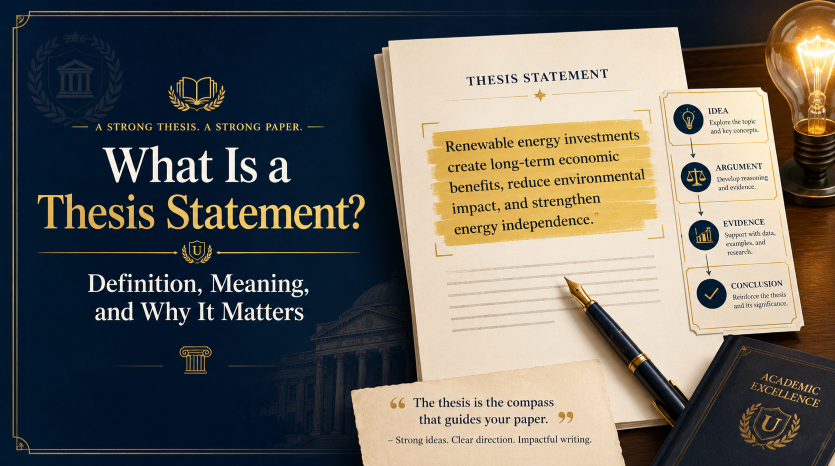
Thesis Statement Definition: The Clearest Way to Explain It
A thesis statement expresses the central claim or controlling idea of a paper, often in one or two sentences. In an argumentative or analytical essay, it states a specific, defensible position. An explanatory assignment may instead state the focus and organizing idea; follow the assignment’s requirements.
The thesis statement meaning goes beyond just “the main idea.” It’s a commitment. When you write a thesis, you’re telling your reader: this is the position I’m taking, and I’m going to back it up with evidence.
For an argumentative essay, if someone reads only your thesis statement, they should know what your entire paper is trying to prove — and ideally, feel curious enough to keep reading.
Thesis Statement vs. Topic: Not the Same Thing
One of the most common sources of confusion is treating a topic and a thesis statement as interchangeable. They’re not.
A topic is a subject area. A thesis statement is an argument about that subject area.
- Topic: The effects of social media on teenagers
- Illustrative thesis to test with evidence: Heavy social media use among teenagers is directly linked to increased rates of anxiety and disrupted sleep patterns, suggesting that platform design — not just usage time — requires regulatory attention.
See the difference? The topic is broad and neutral. The thesis statement takes a position, narrows the focus, and gives the paper a clear direction. Every sentence you write after that should connect back to that claim.
This distinction matters enormously when you’re writing an essay, a research paper, or even a college application. Knowing how to frame a thesis statement defined by argument rather than subject is what separates average academic writing from work that actually persuades.
What Is a Thesis in an Essay vs. a Thesis Paper?
The word “thesis” carries different weight depending on the context.
In an essay, the thesis is that one or two sentences in your introduction that anchor your argument. It appears early — usually at the end of the opening paragraph — and signals to your reader where the whole piece is headed. Whether you’re writing a five-paragraph essay in high school or a twenty-page analytical paper in college, the role of the thesis statement in an essay stays the same: it controls the entire piece.
A thesis can also mean an extended research document. Institutions use “thesis” and “dissertation” differently, and the expected scope depends on the degree and discipline. The project may use primary research, textual analysis, theory, or existing evidence; the concise central claim and the complete document are different things.
When people ask “what is a thesis in college,” they’re usually asking about something in between — a substantial research paper or final project where a clear, arguable claim is expected and evaluated.
Why the Thesis Statement Meaning Runs Deeper Than Most Realize
The thesis statement is where your thinking becomes visible. Before you’ve written a single body paragraph, the thesis is already telling your reader — and your professor — how clearly you understand the topic, how precisely you can articulate a position, and how confidently you’re willing to defend it.
A vague thesis signals vague thinking. A sharp, specific thesis signals the opposite.
This is why instructors push so hard for specificity. Consider these two versions:
Weak: Climate change is a serious problem that affects many people around the world.
More specific illustrative thesis: Rising sea levels driven by accelerating polar ice melt disproportionately threaten low-income coastal communities, exposing a critical gap in current international climate adaptation policy.
The first statement is technically true — and too broad to guide this argumentative paper. No one disagrees with it. There’s nothing to argue. The second version takes a real position, identifies a specific mechanism, names an affected group, and points toward a policy implication. That’s something worth writing a paper about.
Define Thesis in Literature: A Slightly Different Animal
In literary studies, the thesis statement works the same structural way — but the content operates differently. When scholars talk about thesis definition in literature, they’re usually referring to an interpretive claim about a text or set of texts.
You’re not arguing for a policy or a scientific finding. You’re arguing for a reading. Your job is to convince readers that your interpretation of a work — its themes, its symbols, its historical context, its narrative structure — is compelling and well-supported.
Example: In The Great Gatsby, Fitzgerald doesn’t celebrate the American Dream — he conducts a careful autopsy of it, using Gatsby’s relentless optimism as evidence of how the myth of reinvention corrodes moral judgment.
That’s a thesis in the literary sense: a specific, arguable interpretation built for a paper that will analyze the text in detail.
The Core Qualities Every Thesis Statement Needs
For an argumentative or analytical assignment, these qualities provide a useful review:
- It takes a position. Not “there are many views on this topic.” An actual stance.
- It is specific. Naming variables, populations, texts, or conditions rather than speaking in generalities.
- It is arguable. A reasonable, informed person could disagree with it — which means there’s something worth arguing.
- It is appropriately scoped. It doesn’t promise more than the paper can deliver, but it doesn’t undersell the argument either.
If your thesis statement passes all four of those tests, you have something to build on.
From Written Thesis to Presented Argument
A strong thesis statement doesn’t just make your paper better — it makes every downstream task easier. Outlining becomes cleaner. Body paragraphs have a purpose. Conclusions have something to return to.
That logic extends beyond the written page. When you eventually need to present your research — at a seminar, a thesis defense, or a conference — your thesis statement becomes the foundation of your opening slide. It’s the first thing your audience should understand, and it frames everything that follows.
For a research presentation, Presenti AI can draft slides from an outline or supported source file. Word/PDF/TXT input and editable PPTX/PDF export are listed on paid plans. Compare the resulting structure with your claim, evidence, and qualifications before presenting.
The thesis statement, after all, is just the beginning of communicating your ideas. The clearer it is on the page, the clearer it will be on the screen.