A dissertation defense presentation has one job: explain the research clearly within the time your department allocates. That's a different skill than writing the dissertation itself, and it's usually the part students prepare for last — often with the least time left to do it.
This covers what belongs in a dissertation defense presentation, how a proposal defense deck differs from a final defense deck, a worked example outline, and a faster way to get from a finished draft to a presentable set of slides.

Proposal Defense vs. Final Dissertation Defense: Different Decks
These two events get lumped together in search results, but the presentations built for them are structurally different, because the committee is evaluating different things.
| Proposal Defense | Final Dissertation Defense | |
|---|---|---|
| Committee is evaluating | Whether the planned research is sound and worth pursuing | Whether the completed research is valid and the conclusions hold up |
| Core content | Research question, gap in the literature, proposed methodology, timeline | Research question, methodology used, results, discussion, conclusions, limitations |
| Results section | May include pilot or preliminary results; distinguish these from planned work | Central section of the deck |
| Typical length | Set by the program | Set by the program and examination format |
If you're prepping a dissertation proposal defense PowerPoint, the goal is convincing the committee your plan is feasible and worth the time — not proving anything yet. If you're prepping the final dissertation defense presentation, the goal shifts to demonstrating your findings hold up to scrutiny.
Dissertation Defense Presentation Template (Slide by Slide)
There's no single universal format, but most successful final-defense decks follow a recognizable sequence. Use this as a starting template and adjust based on your department's specific expectations.
- Title slide — dissertation title, your name, advisor, committee, institution, date.
- Research question / problem statement — what you set out to answer, and why it matters.
- Background and gap in the literature — brief, not a full lit review; just enough to show where your work fits.
- Methodology — how you gathered and analyzed your data, at a level of detail the committee can evaluate.
- Results — your core findings, presented with figures and tables rather than dense text.
- Discussion — what your results mean, and how they answer your original research question.
- Limitations — addressed proactively; committees respect candor here far more than they penalize it.
- Contributions and future work — what your research adds to the field, and where it could go next.
- Conclusion / summary slide — a compact restatement of your core argument.
- Acknowledgments and Q&A — closes the formal portion and opens the floor to committee questions.
For a dissertation proposal defense PPT, use the same opening (title, question, background, methodology) but stop before Results — replace it with a proposed timeline and expected contribution instead.
Dissertation Defense Presentation Example
Seeing the template applied to an actual topic tends to make it click faster than the abstract structure alone. Here's a condensed example outline for a hypothetical dissertation on urban green space and public health outcomes.
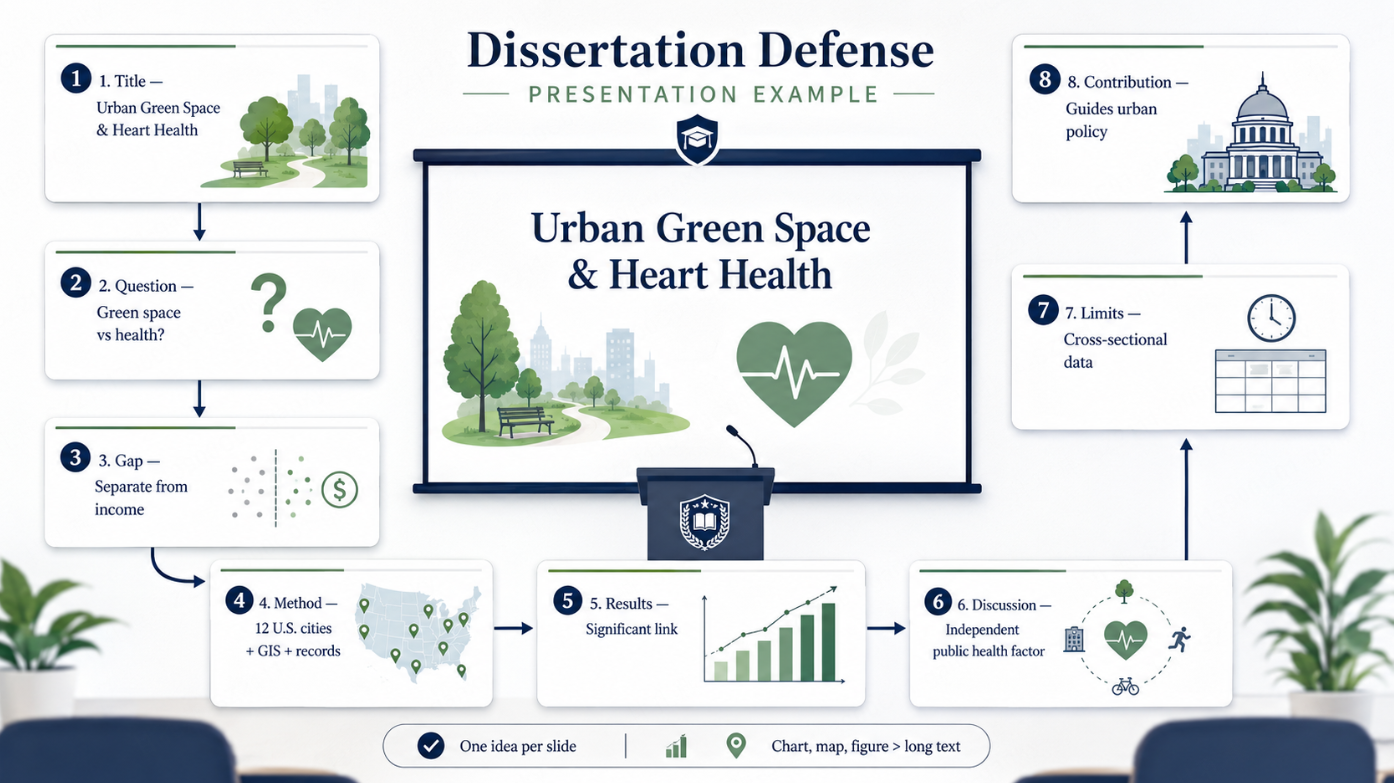
Example outline
1. Title: "Urban Green Space Access and Cardiovascular Health Outcomes in Mid-Sized U.S. Cities"
2. Research question: Does proximity to green space independently predict cardiovascular health outcomes, controlling for income and air quality?
3. Gap: Illustrative gap: prior studies may not adequately separate green space access from socioeconomic factors.
4. Methodology: Cross-sectional analysis of health records across 12 mid-sized cities, matched against GIS-mapped green space data.
5. Results: Statistically significant association after controlling for income and pollution exposure.
6. Discussion: Interpret the adjusted association while considering residual confounding and the limits of the design.
7. Limitations: Cross-sectional design limits causal claims; self-reported health data in a subset of cities.
8. Contribution: Adds evidence at this geographic scale; compare the contribution with prior work before claiming novelty.
Notice how little text sits on each conceptual "slide" here — in an actual deck, each of these points would be its own slide with a chart, map, or figure doing most of the work, not a paragraph of prose.
What Makes Defense Slides Actually Work in the Room
- One idea per slide. If you're narrating three separate points on one slide, split it — the committee should never be reading ahead of what you're saying.
- Figures over paragraphs. A chart, table, or diagram usually communicates a result faster and more credibly than a bullet list summarizing it.
- Consistent template throughout. Fonts, colors, and layout should stay uniform slide to slide — inconsistency reads as unpolished regardless of how strong the research is.
- Numbers labeled clearly. Axis labels, units, and sample sizes should be visible without you having to explain them verbally every time.
- A visible thread. Each slide should connect obviously back to your research question — committees notice when a section feels disconnected from the core argument.
Common Mistakes in Dissertation Defense Presentations
- Cramming the entire dissertation into the slides. The deck is a guide for your talk, not a replacement for the written document — committees have already read the full thing.
- Under-preparing the proposal defense because "it's not the real thing yet." A weak proposal defense can delay your entire timeline; treat it with the same rigor as the final defense.
- Skipping limitations. Leaving them out doesn't make the work look stronger — it just means the committee brings them up first, and now you look unprepared instead of thorough.
- Too much text, too small. If a slide needs a font size under 24pt to fit everything, the slide has too much on it, not too small a screen.
Turning Your Dissertation Into Slides, Without Starting From a Blank Deck
Building a defense deck from scratch usually means re-reading your own dissertation, mentally extracting the structure above, and rebuilding it slide by slide — a slow process at exactly the point in your timeline when you have the least slack left.

Presenti AI is built to skip that manual extraction step. It generates a full presentation online from supported source material within the selected plan’s limits:
- Text or a prompt to presentation: Describe your dissertation topic and argument directly, and it drafts a structured outline from scratch.
- Word documents to presentation: Upload your dissertation or proposal chapters after checking the input limits and selecting the relevant content.
- PDF files to presentation: Works directly from a finished, exported dissertation PDF, including proposal documents.
- Markdown files to presentation: Useful if your drafts or notes are already written in Markdown.
- Web links to presentation: Point it at a published paper, an online proposal document, or another supported, accessible research page.
- PPTX files to presentation: Upload a rough draft deck you've already started, and have it restructured and redesigned rather than rebuilt from zero.
Whichever input you use, Presenti AI maps the content onto a structured slide outline — pulling out your research question, methodology, key findings, and conclusions — and applies a consistent design automatically. Eligible paid plans support editable PPTX export, so you can open it in PowerPoint or Google Slides, adjust the layout, and add your speaker notes and defense talking points before the actual presentation.
Build the Deck Around the Examination’s Purpose
A strong dissertation or proposal defense presentation isn't a shorter version of your written document — it's a different artifact built for a different job: giving a committee a clear, visual path through your argument in a fixed amount of time. Whether you're building the proposal defense deck early in the process or the final defense deck at the end, the same principles hold: one idea per slide, figures over paragraphs, and a structure a committee can follow without your written dissertation open in front of them.