An event marketing plan presentation explains who you want to attend, why the event is relevant to them, and how you will reach them. It also gives the team a campaign schedule, budget, and a way to compare registrations with attendance and follow-up results.
This template works for a conference, webinar, product event, community program, trade show, or customer gathering. It focuses on marketing the event, not the complete venue, production, speaker, or run-of-show plan. Show operational dependencies only when they affect the audience promise, campaign timing, budget, or measurement.
What Should an Event Marketing Plan Presentation Decide?
Start with the business or community purpose and the audience behavior the campaign must create. "Generate awareness" is too broad. A useful objective identifies the event, audience, target action, number or range, deadline, and quality condition.
For example: "Generate 600 qualified registrations from operations leaders by October 10, achieve at least 65% attendance, and create 120 opt-in follow-up conversations within two weeks of the event." The figures are illustrative. The real targets should reflect capacity, economics, prior-event evidence, and the event's purpose.
| Decision | Evidence | Output |
|---|---|---|
| Who is the priority audience? | Need, fit, reachable population, prior response, and value | Primary and secondary audience segments |
| What is the event promise? | Audience problem, differentiated experience, proof, and constraints | Positioning and message hierarchy |
| How will demand be created? | Channel reach, timing, cost, conversion, and partner access | Campaign mix, timeline, and budget |
| What happens after registration? | Attendance risk, reminders, experience, follow-up path | Nurture, attendance, and post-event plan |
Separate event marketing from marketing through events. The first promotes attendance or participation; the second uses an event to create brand, customer, partner, or revenue outcomes. One deck may cover both, but the goals and measures must remain distinct.
Which Slides Belong in an Event Marketing Plan Deck?
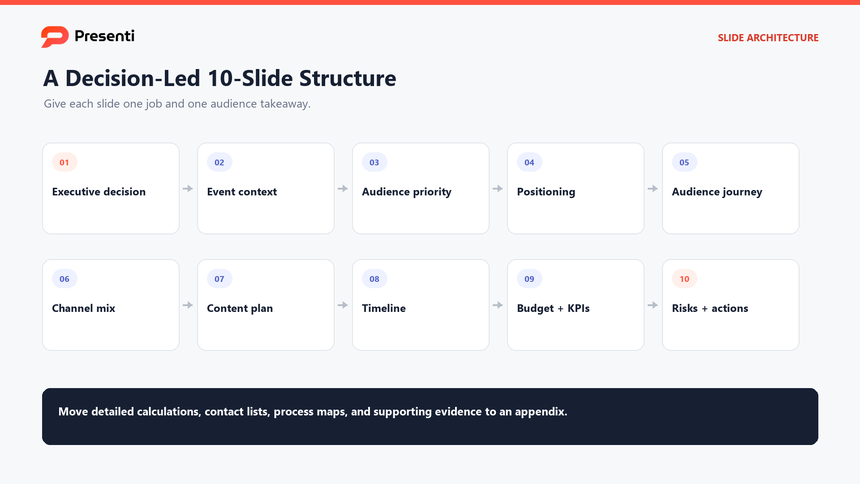
A practical deck usually contains ten core slides. Keep the main narrative focused on decisions and use an appendix for creative examples, media specifications, contact lists, tracking definitions, and detailed production schedules.
- Executive decision. State the event, purpose, audience action, targets, and approval required.
- Event context and constraints. Show format, date, location, capacity, offer, and material dependencies.
- Audience priorities. Define primary and secondary segments using evidence rather than demographic labels alone.
- Positioning and message. Explain the audience problem, event promise, proof, and reasons to act now.
- Audience journey. Map awareness, consideration, registration, attendance, participation, and follow-up.
- Channel and campaign mix. Assign the role of owned, earned, partner, community, paid, and direct channels.
- Content and asset plan. Show the messages and creative assets needed at each phase.
- Timeline and ownership. Connect launch waves, milestones, dependencies, and accountable owners.
- Budget and measurement. Show spend by campaign role, tracking method, targets, and decision thresholds.
- Risks and next actions. Name likely failure modes, contingencies, approvals, and the next review.
For each channel, explain which audience it reaches, what message it carries, and when it enters the campaign. A speaker’s LinkedIn post, a partner email, and a paid ad may all promote the same event, but they serve different audiences and need different content.
How Do You Build the Audience and Message Strategy?
Prioritize audiences by more than size. Evaluate the need the event addresses, strategic fit, likelihood of response, ability to reach the segment, expected value, and the cost or effort required. A small partner community with strong relevance may be more important than a broad audience with weak intent.
Give each segment a short evidence profile:
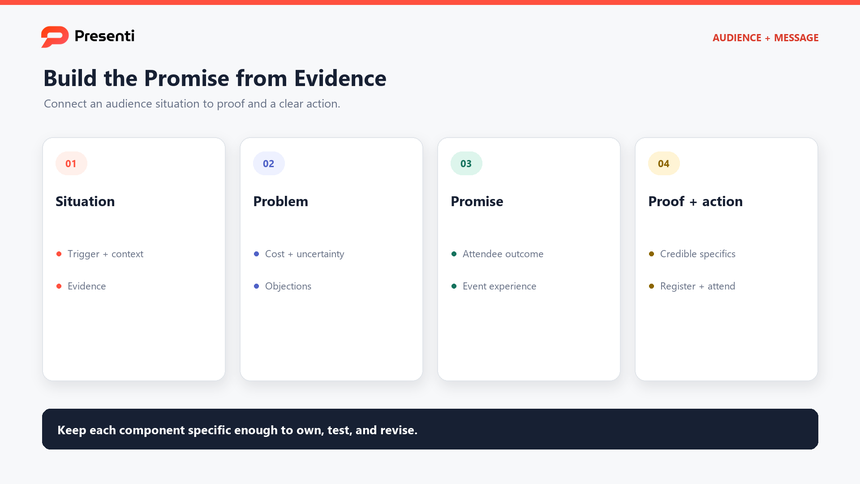
- Situation: the change, task, or trigger that makes the event relevant now.
- Problem: the cost, risk, uncertainty, or missed opportunity the audience feels.
- Desired outcome: what the attendee wants to learn, decide, experience, or accomplish.
- Objection: the reason the person may not register or attend.
- Reach path: trusted channels, partners, communities, and direct contacts.
- Evidence: prior registrations, interviews, behavior, research, or stakeholder knowledge.
Translate the profile into a message hierarchy. Lead with the attendee outcome, support it with specific content or experience, add credible proof, and give a clear action. Avoid describing the event only through internal themes such as innovation or transformation. The audience must see what changes for them.
Use one promise across channels but adapt the proof and format. A partner email may emphasize relevance to a shared community, a speaker post may emphasize expertise, and a paid ad may focus on a specific problem and date. The core event should remain recognizable.
How Should You Plan Channels, Timeline, and Budget?
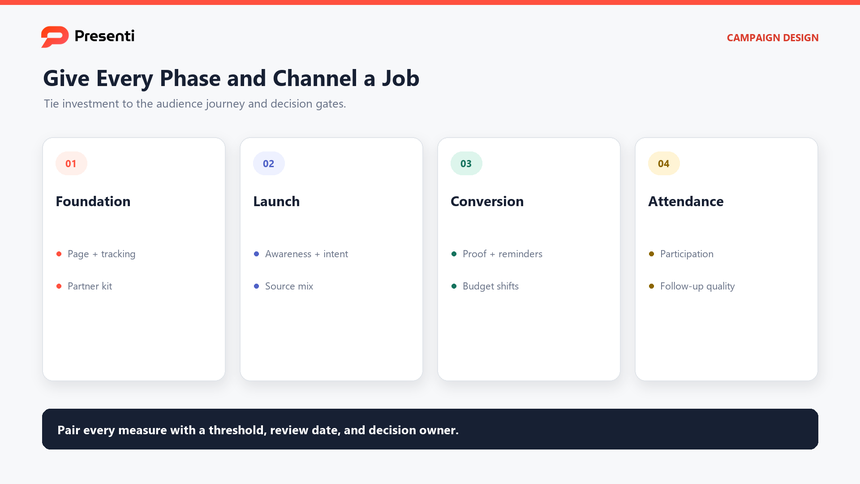
Build the timeline around audience readiness and decision points, not a repeated weekly checklist. Most campaigns need distinct phases: establish the event, build proof, convert interest, reduce non-attendance, and extend value after the event.
| Phase | Primary job | Typical assets | Measure |
|---|---|---|---|
| Foundation | Make the event credible and discoverable | Event page, tracking plan, partner kit, core message | Page quality, tracking readiness, partner commitments |
| Launch | Create awareness and early intent | Announcement, speaker content, direct outreach, PR | Qualified visits, registrations, source mix |
| Proof | Reduce uncertainty and deepen relevance | Agenda detail, clips, case evidence, testimonials, previews | Conversion by segment and content response |
| Conversion | Help interested people act before the deadline | Reminders, retargeting, urgency, partner follow-up | Registration pace, cost, and capacity |
| Attendance and follow-up | Turn registration into participation and next action | Calendar, logistics, reminders, recap, recordings, outreach | Attendance, engagement, qualified follow-up |
Assign every channel a role. Owned channels can educate the existing audience, partners can add trust and reach, direct outreach can target high-value invitees, and paid media can expand or recover demand. Do not assume attribution is complete. Define source rules, campaign naming, registration fields, privacy requirements, and the limitations of cross-device or partner tracking.
Present budget as a choice. Separate fixed campaign infrastructure from variable spend, show committed versus optional funds, and identify the trigger for shifting budget. A channel with a low registration cost may still be weak if registrants do not attend or fit the intended audience.
What Does a Practical Event Marketing Example Look Like?
Consider a fictional one-day customer operations summit with 300 seats, aimed at operations leaders in growing software companies. Suppose the campaign target is 450 qualified registration requests, 300 attendees, and 60 opt-in follow-up conversations. These are planning examples, not benchmarks. With only 300 seats, use confirmations and a waitlist to manage demand; an expected no-show rate is not permission to promise 450 people a seat.
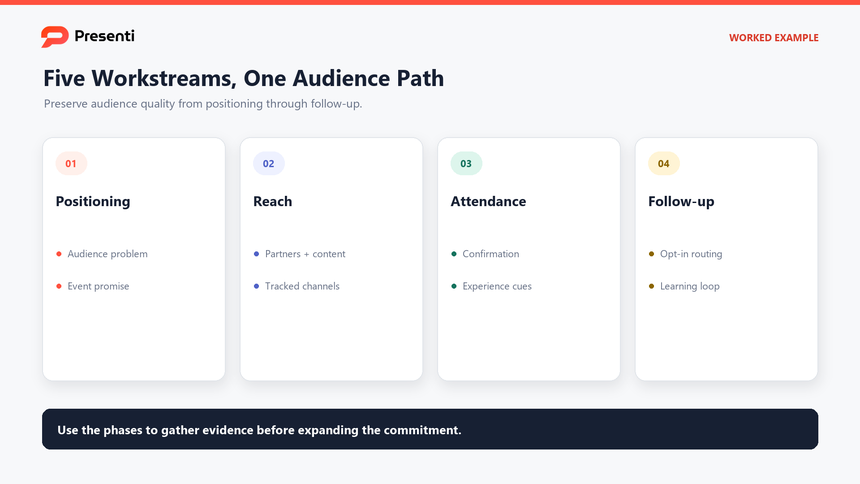
| Workstream | Core action | Owner | Evidence reviewed |
|---|---|---|---|
| Positioning | Frame the event around reducing operational friction with practical peer examples | Event marketing lead | Audience interviews and prior-event feedback |
| Partner reach | Equip five partners with co-branded messages and tracked registration paths | Partnerships lead | Commitments, qualified visits, and registrations |
| Content campaign | Publish speaker previews, a benchmark briefing, and objection-focused FAQs | Content lead | Engagement and assisted registration |
| Attendance | Use calendar confirmation, logistics, agenda value, and segmented reminders | Lifecycle lead | Confirmation and attendance by source |
| Follow-up | Route opt-in attendees by topic and next-step interest within two business days | Revenue operations | Qualified conversations and completion time |
Show a weekly registration trajectory with capacity and decision thresholds. If partner registrations are behind plan by a named date, decide whether to add direct outreach, change the offer, or shift optional media budget. Do not wait until the final week to discover that the audience mix is wrong.
After the event, separate marketing performance from event experience and business outcomes. Registrations, attendance, session engagement, satisfaction, and follow-up may move differently. Capture lessons by segment and source so the next plan is based on evidence rather than a single total.
How Can Presenti Turn an Event Brief into an Editable Deck?
Presenti can draft slides from your event brief. Use text to presentation for a written outline, or a supported document input for an existing plan. Word and PDF inputs require an eligible paid plan. Remove outdated dates and attendee information that does not belong in the presentation.
A free Presenti account includes limited AI use for trying a draft. Paste the campaign brief, review the outline, and choose a style from the Presenti template center. PowerPoint and PDF exports require an eligible paid plan.
The product supports the communication step. It does not validate venue capacity, media costs, registration tracking, consent, or partner commitments. Keep a source sheet for every target and ask owners to verify the final deck.
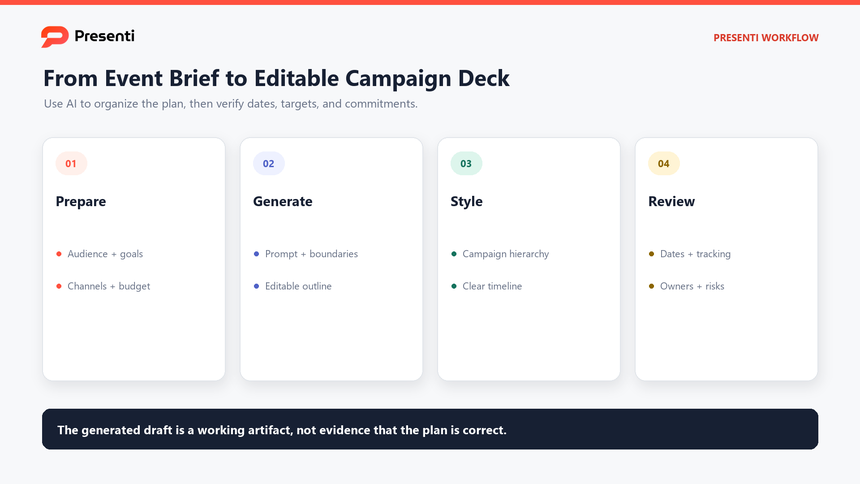
Step 1: Prepare the campaign brief
Include the event purpose, format, date, audience segments, positioning, offer, capacity, goals, channels, content, timeline, budget, owners, dependencies, measurement rules, risks, and the decision required.
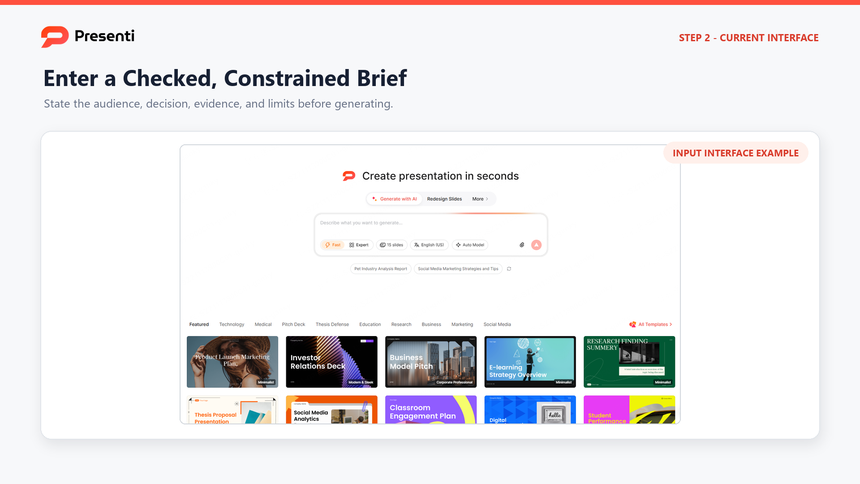
Step 2: Enter a prompt with evidence boundaries
Use a prompt such as:
Create a 10-slide event marketing plan presentation for a leadership review. Event: a one-day customer operations summit for 300 attendees. Include the business purpose, priority audience, positioning, audience journey, channel roles, content plan, campaign timeline, budget choices, registration and attendance KPIs, risks, owners, and the approval required. Treat the sample targets as illustrative. Do not invent channel benchmarks, partner commitments, or customer results.
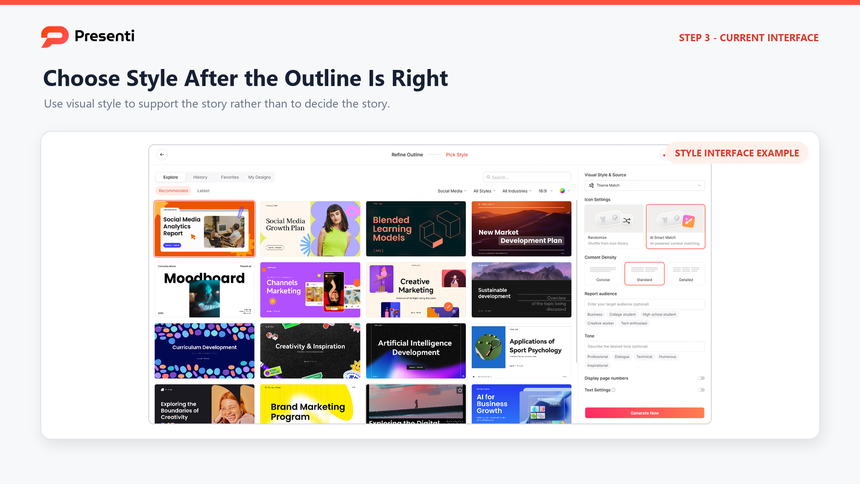
Step 3: Review the audience journey, then choose an event template
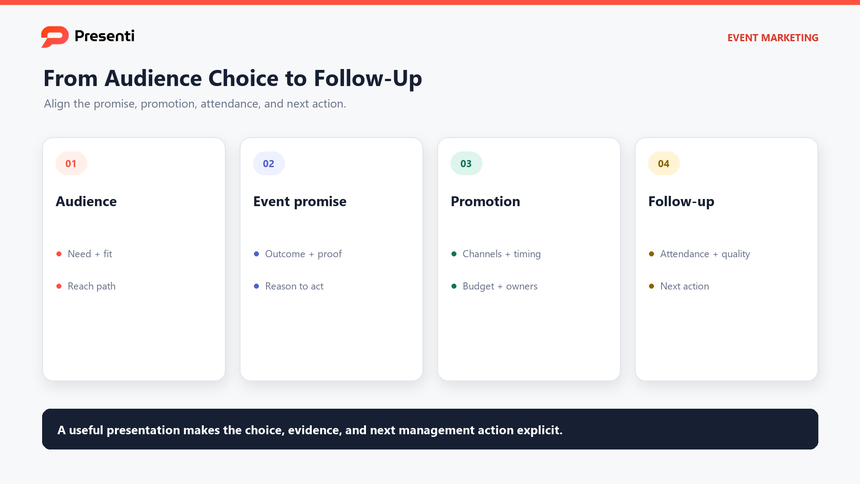
Check that the story moves from audience choice to message, promotion, attendance, and follow-up. Remove generic event-planning slides and add a tracking or decision slide if the outline does not explain how the team will learn. When the campaign sequence is right, preview a template that can distinguish audience, channel, timeline, and budget without turning the plan into a promotional poster.
Step 4: Verify the editable campaign deck
Check dates, audience definitions, channel roles, budget figures, tracking logic, owners, capacity, and risk responses. Replace illustrative values with approved data, confirm that partners have accepted their commitments, and test whether the call to action is clear at presentation distance.
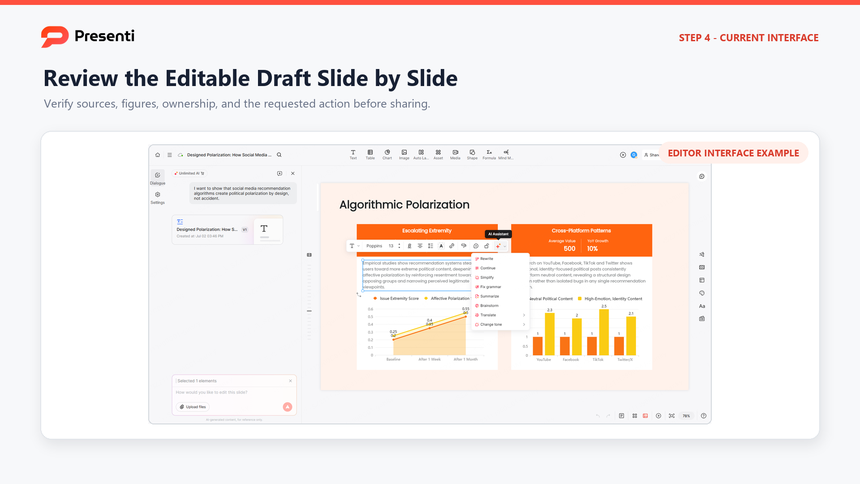
The final presentation should help the team make trade-offs across audience, timing, channels, and budget while preserving a clear path from registration to post-event value.
Frequently Asked Questions
What should an event marketing plan presentation include?
Include the event purpose, audience segments, positioning, audience journey, channel roles, content plan, campaign timeline, budget choices, owners, measurement, risks, and the decision required. Put detailed creative specifications and contact lists in an appendix.
How is event marketing different from event planning?
Event marketing focuses on attracting the right audience, converting interest into registration and attendance, and creating post-event action. Event planning covers production, venue, speakers, logistics, experience, and delivery. The work overlaps where operational choices affect the audience promise.
How many slides should an event marketing deck have?
About ten core slides are enough for most leadership reviews. Use fewer for a small event and an appendix for creative samples, detailed media plans, tracking definitions, and production dependencies.
Which event marketing KPIs matter?
Use measures across qualified reach, registration, attendance, engagement, and follow-up. Segment them by priority audience and source where possible. Cost per registration alone can mislead when attendance or audience quality varies.
When should event promotion begin?
The correct lead time depends on the event type, audience decision cycle, capacity, ticket model, speakers, and channels. Build backward from the event date and define foundation, launch, proof, conversion, attendance, and follow-up phases.
Plan Beyond the Registration
Choose the audience first, then explain how each channel will help people discover, register for, and attend the event. Keep the schedule and budget realistic, and plan the follow-up while the campaign is still being designed. That gives the team a usable plan from the first announcement to the final attendee conversation.