Every thesis statement makes an argument — but it can make that argument two different ways. One spells out exactly what points you'll cover, in order. The other states the position and leaves the roadmap unwritten, on purpose.
Neither approach is "correct" in general. Which one you should use depends on your assignment, your essay's length, and how much room you want to leave yourself to explore. Below: what separates an open thesis from a closed one, illustrative examples of each, and a few pointers on picking the right one for the paper in front of you.
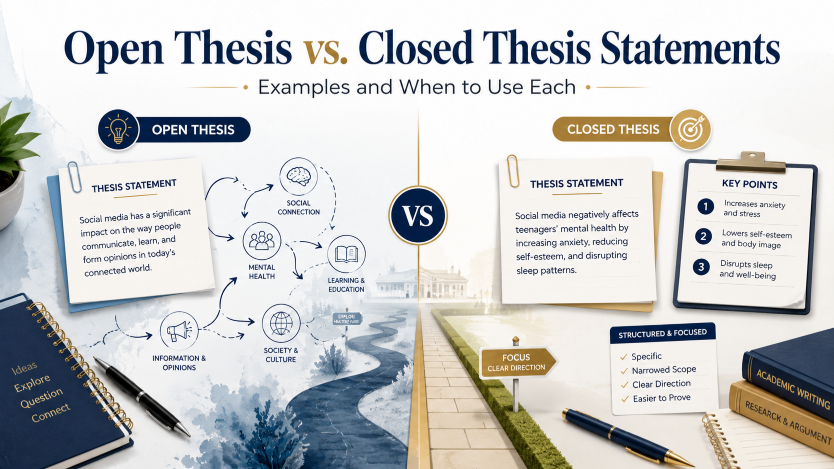
Closed Thesis Statements: Definition and Examples
A closed thesis statement names your position and previews the specific points you'll use to support it — usually two or three, right in the sentence. It gives readers a brief roadmap of the points to follow. The examples below demonstrate structure; they are proposed claims to support or revise with evidence, not established findings.
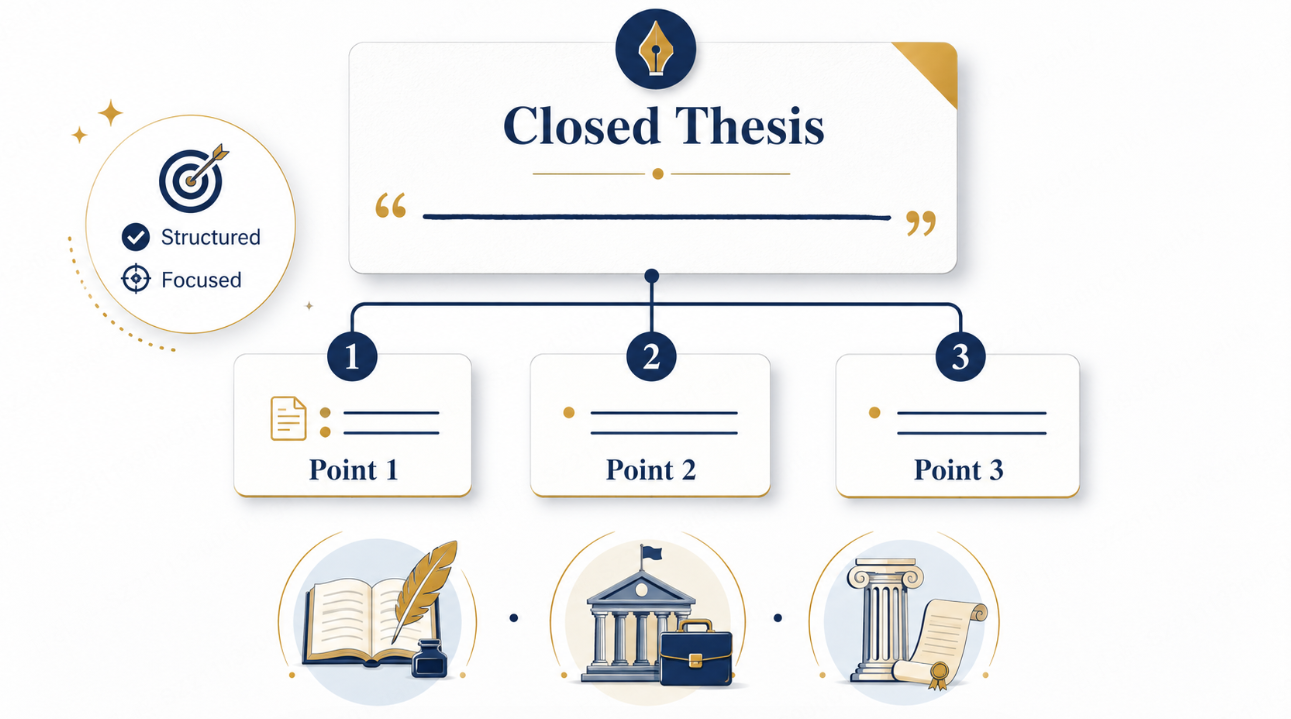
This makes closed statements a natural fit for shorter essays, timed writing, and any assignment that rewards a tightly organized structure. The tradeoff is flexibility — once you've listed your points, your essay is expected to follow them.
- Closed thesis example — literature
Coming-of-age novels rely on three recurring devices to mark a character's transition into adulthood: a symbolic journey, a betrayal by a trusted adult, and a final act of independent choice.
- Closed thesis example — public policy
Remote work policies improve organizational performance by reducing office overhead, widening the talent pool beyond a single city, and lowering employee turnover.
- Closed thesis example — history
The fall of the Roman Empire resulted from a combination of military overextension, currency devaluation, and a fractured system of political succession.
Notice the pattern: each one names the argument, then locks in the exact sub-points the essay will cover. A reader — or a grader — can check the body paragraphs against that list.
Open Thesis Statements: Definition and Examples
An open thesis statement makes a clear claim but doesn't itemize how you'll support it. It signals direction without committing to a fixed structure, which gives you room to bring in ideas as the essay develops rather than locking them in up front.

This makes open statements better suited to longer, more exploratory, or more analytical papers — research essays, argumentative papers with several possible angles, or any assignment where the strongest supporting points might only become clear once you're deep into the research.
- Open thesis statement example — literature
Coming-of-age novels use narrative structure to mirror the psychological instability of adolescence.
- Open thesis statement example — public policy
Remote work is reshaping the fundamental relationship between employers and employees.
- Open thesis statement example — history
The fall of the Roman Empire reflects the limits of managing an empire built faster than it could be governed.
Each of these still stakes out a clear position — nothing here is vague or wishy-washy — but none of them promise a specific set of supporting points. The writer keeps the option to bring in whichever evidence turns out to be strongest.
Side-by-Side: Same Topic, Two Approaches
Seeing both versions of the same argument next to each other usually makes the distinction click faster than any definition does.
| Topic | Closed Thesis | Open Thesis |
|---|---|---|
| Social media | Social media has damaged teenage mental health through constant comparison, disrupted sleep, and reduced face-to-face interaction. | Social media has fundamentally altered how teenagers understand themselves in relation to others. |
| Climate policy | Carbon taxes reduce emissions more effectively than subsidies because they change consumer behavior directly, require less bureaucratic oversight, and generate public revenue. | Carbon taxes represent a more direct, if politically riskier, path to reducing emissions than subsidy-based approaches. |
Both columns address the same topic, though their claims differ in scope and emphasis. The closed version commits to a structure before the essay even starts; the open version commits to a stance and leaves the structure to develop through the writing itself.
When to Use a Closed Thesis
- Timed or exam essays — a closed thesis gives you an instant outline when there's no time to plan one separately.
- Shorter papers (roughly under five pages) — there's rarely room to explore beyond two or three points anyway.
- Assignments that explicitly ask for a clear roadmap — some instructors grade partly on whether your intro previews your structure.
- When you already know your strongest points — if the research is done and the argument is settled, a closed thesis reflects that clarity.
When to Use an Open Thesis
- Longer or research-heavy papers — locking in three points before you've finished researching often means cutting good evidence that doesn't fit the list.
- Exploratory or analytical topics — when the goal is to examine a question rather than prove a fixed set of points.
- Topics where the strongest angle may shift — an open thesis lets your argument sharpen as you write, instead of forcing early commitments.
- Graduate-level or thesis/dissertation work — longer academic projects tend to favor open statements since the full scope of findings isn't always clear until the research is well underway.
Common Mistakes With Both Types
A few issues show up regardless of which style you choose:
- Confusing "open" with "vague." An open thesis still needs to take a clear position — "social media affects teenagers" isn't an open thesis, it's a topic sentence with nothing to argue.
- Confusing "closed" with "restrictive." A closed thesis lists your main points, but each point can still be explored with nuance and depth in the body paragraphs — it's not a checklist to rush through.
- Mismatching thesis type to assignment length. A closed thesis with three tightly listed points can feel thin stretched across a 15-page paper; an open thesis can leave a two-page essay feeling unfocused.
- Treating an early thesis as fixed. A working thesis can guide research, but revise either an open or a closed version when the evidence changes your position or supporting points.
From Thesis to Outline: Turning Your Argument Into a Presentation
Whichever style you land on, a strong thesis statement is really the seed of your entire paper's structure — and often, of a presentation built from that same paper down the line, whether that's a class presentation, a research pitch, or a defense.

Presenti AI can take that structure and turn it into slides directly. Paste in your thesis statement and a prompt describing your paper's argument, or upload the finished essay itself as a PDF, Word document, or Markdown file, and it generates a structured slide outline built around your actual argument and supporting points — closed thesis sub-points map naturally onto individual slides, while an open thesis can be broken into the themes that emerged as you wrote. Word/PDF input and editable PPTX/PDF export are listed on paid plans; Markdown input is listed with free access. Check the generated outline and exported layout against your argument.
The Bottom Line
An open thesis and a closed thesis are both legitimate ways to state an argument — the difference is how much of your essay's structure you commit to upfront. Short, timed, or tightly scoped assignments tend to favor closed statements; longer, research-driven, or exploratory work tends to favor open ones. Look at your assignment's length and purpose before you write your thesis, and the right format usually becomes obvious.
You may also be interested in reading: Choosing a Thesis vs. Non-Thesis Program: What Every Graduate Student Needs to Know