A PESTLE analysis template should help a strategy team turn external signals into decisions, not merely fill six labeled boxes. A useful template records each political, economic, social, technological, legal, and environmental factor with its source, date, geography, time horizon, likely implication, and strategic action. The finished deck should show what changed, why it matters, what remains uncertain, and who will respond.
This guide is for strategy, product, marketing, risk, and leadership teams preparing a PESTLE analysis presentation for market entry, annual planning, a product launch, or an external-risk review. It uses PESTLE and PESTEL as equivalent six-factor spellings, while keeping the framework separate from SWOT and competitor analysis.
What Should a PESTLE Analysis Presentation Decide?
A PESTLE analysis studies macro-environmental forces outside the organization's direct control. The CIPD PESTLE analysis factsheet defines the six categories as Political, Economic, Sociological, Technological, Legal, and Environmental, and recommends connecting the findings to business options, actions, and ongoing monitoring. The presentation therefore needs a decision question before it needs a diagram.
Write that decision as one sentence. For example: "Should we enter the U.S. commercial heat-pump market in the next 18 months, and which external conditions would change the answer?" The sentence establishes the unit of analysis, geography, audience, and time horizon. Without those limits, a team can collect many true facts that are irrelevant to the choice in front of it.
| Scope field | Question to answer | Example |
|---|---|---|
| Decision | What choice will this analysis inform? | Enter, delay, adapt, invest, or monitor |
| Unit | Which business, product, market, or policy is in scope? | One product line in one region |
| Geography | Which jurisdictions and markets matter? | National, state, and local conditions |
| Time horizon | When could the factor affect the decision? | Now, 6-18 months, or 2-5 years |
| Evidence cutoff | How current must the source be? | Published or checked by the review date |
| Audience | Who approves or acts on the result? | Leadership, product, finance, legal, and operations |

The output is not a forecast. It is an evidence-based view of plausible external forces and the actions they justify now. Label observed conditions, expected developments, and speculative signals differently. That distinction prevents a polished PESTLE template from making a weak assumption look like a settled fact.
Which Slides Belong in a PESTLE Analysis Deck?
A ten-slide structure is usually enough for the main discussion. Keep the source register, detailed scans, alternative scenarios, and calculations in an appendix. The core deck should move from the decision to the external drivers, then to implications, priorities, and actions.
- Decision and scope. State the question, unit, geography, audience, evidence cutoff, and time horizon.
- Executive finding. Name the two or three external drivers most likely to change the decision.
- Political factors. Show policy direction, public spending, trade conditions, stability, or government priorities relevant to the scope.
- Economic factors. Show demand, inflation, interest rates, exchange rates, labor costs, financing, or other material indicators.
- Social factors. Show demographic, behavioral, cultural, workforce, or trust changes that affect adoption and expectations.
- Technological factors. Show enabling technologies, substitution risks, infrastructure, standards, and the pace of adoption.
- Legal and environmental factors. Separate binding requirements from proposed rules, then show climate, resource, energy, and physical-risk conditions.
- Cross-factor implications. Explain how the strongest signals interact and affect demand, cost, operations, timing, or risk.
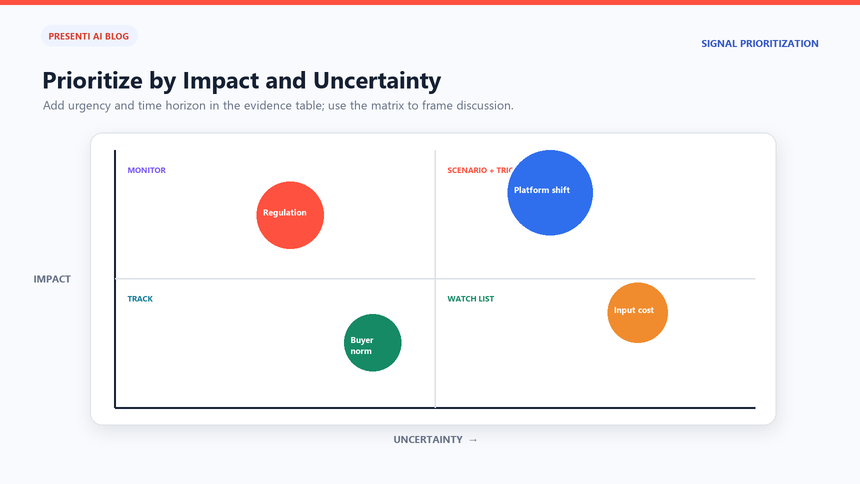
- Priority matrix. Rank the short list by impact, uncertainty, and urgency without hiding judgment inside one unexplained score.
- Strategic actions. Assign a response, owner, leading indicator, trigger, and review date.
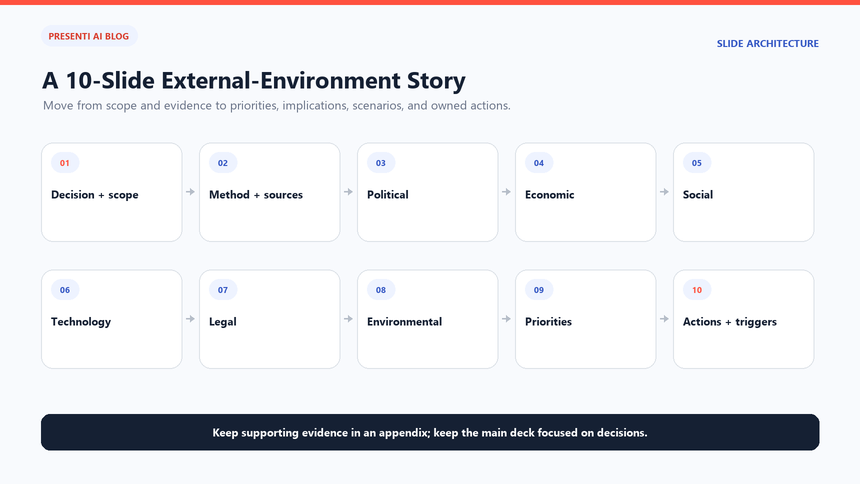
This sequence works for a board review, market-entry discussion, or annual planning meeting because it does not force six equal sections when the evidence is uneven. Give every factor a documented scan, but give the most material factors more presentation space. A PESTEL analysis template should create complete coverage without suggesting that every category has equal strategic weight.
How Do You Research and Date the Six PESTLE Factors?
Collect signals from original or authoritative sources whenever possible: legislation and regulator notices for legal change, official statistics and central-bank releases for economic conditions, peer-reviewed or government research for social trends, technical standards and first-party documentation for technology, and relevant environmental agencies for climate or resource data. Do not use an undated summary when the underlying source is available.
The UK Government Office for Science Futures Toolkit recommends recording metadata such as the date, author, source link, PESTLE category, time scale, and initial importance. It also advises reviewing original source material and scanning widely enough to avoid overfocusing on one familiar category such as technology.
| Factor | Questions to investigate | Evidence examples | Boundary check |
|---|---|---|---|
| Political | Which policy priorities, public programs, trade decisions, or stability issues could alter the choice? | Government plans, budgets, consultations, election calendars, trade notices | Record policy direction separately from enacted law |
| Economic | Which conditions affect demand, pricing, capital, labor, or supply? | Official statistics, central-bank releases, wage and industry data | State the period, geography, and units |
| Social | Which demographic, cultural, behavioral, or workforce changes matter? | Census data, surveys, workforce research, adoption studies | Do not generalize beyond the sample |
| Technological | Which capabilities, infrastructure, standards, or substitutes are changing? | Standards, patents, first-party releases, adoption research | Separate demonstrated capability from announced intent |
| Legal | Which enacted, proposed, or jurisdiction-specific rules affect the decision? | Legislation, regulator guidance, court decisions, compliance notices | Record status and effective date; obtain legal review |
| Environmental | Which physical, energy, resource, emissions, or supply-chain conditions matter? | Environmental agencies, climate assessments, energy and resource data | State the scenario and time horizon |
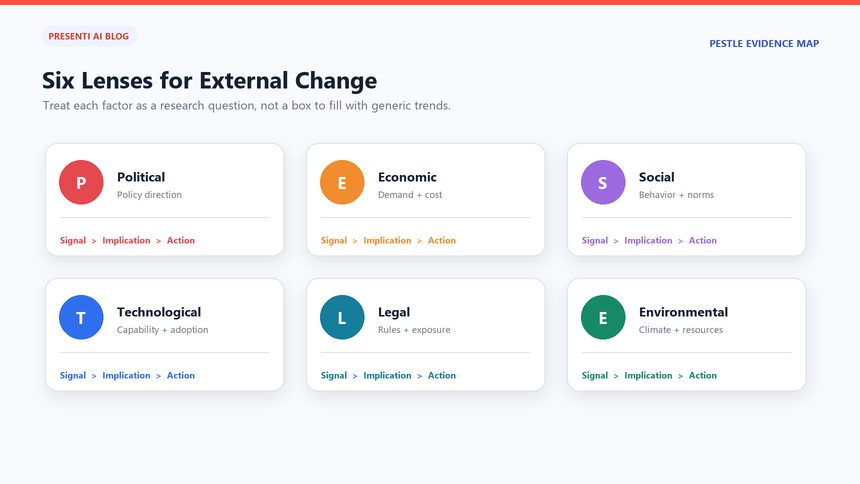
Use one evidence record per material signal. A practical record contains: factor, signal statement, source organization, source URL, publication date, access date, geography, observed period, forward horizon, evidence owner, and confidence note. If a source has no date or method, flag the weakness rather than filling the gap with certainty.
Set a review rhythm that matches the decision. A regulated product launch may need monitoring tied to consultation and effective dates. A multi-year capacity plan may need quarterly economic and technology updates. The useful rule is not "update every PESTLE quarterly." It is "review each priority signal when its leading indicator or decision window changes."
How Do You Turn Signals into Priorities and Strategic Actions?
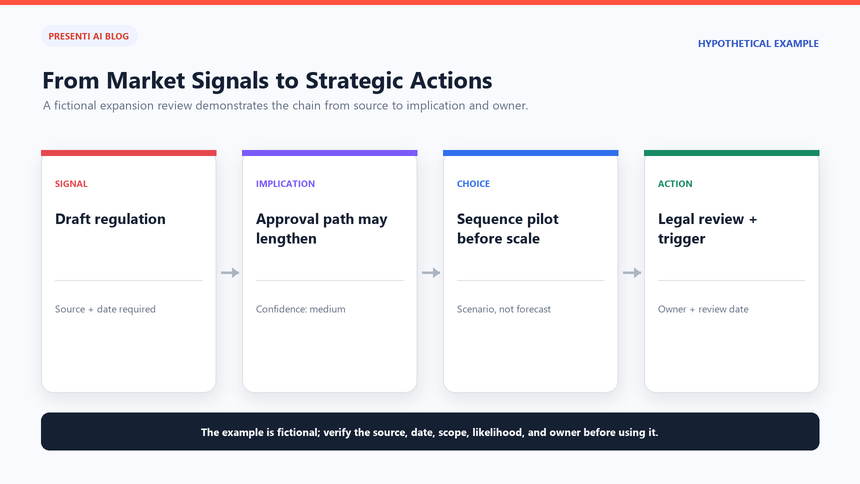
An external environment analysis becomes useful when the team completes a three-part chain: signal, implication, action. The signal describes an external change with evidence. The implication states the mechanism by which it could affect the scoped decision. The action names what the organization will do, who owns it, and what would trigger escalation or reversal.
| Stage | Required statement | Weak version | Decision-ready version |
|---|---|---|---|
| Signal | What changed, where, when, and according to which source? | Regulation is increasing | A named regulator published a dated proposal affecting the scoped product in the target jurisdiction |
| Implication | How could the signal change demand, cost, operations, risk, or timing? | This may be a threat | If adopted as written, the proposal would add a review step before launch and extend the current schedule |
| Action | What will the team do now, and what indicator changes the response? | Monitor the issue | Legal owns a monthly status check; product keeps an alternative path ready until the final rule is published |
Prioritize the completed chains on three separate dimensions:
- Impact: Rate the plausible effect on the decision from 1 (minor) to 5 (decision-changing).
- Uncertainty: Mark low, medium, or high based on source quality, outcome range, and unresolved assumptions.
- Urgency: Mark act now, prepare this planning cycle, or monitor, based on the earliest decision or trigger date.
Do not automatically multiply the three ratings into one number. A high-impact, high-uncertainty factor may require a scenario and leading indicator, while a high-impact, low-uncertainty factor may justify a committed action. A low-impact legal deadline can still require immediate compliance work. Keep the three judgments visible so decision-makers can challenge them.
Where does PESTLE stop and SWOT begin?
PESTLE maps external macro drivers. SWOT combines internal strengths and weaknesses with external opportunities and threats. Use the strongest PESTLE implications as evidence for the opportunity and threat side of a later SWOT, but do not put internal capabilities into the PESTLE grid. The frameworks are connected, not interchangeable.
How is PESTLE different from competitive analysis?
PESTLE explains the external conditions affecting an industry or decision. Competitive analysis compares named companies, offers, positioning, capabilities, and likely moves. A regulation may belong in PESTLE; how three competitors respond to it belongs in competitive analysis. When the decision requires company-level comparison, use the competitive analysis presentation workflow as the next step instead of forcing competitor rows into the PESTLE template.
What Does a Practical PESTLE Example Look Like?
The following example is hypothetical and uses a fictional company. It demonstrates the method, not observed market facts or Presenti customer results. Northstar Heat is considering whether to launch a commercial heat-pump service in a new region over the next 18 months. Its decision team includes strategy, finance, operations, product, and legal.
| Factor | Illustrative signal | Implication | Priority and action |
|---|---|---|---|
| Political | A proposed public incentive could favor qualifying installations; final terms are not known | Demand could rise, but product eligibility and timing remain uncertain | High impact, high uncertainty: model two scenarios and track the final program rules |
| Economic | Financing costs remain material for customers with long payback periods | Adoption may depend on financing design and verified operating savings | High impact, medium urgency: test a financing offer before full launch |
| Social | Facility managers report growing interest in predictable energy costs | The message should lead with budget control rather than technology novelty | Medium impact: validate the message in customer interviews |
| Technological | New control integrations could reduce installation complexity | A narrower set of compatible systems may shorten deployment | Medium impact: run a technical pilot and define compatibility limits |
| Legal | Licensing and inspection requirements vary by jurisdiction | The operating model and launch sequence cannot be uniform | High urgency: legal and operations map requirements before selecting the first market |
| Environmental | Extreme-temperature performance affects sizing and customer expectations | The offer needs a climate-specific design and performance boundary | High impact: engineering validates assumptions for the target climate |
The executive finding is not "all six factors matter." It is that program design, financing, jurisdiction-specific licensing, and climate performance determine whether the launch sequence is viable. The strategic response is therefore staged: confirm requirements, test the financing and technical assumptions, define launch triggers, and keep the incentive scenario separate until the policy is final.
A good PESTLE analysis presentation also shows what would change the recommendation. In this example, the team might proceed only if the licensing path is confirmed, the pilot meets a defined installation threshold, and the financing test reaches an agreed customer response. Those are decision triggers, not decorative observations.
How Can Presenti Turn a PESTLE Brief into an Editable Template?
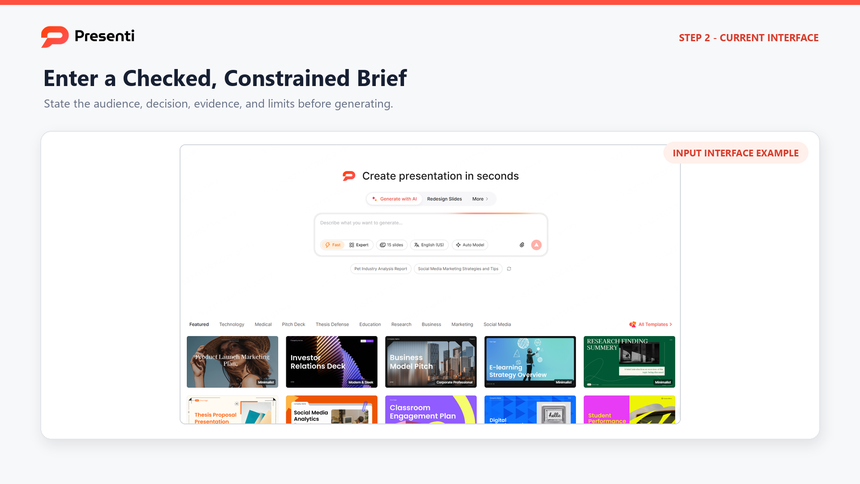
Once the team has the decision question, six-factor evidence log, implications, priorities, and actions, Presenti can organize that material into an editable first draft. Use text to presentation when the analysis is already written as a brief. Presenti can help structure and design the draft, but it cannot verify laws, forecasts, source quality, or strategic judgment.
You can use a free Presenti account to create a tailored starting template instead of downloading a generic file. Enter the checked brief, review the generated outline, and then choose a suitable design from the Presenti template center. The resulting deck remains a working draft until the relevant owners verify every source, date, implication, and action.
Step 1: Enter a decision-focused PESTLE brief
Include the decision, business unit, geography, audience, evidence cutoff, time horizon, priority signals, uncertainties, and required actions. Remove confidential information unless its use is approved. A constrained prompt can be:
Create a 10-slide PESTLE analysis presentation for a market-entry decision. Audience: strategy, finance, product, operations, and legal. Include the decision and scope, executive finding, Political, Economic, Social, Technological, Legal, and Environmental factors, cross-factor implications, an impact-uncertainty-urgency priority view, and strategic actions with owners and review triggers. Keep source names, publication dates, geography, and time horizons visible. Use placeholders for unverified claims. Do not invent laws, statistics, forecasts, sources, or market results.
Check: the prompt should identify the decision and evidence boundary before generation begins. If it only says "make a PESTLE deck," rewrite it.
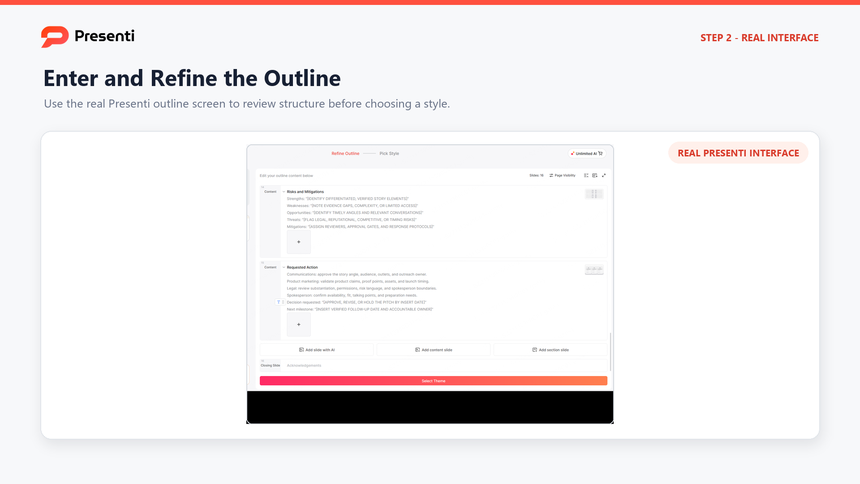
Step 2: Review and correct the outline
Confirm that the outline moves from scope to evidence, implications, priorities, and actions. Remove generic history slides, combine repeated factor summaries, and add an appendix for the source register. Make sure the outline does not turn into a SWOT or competitor comparison.
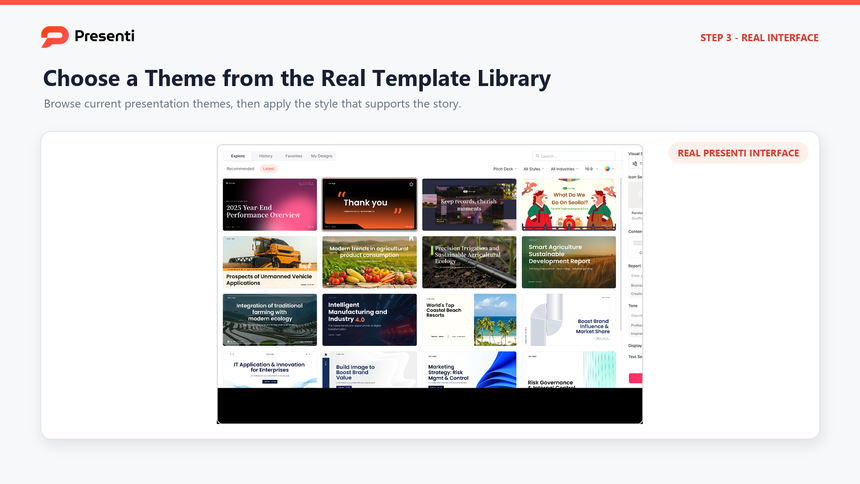
Step 3: Choose a template that supports comparison
Preview a strategy or business template after the structure is correct. Favor layouts that can show six factors, evidence metadata, a priority matrix, and an action table without shrinking the text. A wheel diagram can introduce the framework, but the main findings need readable tables and message-led headlines.
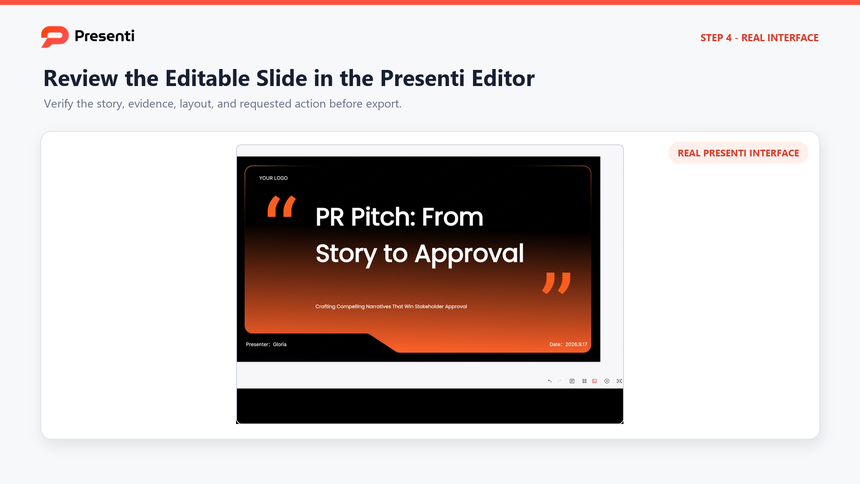
Step 4: Edit and verify every strategic claim
Compare each slide with the source register. Check the factor classification, source organization, dates, units, geography, legal status, horizon, uncertainty, and causal implication. Replace placeholders and ask legal, finance, technical, or environmental owners to review the claims in their fields.
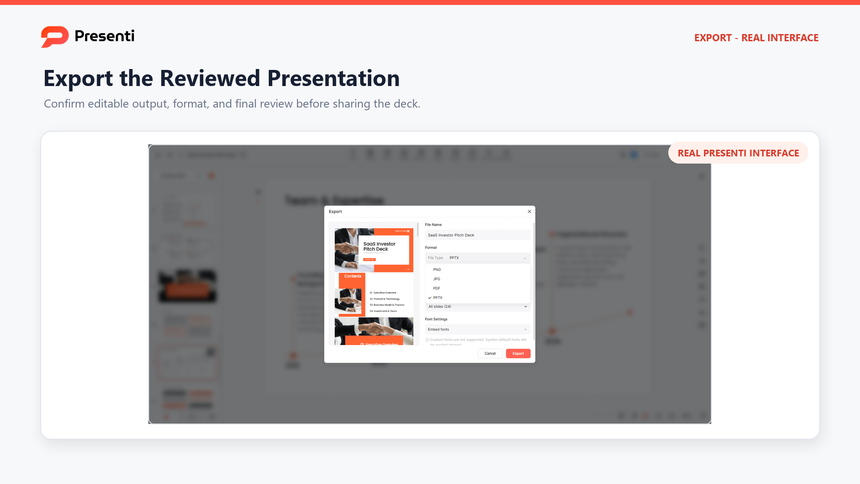
Step 5: Export only after the action review
Confirm the final format after the team approves the decision, priority logic, owners, triggers, and next review date. PPTX and PDF export require an eligible paid plan. Reopen the exported file and check fonts, tables, source notes, links, confidentiality markings, and speaker notes before sharing it.
The final deck should make the external evidence and response easier to challenge. It should never make an uncertain signal look certain simply because the slide is polished.
Frequently Asked Questions
What should a PESTLE analysis template include?
Include the decision and scope, all six external factors, the source and date for every material signal, geography, time horizon, implication, impact, uncertainty, urgency, action, owner, trigger, and review date. Use an appendix for the full source register.
Are PESTLE and PESTEL the same?
Yes. Both use Political, Economic, Social, Technological, Legal, and Environmental factors. The order of Legal and Environmental changes in the acronym, but the analytical coverage is the same. Use the spelling your organization recognizes and stay consistent throughout the deck.
How often should a PESTLE analysis be updated?
Update priority signals when a source, leading indicator, trigger, or decision window changes. Also set a formal review date. A fast-moving regulatory or technology decision may need frequent monitoring, while a stable planning context may use a longer review cycle.
Should every PESTLE factor receive equal space?
No. Scan all six factors to reduce blind spots, then allocate presentation space according to materiality. A low-priority factor can remain in the appendix, while a decision-changing factor may need a full slide, scenario, and action plan.
Can AI complete a PESTLE analysis?
AI can help organize supplied material and draft an editable presentation. It cannot replace current source research, legal or financial review, domain expertise, or the team's judgment about implications and actions. Treat generated text as a draft and verify it against original sources.
Bottom Line
Use a PESTLE analysis presentation to explain which external changes could affect the decision in front of your team. Cover all six factors, but give the most space to the signals that could change the plan. Date the sources, distinguish likely effects from uncertain ones, and explain what new information would make you reconsider.