A useful supplier evaluation presentation answers three questions: which supplier best fits the requirement, what evidence supports that choice, and what still needs checking. Put the recommendation and its conditions near the beginning. Then give reviewers enough detail to challenge it.
The difficult part is rarely making the slides. It is comparing bids that use different assumptions and explaining why a higher price might be worth paying. The principles in this guide to data storytelling for presentations help you turn those differences into a clear decision, without hiding uncertainty behind a polished chart.
Define the decision before building the scorecard
Write the decision in one sentence: for example, select a support provider for the next twelve months, subject to a successful pilot. Identify the approver, the deadline and the scope. A selection presentation should not quietly become approval for an unsigned contract or an untested rollout.
Separate requirements into three groups. Must-haves can disqualify a bid. Scored criteria distinguish otherwise acceptable options. Open questions need an answer before the next commitment. Keep those groups visible: a high overall score must not conceal a failed mandatory requirement.
Suppose an illustrative team is choosing a partner to process customer support requests. Its must-haves might include support during agreed hours and an approved approach to customer information. Its scored criteria might include service quality, implementation effort, total cost and reporting. The exact requirements belong to the team responsible for the service; these examples are a starting point.
Make the bids comparable
Before scoring, normalize the commercial and operational assumptions. Check the currency, tax treatment, contract period, included volume, implementation fee, renewal terms and exclusions. A monthly figure may appear cheaper simply because onboarding or overage charges sit elsewhere in the proposal.
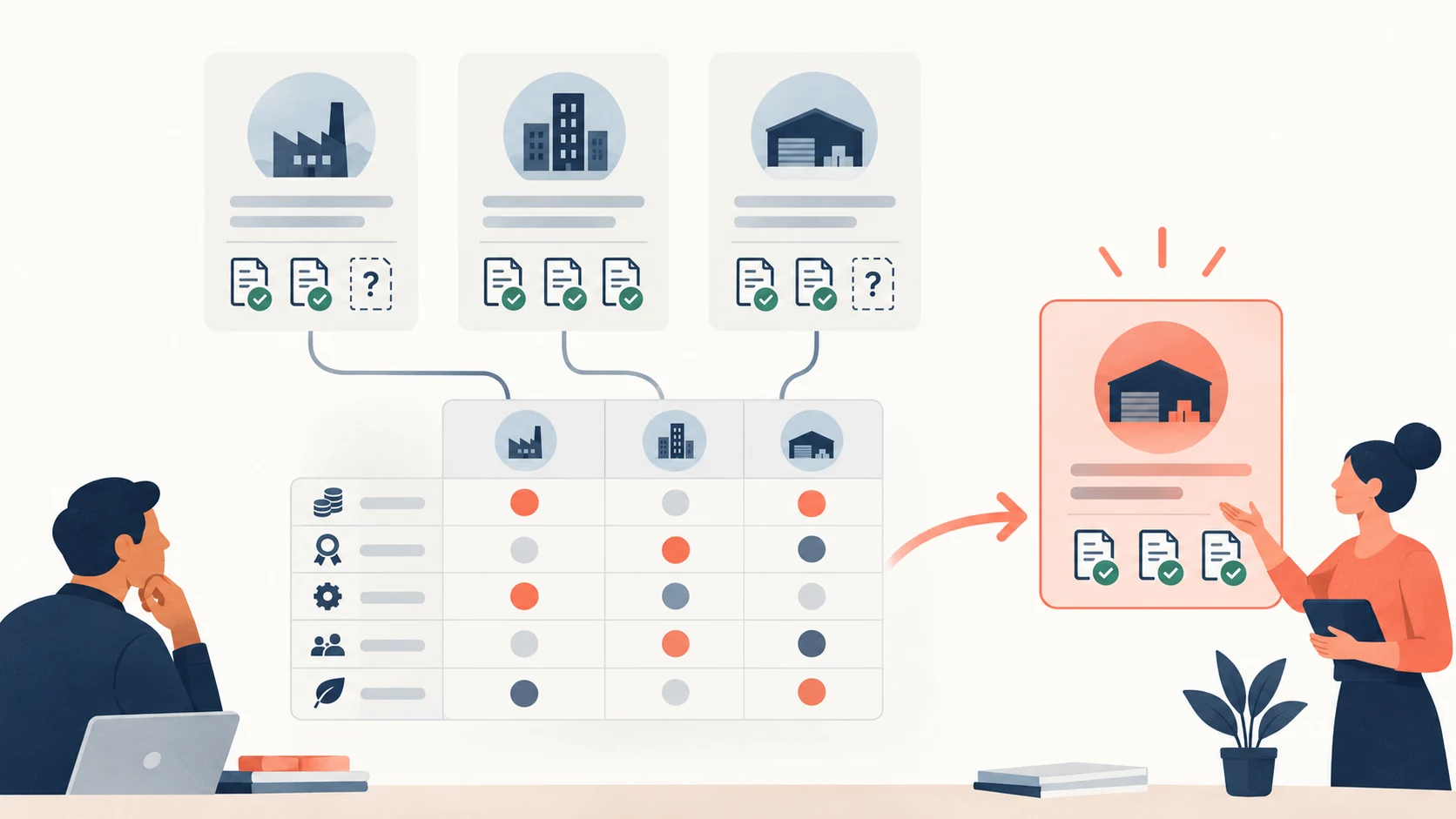
Create a comparison worksheet with one row per material assumption and one column per supplier. Mark missing answers as missing. Do not turn an unquoted cost into zero or assume that an unnamed integration is included. If you estimate an item, show the estimate separately from the supplier's confirmed price.
Present both the base scenario and a plausible change in demand. For example, compare the quoted cost at the expected number of requests and at a higher volume the team considers credible. State the volume and period on the slide. This reveals which option is sensitive to usage without pretending to predict future demand.
Use a small scorecard with defined ratings
Choose a manageable set of criteria and agree the weights before looking at the final totals. Otherwise, people can unconsciously adjust the model to favor a preferred supplier. Define what each rating means. On a one-to-five scale, a three might mean the requirement is met with acceptable evidence; a five might require stronger evidence against a specific, agreed standard.
The following numbers are a worked example, not a procurement benchmark. Assume the team agrees to weight service quality at 40%, implementation at 25%, cost at 20% and reporting at 15%. Supplier A scores 4, 3, 4 and 3; Supplier B scores 3, 5, 3 and 4. The weighted totals are 3.60 and 3.65 respectively.
That narrow gap is the finding. It does not justify claiming B is decisively better. B's easier implementation offsets A's stronger service score. Explain that trade-off beside the totals, then show the evidence behind the two largest differences. A decimal alone cannot tell the audience whether the assumptions are sound.
If changing a disputed rating by one point reverses the result, show that sensitivity. It can support a pilot, a reference call or another test before selection. It can also tell the team that the two options are effectively tied under its current knowledge.
Show where the evidence comes from
For each important score, record the claim, its source, the date checked and the reviewer. Distinguish a supplier statement from a demonstrated result. A proposal can document a commitment, but a demonstration, contractual term and reference interview answer different questions.
Use plain evidence labels such as confirmed in proposal, observed in demonstration, customer reference or unanswered. Keep the detailed source list in an appendix, with a short reference next to the relevant score. Reviewers should be able to trace a claim without searching through an entire proposal during the meeting.
Be careful with references. A supplier's success with another customer may establish relevance, but it does not guarantee the same result for your organization. Note differences in scale, staffing, integrations or use case when they affect the comparison.
Arrange the presentation around the choice
A compact review deck can follow this order: decision and recommendation; requirements and exclusions; comparable cost assumptions; weighted result; the two or three decisive trade-offs; open diligence questions; and next action. Put detailed scoring and source material in an appendix.
Use one visual job per slide. A table works for exact contract differences. Bars work for comparing criterion scores. A simple scenario table works for cost sensitivity. Avoid combining a large scorecard, a cost chart and paragraphs of rationale on one slide.
Give the recommendation a condition and an owner. An example is: recommend B for a limited pilot, provided the service lead confirms coverage and procurement resolves the setup fee. List who will answer each open question and when the team will review the result.
Finish with a decision the team can record
The meeting should produce an approval, a rejection or a specific request for more evidence. Record the accepted trade-offs alongside the chosen supplier. If the team accepts higher implementation effort to obtain better service evidence, that decision should remain visible to the people who deliver the rollout.
Before sharing, ask a colleague who did not build the model to explain why the recommendation wins. If they can only repeat the total score, the deck needs a clearer explanation. A strong supplier presentation makes the reasoning understandable and leaves a practical trail for the next person who has to act on it.