Reading about thesis statements is useful. Seeing them in action is better. This article collects thesis statement examples across different paper types, breaking down what makes each one work — and offering reusable templates you can adapt for your own writing.
Whether you’re writing a high school essay, a college research paper, or preparing an academic argument from scratch, you’ll find something here you can use.
What Makes a Sample Thesis Statement Worth Studying?
Before diving into examples, it helps to know what to look for. A useful thesis or purpose statement should fit its paper type. The examples below illustrate writing choices; their factual and interpretive claims require evidence in an actual paper.
- State a specific arguable position for an argumentative paper, or a clear explanatory focus for an informative paper
- Signal the scope of the paper — what’s being examined and within what limits
- Give the reader a reason to keep going — there’s an implication, a tension, or a “so what” built in
When you look at sample thesis statements that don’t work, they usually fail on one of those three points. Keep that framework in mind as you read through the examples below.
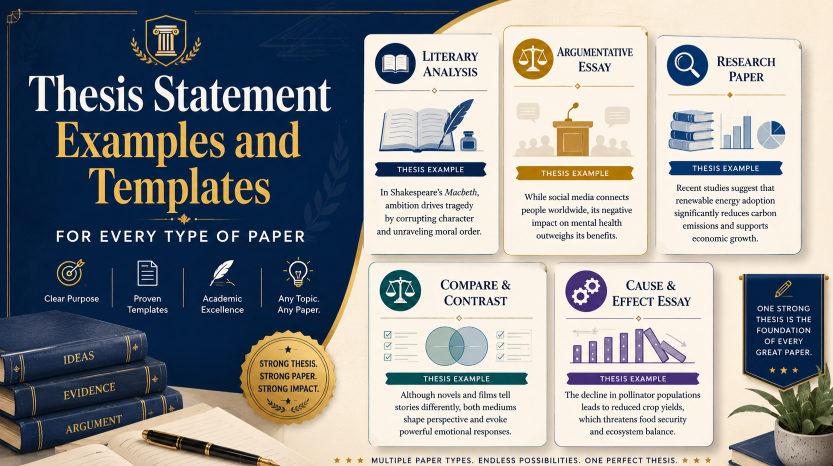
Thesis Statement Examples — Argumentative Essay
Argumentative essays require a thesis that takes a clear, debatable stance. The stronger the position, the more the paper has to work with.
Weak example:
Social media affects mental health in various ways.
This is a topic description, not a thesis. It doesn’t take a position, and no one would disagree with it.
Strong example:
The design mechanics of social media platforms — including infinite scroll, variable reward notifications, and engagement-optimized content ranking — are functionally addictive and should be subject to the same regulatory scrutiny applied to other products designed to exploit compulsive behavior.
This works because it identifies a specific mechanism (design mechanics), takes a clear position (they’re addictive and should be regulated), and opens a genuine debate.
Template:
[Specific subject or practice] [does/causes/reflects] [specific claim], and therefore [implication or recommended action].
Thesis Statement Examples — Informative or Expository Essay
A thesis statement for an informative paper doesn’t argue a controversial position — but it still needs to do more than describe. The thesis should signal the organizational framework and tell readers what they’ll understand by the end.
Weak example:
This paper will explain how vaccines work.
Announcing the topic is not the same as making a claim about it.
Strong example:
Vaccines prepare immune responses to targeted pathogens, helping reduce the risk or severity of disease; their effects on infection and transmission vary by vaccine and disease.
This version identifies a mechanism and its limits, giving the paper an explanatory focus beyond a simple definition.
Template:
[Subject] works/operates/functions through [mechanism or process], which [explains/demonstrates/reveals] [broader significance or implication].
Thesis Statement Examples — Analytical Essay (Literature or Media)
In literary analysis, the thesis is an interpretive claim about a text. You’re not arguing a policy position — you’re arguing a reading.
Weak example:
In 1984, Orwell writes about a dystopian society where the government controls everything.
This is a summary of the plot. There’s no argument.
Strong example:
Orwell’s 1984 uses Winston Smith’s professional role as a history falsifier not simply to critique totalitarianism, but to implicate the reader in the same mechanisms of self-deception that sustain authoritarian systems — making complicity, rather than force, the novel’s true subject.
This is an interpretive thesis with a clear claim: the novel isn’t primarily about external oppression, it’s about internalized complicity. That’s arguable, specific, and interesting enough to write an essay about.
Template:
[Author’s] [work] uses [specific literary element] not merely to [surface-level function], but to [deeper interpretive claim], revealing [central thematic argument].
Thesis Statement Examples — Research Paper (Social Sciences or Education)
Research papers in APA style often use thesis statements that function as research purpose statements — they identify the question being investigated without overstating findings that haven’t been presented yet.
Weak example:
This paper studies the effects of homework on student performance.
This tells us the topic but says nothing about the approach, the population, or the stakes.
Strong example:
This study examines the relationship between daily homework load and academic burnout in middle school students, with particular attention to how assignment volume interacts with extracurricular participation and household socioeconomic status.
This version specifies the relationship being investigated, the population, and the variables being examined. It gives the paper a precise research focus.
Template:
This study investigates [relationship or phenomenon] among [specific population], focusing on how [variable A] interacts with [variable B] to [produce outcome or reveal pattern].
Thesis Statement Examples — Compare and Contrast Essay
Thesis sentence examples for comparative essays need to do more than acknowledge that two things are different. The thesis should stake a claim about the significance of the comparison.
Weak example:
Shakespeare’s Romeo and Juliet and West Side Story are similar in some ways but different in others.
There’s no argument here. The paper could go in any direction.
Strong example:
While both Romeo and Juliet and West Side Story use tragic romance to explore social conflict, West Side Story’s racial framing transforms Shakespeare’s feudal family rivalry into a critique of systemic racism in mid-twentieth century America — a shift that reveals how the same narrative structure carries entirely different ideological weight across historical contexts.
Template:
While both [A] and [B] [share common quality], [A/B]'s [specific difference] [reveals/challenges/demonstrates] [interpretive claim about what the difference means].
What a Thesis Statement Template Actually Looks Like
Strip away the specific subject matter, and every strong thesis statement is built from the same handful of moving parts. A template just makes those parts visible — bracketed placeholders standing in for the pieces you'll fill in with your own topic, so the underlying structure is easier to copy than the finished sentence would be on its own.
Most thesis templates break down into four components:
Not every thesis needs all four pieces spelled out in one sentence — plenty of strong theses fold the reasoning into the claim itself, or leave the implication implicit. But as a starting scaffold, each bracket is doing distinct work:
- Subject or text — what you are analyzing, arguing about, or explaining.
- Specific claim — your actual position, narrow enough that someone could disagree with it.
- Reasoning or evidence — the basis for the claim, in brief; the full argument comes later in the paper.
- Implication — why the claim matters beyond just being true.
Filled in, the same skeleton might look like this:
In remote work policy, companies that mandate full-time office return may face retention challenges because they're competing for talent against firms offering flexibility as a default, which reveals that flexibility has shifted from a perk to a baseline expectation in knowledge work.
A template's value isn't the finished sentence — it's rarely one you'd submit exactly as generated. Its value is forcing you to identify each component separately before you try to write a polished version, so revise the filled-in version until it expresses the claim and scope your evidence can support.
Taking Your Thesis From Paper to Presentation
Once you’ve written a thesis that works on the page, you’ll eventually need to translate it for an audience. Whether that’s a classroom presentation, a thesis defense, or a conference panel, your opening slide carries the same weight as your opening paragraph.
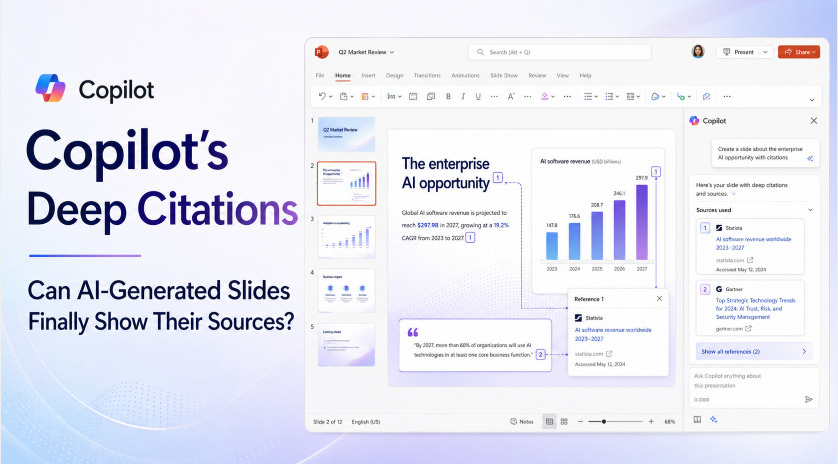
If you’re building slides alongside your written work, Presenti AI is worth knowing about. You can draft from an outline or supported document and check whether the generated structure keeps the thesis and evidence connected. Word/PDF/TXT imports are listed on paid plans. For students and academics who want professional-quality slides without spending hours on layout, it handles the design layer while you stay focused on the content.
The examples above are yours to use. The templates are starting points. What you argue is still up to you — and that part, no tool can do for you.