A thesis statement usually appears near the end of the introduction. That is a useful default for a classroom essay, but longer papers and different rhetorical styles may use another placement.
Below we will discuss why the end of the intro became the default location, whether it has to be the literal last sentence, what comes before it, and a couple of full introductory paragraphs showing the placement in context.
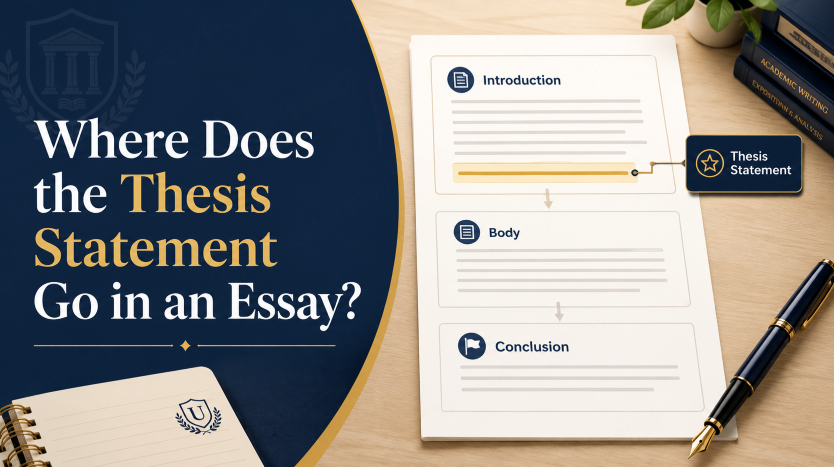
Typically, a Thesis Statement Is Found at the End of the Introduction
In the standard essay structure taught in most US classrooms, the introduction moves from general to specific — a broad opening, some context or background, and then the thesis statement as the final, narrowest point the paragraph arrives at. It's often described as a funnel: wide at the top, narrow at the bottom, with the thesis as the point of the funnel.
This placement isn't arbitrary. By the time a reader reaches the thesis, they've already been given enough context to understand exactly what claim is being made and why it matters. Putting the thesis first, before any context, tends to leave readers without the background needed to fully register the argument's significance.
Is the Thesis Statement Always the Last Sentence?
Not strictly, and this is where a lot of writers get overly rigid. "End of the introduction" is the reliable rule. "Literal last sentence" is the common case, but not an absolute requirement.
A few situations where the thesis isn't the final sentence, and that's still perfectly fine:
- Longer or more complex introductions. A thesis might be followed by a brief transitional or roadmap sentence previewing the essay's structure.
- Multi-paragraph introductions in longer academic papers, where the thesis can appear at the end of an early paragraph rather than the single opening one.
- Some argumentative or narrative styles intentionally delay or restate the thesis for rhetorical effect, though this is more common in advanced or creative writing than standard academic essays.
If you're working within a standard five-paragraph essay format for a class assignment, treating the thesis as the last sentence of the intro is a safe, expected default. Once you're writing longer or more advanced pieces, "end of the introduction" is the more accurate rule to hold onto.
What Comes Before the Thesis in the Introduction
The sentences leading up to the thesis aren't filler — they do real work setting up why the argument matters. A typical introduction builds in this order:
- The hook — a sentence that draws the reader in: a question, a striking fact, a brief scenario.
- Context or background — enough information for the topic and its significance to make sense.
- Narrowing — moving from the general topic toward the specific angle the essay will take.
- The thesis statement — the specific, arguable claim the rest of the essay will support.
Skipping straight from the hook to the thesis, with no context in between, is one of the more common reasons an otherwise strong thesis statement feels like it's dropped in out of nowhere.
Introductory Paragraph and Thesis Statement Examples
The following illustrative paragraphs show where a thesis can appear. Their claims would need evidence in an actual essay.
Example — standard placement, last sentence
Social media platforms were originally built to connect people across distance. Two decades later, they've become something closer to a constant audience — a space where nearly every action, from a meal to a milestone, is performed for an audience rather than simply lived. This shift from private experience to public performance has fundamentally changed how young people develop a sense of identity, often at real psychological cost.
Example — thesis followed by a brief roadmap sentence
Urban planning decisions made decades ago continue to shape which neighborhoods have access to green space today, and which don't. Historic zoning practices may help explain differences in park access alongside present-day income. This becomes clear when examining zoning history, current park distribution data, and the neighborhoods where the two most sharply diverge.
In both examples, everything before the highlighted sentence exists to earn the reader's attention and understanding before the actual claim arrives.
Is a Thesis Statement the Same Thing as an Introduction?
No — this is a common point of confusion worth clearing up directly. The thesis statement is one sentence (occasionally two) within the introduction, not the introduction itself. The introduction is the opening section—sometimes one paragraph, sometimes several—that provides context and leads into the argument. The thesis is the destination that paragraph is heading toward, not the whole journey.
You'll sometimes see "opening thesis" used loosely to describe this same idea — the thesis statement positioned at the opening of the essay — but it refers to the same single sentence, not a separate concept.
Presenti AI: Turning Your Essay's Argument Into a Presentation Outline
Once your thesis is placed and your essay is drafted, a lot of the same courses that assign essays also ask for a class presentation built around the same argument — which means restructuring a written introduction and thesis into slide form.
Presenti AI can generate that presentation directly from your essay. Upload the finished draft as a PDF, Word document, or Markdown file, paste in a web link if it's published online, or just describe your thesis and argument as a prompt, and it produces a structured slide outline built around your actual thesis and supporting points. Word/PDF input and editable PPTX/PDF export are listed on paid plans. Check the generated outline and exported layout against the argument before presenting.
The Bottom Line
The thesis statement typically belongs at the end of the introduction, after enough context has been given for the reader to understand what's being argued and why it matters. In shorter or classroom essays, that usually means the literal last sentence of the first paragraph. In longer or more advanced writing, "end of the introduction" is the rule to follow — the thesis just might not be the final word before the body paragraphs begin.