Most advice on how to write a thesis statement skips straight to "here's a formula, fill in the blanks." That works for a rough draft, but it rarely produces a thesis that actually survives contact with the rest of your paper. What follows is the fuller process — the one that gets you from a vague assignment prompt to a claim you can actually defend for five, ten, or thirty pages.
None of these steps are complicated on their own. Skipping them, though, is exactly how people end up with a thesis statement that sounds fine in isolation but falls apart once they start writing the body paragraphs.
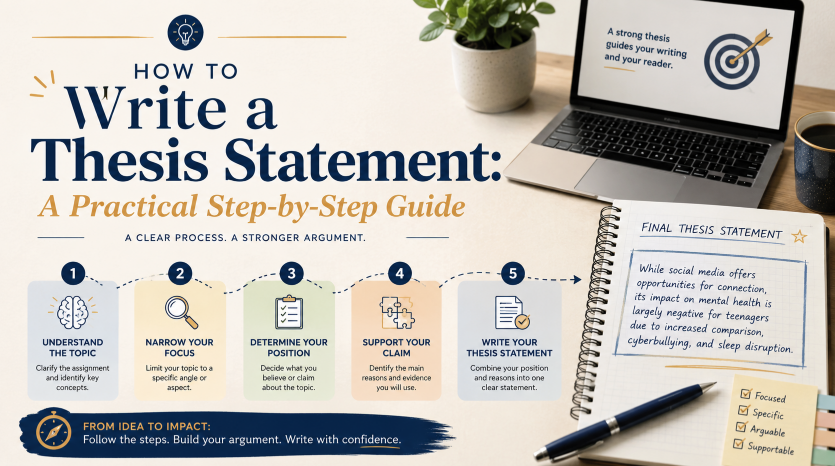
What a Thesis Statement Actually Needs to Do
Before constructing one, it helps to know what you're actually building toward. For argumentative or analytical writing, a working thesis should meet three criteria. Informative papers may instead use a focused explanatory or purpose statement:
- Arguable — a reasonable person could disagree with it. If everyone would nod along immediately, it's a fact, not a thesis.
- Specific — narrow enough that your paper can actually prove it in the space you have, not so broad it could apply to a dozen different essays.
- Provable — supportable with real evidence from your text, data, or research, not just a personal opinion floating free of support.
Every step below exists to get your thesis to hit all three at once — most rough drafts nail one or two and miss the third.
Step 1: Turn Your Assignment Into a Question
Assignment prompts rarely hand you a thesis directly — they hand you a topic or a broad question, and it's on you to narrow that into something specific enough to argue. Before writing a single claim, restate the assignment as a direct question you're trying to answer. Keep the distinction between a research question and a thesis statement clear: the question guides the inquiry, while the working claim gives the answer you will investigate and refine.
"Discuss the causes of the 2008 financial crisis" becomes: How did mortgage lending practices contribute to the 2008 financial crisis? "Analyze a theme in the novel" becomes: How does the author use [specific device] to develop [specific theme]? The question forces specificity that the open-ended prompt doesn't.
Step 2: Write a Rough, "Working" Thesis First
Don't aim for your final sentence on the first attempt — aim for an honest, rough answer to the question you just wrote. This is sometimes called a working thesis, and its only job is to give you something to write toward. It will almost certainly change once you're deeper into your research or drafting. The thesis statement examples by paper type show how the form changes between an argumentative claim, an analytical interpretation and an explanatory purpose.
A working thesis can be clunky. It just needs to state your actual current best answer, even if the phrasing needs work later:
My working claim is that mortgage lending practices helped amplify the housing bubble and its financial consequences.
This is a provisional example, not an established conclusion. Investigate it alongside other contributing factors and revise it to reflect the evidence.
Step 3: Stress-Test It With Three Quick Questions
Once you have a working thesis, run it through a quick gut-check before investing more time writing around it:
- Could someone reasonably disagree? If not, sharpen the claim until there's real tension in it.
- Can I actually prove this in the space I have? A claim that would need a book to defend needs to shrink to fit an essay.
- Does it answer "so what"? A thesis that's technically true but doesn't matter to anyone still needs a reason to exist.
Failing any of these isn't a sign to start over — it usually just means narrowing the scope or sharpening the specific claim, not abandoning the underlying idea.
Step 4: Decide How Much Structure to Reveal
Once your claim is solid, you've got a choice about how much of your supporting structure to put directly into the sentence itself. A thesis that lists your exact supporting points up front is a closed thesis; one that states the claim without previewing the specific points is an open thesis. Which one fits depends heavily on your paper's length and how settled your supporting points already are.
For a full breakdown of both formats with side-by-side examples, see Open Thesis vs. Closed Thesis Statements: Examples and When to Use Each.
Step 5: Place It Correctly in Your Introduction
Where the sentence physically sits matters almost as much as what it says. In standard essay structure, the thesis often appears near the end of the introduction, after enough context has been established for the claim to make sense — while some genres and longer papers use a different placement.
Related reading: For the full explanation of thesis placement, including when it isn't the literal last sentence, see Where Does the Thesis Statement Go in an Essay?
Step 6: Revise It Once the Draft Is Written
This is the step most people skip, and it's arguably the most important one. Your thesis is a prediction about what your paper will prove — written before you'd actually written the paper. It's completely normal, even expected, for your argument to sharpen, shift, or narrow as you write the body paragraphs.
Once your draft is finished, go back and reread your thesis against what you actually argued. If the body of your paper ended up proving something slightly different — often more specific or more nuanced — than your opening thesis promised, rewrite the thesis to match the paper you actually wrote, not the one you planned to write three drafts ago.
A Quick Formula, If You're Stuck
If you're staring at a blank page after Step 1, this skeleton can jumpstart a working draft — treat it as scaffolding to knock down later, not a finished sentence:
Filled in loosely: "Mortgage lending practices may have amplified the housing bubble by increasing exposure to risky loans, making lending incentives one factor to examine in explaining the crisis." Rough, but workable — exactly what a first pass through the formula should produce.
Presenti AI: From Written Thesis to Presented Argument
Once your thesis is written and the paper is drafted around it, the next ask in a lot of courses is a class presentation covering the same argument — which means re-extracting your thesis and supporting points from paragraph form into slides.
Presenti AI can build that presentation directly from what you've already written. Upload your finished essay or draft as a PDF, Word document, or Markdown file, paste in a web link if it's published online, or describe your thesis and argument as a text prompt if the writing isn't finished yet, and it generates a structured slide outline built around your actual claim and supporting points. Word/PDF input and editable PPTX/PDF exports are listed on paid plans. Check the generated outline and exported file against the argument before presenting.
The Bottom Line
Constructing a thesis statement isn't really a one-step task, even though most quick guides treat it that way. It's a short cycle: turn the prompt into a question, draft a rough answer, stress-test it, decide how much structure to reveal, place it correctly, and then revise it once you know what your paper actually argues. The formula gets you unstuck on a blank page — the steps around it are what turn that rough draft into a thesis that holds up under its own paper's weight.