A PhD defense asks you to explain your research decisions, contribution, and limitations. The format may include a public talk, a private examination, or both. Confirm the local requirements before deciding whether and how to build slides.
This covers what a PhD defense presentation actually needs to include, how the format shifts depending on your country, how to handle presentations built around a single paper rather than a full dissertation, and what to expect once your slides are done and the questions start.

What a PhD Defense Presentation Actually Involves

At its core, a PhD defense presentation is a talk — of a duration set by the department — that walks a faculty committee through your research question, your methods, your findings, and your contribution to the field. It's not a re-read of your dissertation; the committee has already done that. The talk exists to demonstrate that you can synthesize years of work into a coherent argument, on your feet, in real time.
What follows the presentation matters just as much: an extended question-and-answer session, often longer than the talk itself, where the committee probes your methodology, challenges your interpretations, and checks that the work is genuinely yours. In most defenses, this exchange — not the slides — is what the committee is really evaluating.
How the Defense Format Changes by Country
One detail that trips up a lot of candidates: "PhD defense" doesn't mean the same thing everywhere, and the format of your presentation should match your specific institution's convention rather than a generic template.
| Region | Common term | Typical format |
|---|---|---|
| United States | Dissertation defense | Often a public presentation followed by a closed-door Q&A with the committee, whose roles and membership follow local rules. |
| UK and Ireland | Viva voce ("viva") | Usually private — just the candidate and one internal plus one external examiner. Some examiners request a short presentation first; others go straight to questioning. |
| Netherlands, Scandinavia | Disputation / PhD defence | Often public and ceremonial, sometimes with an invited "opponent" who formally critiques the thesis in front of an audience. |
Session length varies by the same logic — a UK viva commonly runs a couple of hours of direct questioning, while a US defense often adds a public presentation segment on top of committee deliberation. The safest move, regardless of what you've read online: ask your department directly whether a presentation is expected, how long it should run, and who will be in the room. That single conversation resolves more uncertainty than any general guide can.
Structure of a PhD Defense Presentation Template
Once you know your format, most successful defense decks — public or private — follow a similar backbone:
- Title slide — dissertation title, your name, advisor, institution.
- Research question and motivation — the problem, and why it's worth years of your life.
- Positioning in the literature — brief; just enough to show the gap your work addresses.
- Methodology — detailed enough for the committee to evaluate its rigor, not just its existence.
- Key findings — your strongest results, led with figures rather than text.
- Discussion and contribution — what the findings mean, and what's genuinely new here.
- Limitations — raised by you, before a committee member raises it for you.
- Future directions — where this research could go next, which often doubles as your closing note.
Keep the talk itself lean — the goal is orientation, not exhaustive coverage. Nearly every one of these sections will get revisited, in far more depth, during the Q&A that follows.
Presenting a Single Paper: Special PhD Paper Presentations
Not every doctoral presentation covers an entire dissertation at once. In fields where PhDs are structured as a series of published or publishable papers rather than one monograph — common in the sciences, engineering, and increasingly in social sciences — candidates often give special presentations built around a single paper, whether at a qualifying exam, a department seminar, or a committee check-in well before the final defense.
These paper-specific presentations differ from a full defense in a few practical ways:
- Narrower scope, deeper detail. Since you're covering one study instead of an entire body of work, there's more room to walk through methodology and results carefully rather than compressing everything.
- Framing still matters. Even a single-paper talk should briefly connect back to your broader dissertation narrative — how does this paper fit with the others, and what's it building toward?
- Different purpose and stakes. A progress update, qualifying exam, and final defense have different assessment rules. Confirm what the single-paper presentation is intended to demonstrate.
If your program uses a multi-paper dissertation format, it's worth building each paper's presentation with a consistent template from the start — it makes assembling the final, full defense deck out of your existing paper decks considerably faster later on.
Preparing for the Q&A That Follows
For most PhD defenses, the presentation is the shorter, more scripted half of the day. The committee discussion afterward — sometimes running well past an hour — is where the actual examination happens, and it tends to circle around a predictable set of themes:
- Contribution and significance — what's genuinely new here, and why does it matter to the field?
- Methodological choices — why this method instead of a plausible alternative, and how do you know it was valid?
- Interpretation of findings — how confident are you in this result, and what would change your conclusion?
- Limitations and scope — what does this work not tell us, and how does that affect what you can claim?
- Positioning in the field — how does this relate to specific competing or complementary work?
Rehearsing your presentation matters, but rehearsing answers to these categories — out loud, ideally with a colleague pushing back — tends to matter more. Prepare to explain the evidence and acknowledge what remains uncertain. The outcome and any revision requirements are determined through the institution’s examination process.
Presenti AI: Building Your Defense Deck From What You Already Have
By the time a defense is scheduled, the research and writing are done — the remaining work is translation: pulling your argument, methods, and results out of a 100+ page document and into a talk a committee can follow in 20 or 30 minutes.
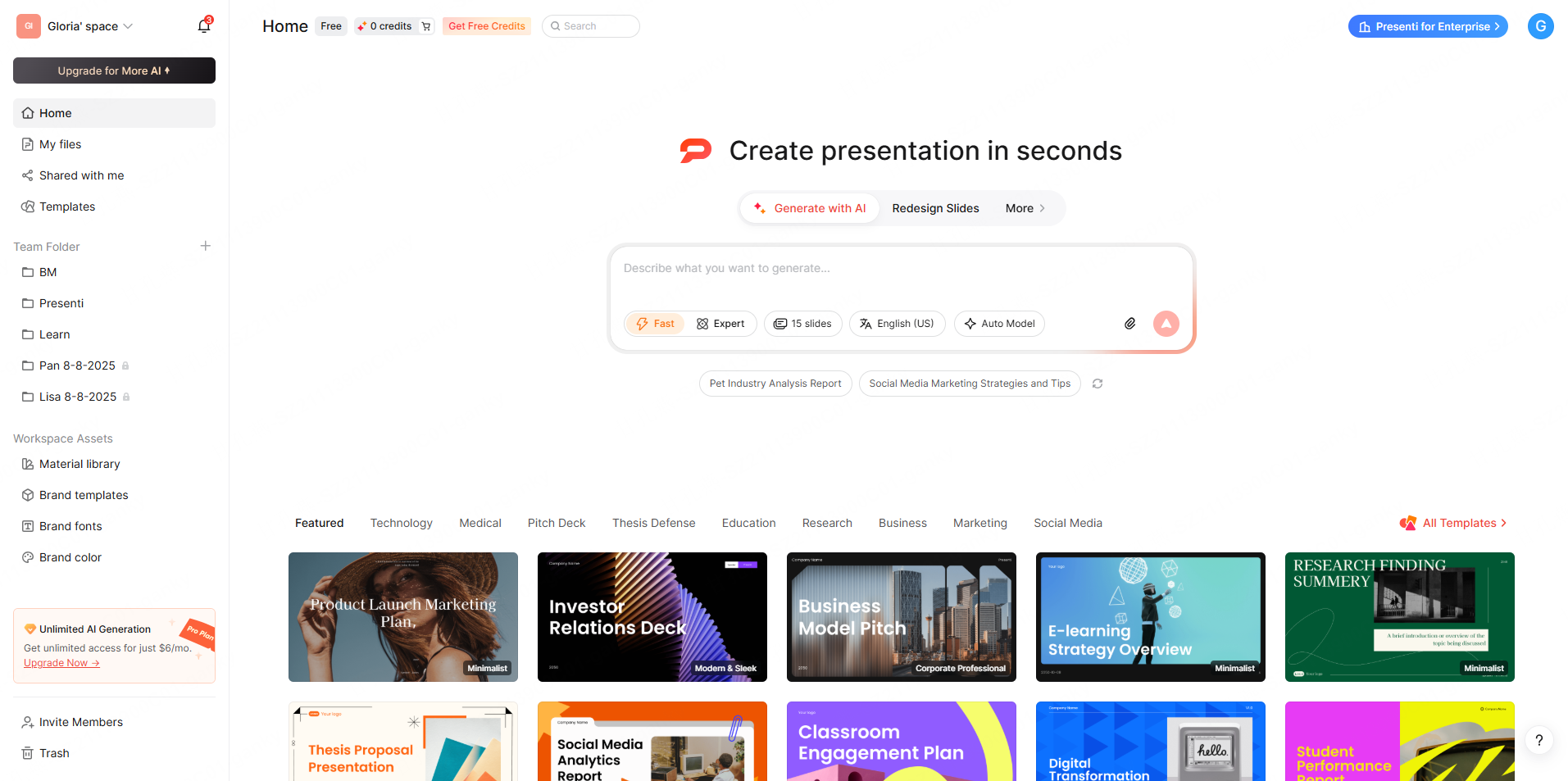
Presenti AI generates that presentation online directly from supported source material, subject to plan and file limits:
- Text or a prompt to presentation: Describe your dissertation topic and argument directly, and it drafts a structured outline from scratch.
- Word documents to presentation: Upload your dissertation or proposal chapters after checking the file limits and removing material not needed for the talk.
- PDF files to presentation: Works directly from a finished, exported dissertation PDF, including proposal documents.
- Markdown files to presentation: Useful if your drafts or notes are already written in Markdown.
- Web links to presentation: Point it at a published paper, an online proposal document, or another supported, accessible page containing your research.
- PPTX files to presentation: Upload a rough draft deck you've already started, and have it restructured and redesigned rather than rebuilt from zero.
From any of these inputs, Presenti AI maps your content onto a structured slide outline — research question, methodology, findings, contribution — and applies a consistent design automatically. Eligible paid plans support editable PPTX export, so you can open it in PowerPoint or Google Slides, adjust the flow, and add the speaker notes you'll actually rely on once the Q&A starts.
Prepare for Your Department’s Defense Format
Defense formats vary between institutions as well as countries. Confirm who will attend, whether a talk is required, and how long it should last. Build the slides around your contribution and evidence, then rehearse both the presentation and responses to likely questions.