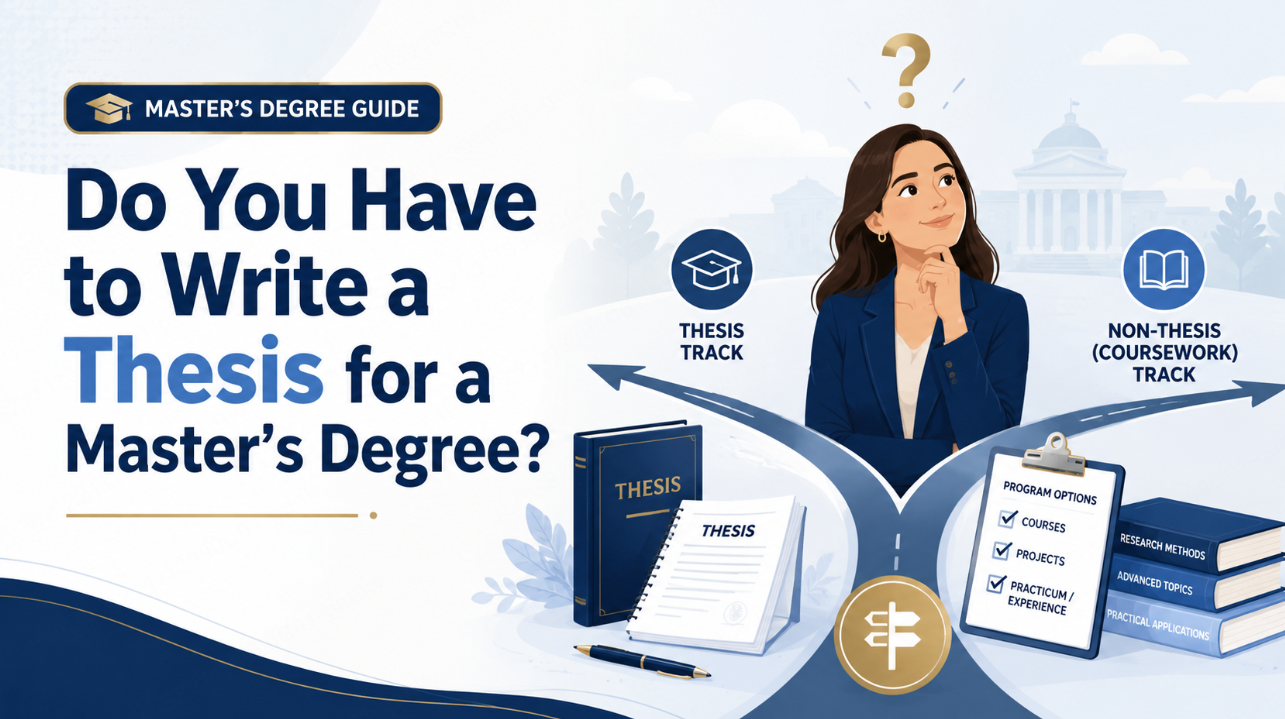
Short answer: no — not automatically, and not everywhere. Whether you have to write a thesis for a master's degree comes down to your field, your specific program, and sometimes even which track you pick within that program. Some master's degrees are built entirely around a thesis. Others never mention the word once.
If you're weighing grad school options or already enrolled and trying to figure out what you actually signed up for, here's a clear breakdown of what a thesis is, which programs require one, and what your alternatives look like if yours doesn't.
Do All Master's Programs Require a Thesis?
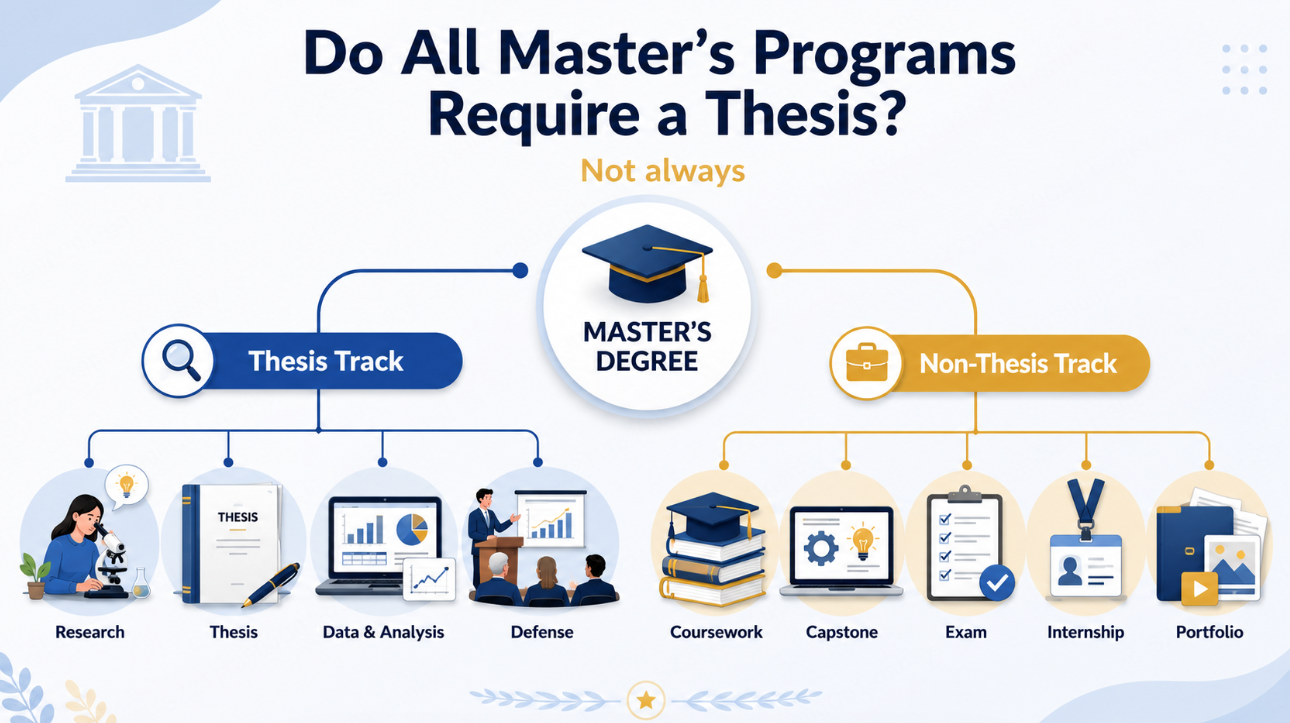
No. This is one of the more common misconceptions about graduate school — people assume a master's degree automatically means a long research paper at the end, the way a bachelor's assumes general education requirements. It doesn't work that way.
Master's programs generally fall into two categories:
- Thesis-track (or "research") programs — you complete original research and write it up as a formal thesis, typically defended in front of a faculty committee.
- Non-thesis (or "professional"/"applied") programs — you complete coursework and satisfy the degree through some other combination of a capstone project, comprehensive exam, internship, or portfolio.
Which category you land in depends heavily on the field. Whether you have to write a thesis really comes down to your specific program's requirements — not every master's program requires one, but a substantial share of them still do. Business, education, healthcare administration, and IT management programs, for example, commonly skip it entirely in favor of practical projects. Programs in the sciences, engineering, and social sciences are far more likely to build a thesis into the requirements, especially if the program is designed to feed into a PhD.
Thesis vs. Non-Thesis Master's: What's Actually Different
The core distinction is simple: a thesis-track master's asks you to design and carry out original research; a non-thesis master's uses a different culminating requirement, which may still involve research. Read Choosing a Thesis vs. Non-Thesis Program: What Every Graduate Student Needs to Know
| Thesis Track | Non-Thesis Track | |
|---|---|---|
| Core requirement | Original research + formal written thesis, usually defended orally | Coursework, often plus a capstone project or comprehensive exam |
| Typical length | Depends on research milestones and the published program schedule | Depends on coursework, placement, and capstone requirements |
| Best fit for | Students planning a PhD or research-heavy career | Students aiming for direct industry/practice roles |
| Common fields | Sciences, engineering, social sciences, humanities | Business, education, healthcare admin, IT |
Neither path is objectively "better" — they're built for different goals. Programs weighted more toward application than research typically don't require a thesis, though many still offer it as an option for students who want the research experience anyway. If you are choosing between available tracks, the non-thesis master's decision guide sets out career, research and final-project considerations to discuss with the program.
What Is a Thesis for a Master's Degree, Exactly?
A master's thesis is a formal, original piece of research you design, carry out, and write up yourself, under the guidance of a faculty advisor. It's meant to demonstrate that you can independently identify a research question, gather and analyze evidence, and draw defensible conclusions — not just absorb what you've been taught.
Most master's theses follow a recognizable structure:
- Introduction — the question or problem, and why it matters
- Literature review — what's already known, and where the gap is
- Methodology — how you gathered and analyzed your data
- Results — what you found, presented without interpretation
- Discussion — what it means, and how it connects back to your original question
Once the written thesis is complete, many programs require an oral defense — a presentation of your work to a faculty committee, followed by questions. Exactly how this works varies by school and department, so it's worth checking your program's specific guidelines early rather than assuming.
Master's Thesis vs. Dissertation: Are They the Same Thing?
Not quite, though the terms get used loosely and the confusion is understandable. In the US, "thesis" is generally the term for the master's-level research project, while "dissertation" refers to the much longer, more extensive research document required for a PhD. Outside the US — the UK in particular — the terminology can flip, with "dissertation" used at the master's level.
So if you're asking whether you have to write a dissertation for a master's, the honest answer is: probably not, if you're using the American convention — that's a PhD-level requirement — but check your specific institution's terminology, since usage isn't universal, especially for international programs.
Which Master's Programs Actually Require a Thesis?
There's no universal rule, but some patterns hold fairly consistently across US institutions:
Commonly thesis-required:
- Master of Science (MS) programs in research-oriented fields — biology, chemistry, physics, many engineering disciplines
- Master of Arts (MA) programs in the humanities and some social sciences
- Any program explicitly marketed as a "research track" or intended as PhD preparation
Commonly non-thesis or optional:
- MBA programs — the large majority skip a thesis in favor of case studies, a capstone, or a practicum
- Master of Education (MEd) and other applied education degrees
- Master of Public Health (MPH), Master of Social Work (MSW), and similar applied professional degrees
- Many MS programs in applied or industry-facing specializations, even within STEM
The degree title alone does not tell you whether a thesis is required. Even within one MS program, some universities offer both a thesis track and a non-thesis track side by side, and you choose when you enroll or sometimes partway through. Program websites and graduate handbooks are the only fully reliable source — search for your specific program name plus "thesis requirement" and check directly with the graduate coordinator if the page is ambiguous.
How to Decide Between Thesis and Non-Thesis, If You Have a Choice
If your program offers both tracks, a few questions tend to make the decision fairly clear-cut:
Are you planning to apply to a PhD program? A completed thesis is one of the strongest signals you can put in front of a PhD admissions committee — it shows you can independently execute a research project, not just take classes about one.
Do you want to publish? Thesis research can often be adapted into a journal submission. Non-thesis capstones generally aren't built with that in mind.
How much time do you have? Compare the published duration and completion milestones of the actual programs. Research, placements, course availability, and part-time study can all affect the schedule.
What does your target job actually value? For most industry roles outside research and academia, employers care more that you can execute a substantial project and communicate the results clearly than whether that project was labeled "thesis" or "capstone."
There's no universally correct answer — it depends on where you're headed after the degree, not some inherent superiority of one path over the other.
If You Are Writing One: What the Process Generally Looks Like
For anyone heading into a thesis-track program, the rough sequence usually looks like this:
- Find an advisor — often earlier than people expect, since your advisor shapes what's even feasible to research.
- Propose a topic — usually formalized through a written proposal, sometimes with its own committee approval step.
- Conduct the research — data collection, experiments, or analysis, depending on your field.
- Write the thesis — following your program's required structure and formatting guidelines.
- Defend it — present your work to a faculty committee and field their questions.
The defense is often the part students dread most, and it's usually the shortest step in the whole process — a presentation and question period whose length is set by the program.
Turning Your Research Into a Defense-Ready Presentation
Once the writing is behind you, the defense itself is a different skill entirely: distilling a 60–100 page document into a tight, visual narrative a committee can follow in half an hour.

Presenti AI is built for exactly that kind of translation. You can upload your finished thesis, proposal, or key chapters directly — as a PDF, Word document, or Markdown file — and it generates a structured slide outline pulling out your research question, methodology, key findings, and conclusions, with a clean design ready to refine. It saves you the step of manually re-typing your own research into slide form from scratch, and the output exports as a standard PPTX file you can open in PowerPoint or Google Slides to fine-tune before your defense.
Check the Requirements of Your Chosen Program
Not every master's degree requires a thesis, and that's by design — the two tracks exist to serve genuinely different goals. If you're weighing your options, look at where you want to end up: research or academia points toward a thesis, most industry-facing careers don't require one. Either way, check your specific program's requirements directly rather than assuming based on the degree name alone, since the same MS or MA title can mean very different things from one university to the next.