Good speaker notes explain what the audience cannot learn by reading the slide. For an AI-generated presentation, they have a second job: prevent a polished but unsupported sentence from turning into a confident spoken claim. Start with the evidence, add the explanation, and finish with the transition—not a longer version of every bullet.
If you are still assembling the deck, Presenti’s text-to-presentation workflow can turn your approved outline into an editable draft. Write the speaking notes against the final slide wording. The method below does not assume that Presenti generates, stores, or exports speaker notes automatically.

Correct the slide before writing around it
Imagine a fictional support team reviewing a two-week pilot. Its AI draft says: “Our new routing process transformed support performance.” The underlying figures show median first-response time falling from 18 to 12 hours. However, the compared periods contain 30 and 15 tickets, and the later period has fewer complex cases.
A speaking script cannot repair that headline by quietly adding reservations. Replace it with “Median first response was shorter during the pilot.” Put the different ticket counts and case mix where the audience can see them. Then use the notes to explain why the team proposes a further test rather than a permanent rollout.
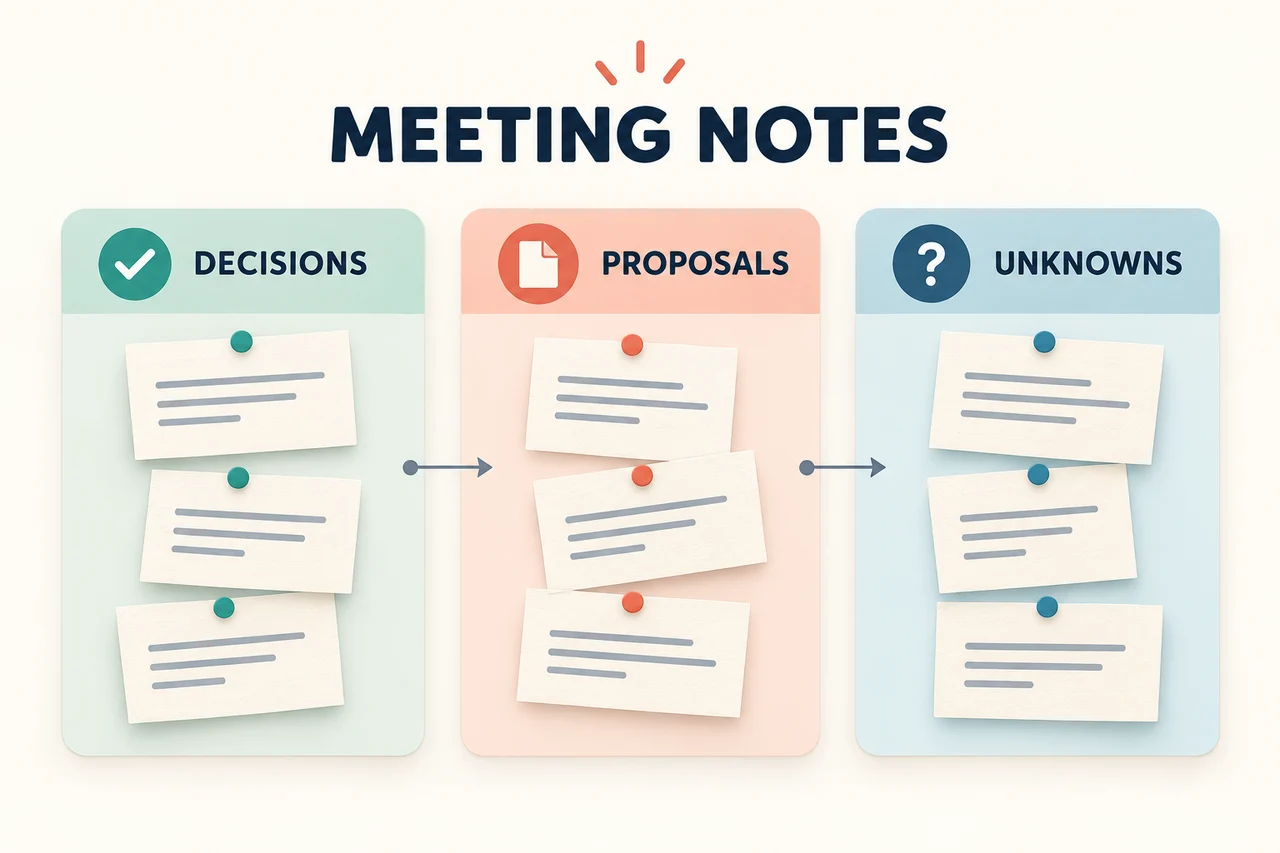
Separate three things before you write: what was observed, what you think may explain it, and what you want the audience to authorize. AI drafting often compresses these into one persuasive sentence. Your notes should make the distinctions easier to hear, not conceal them.
Give each note a clear speaking function
For each slide, write a short opening line, an explanation the slide leaves out, the evidence boundary, and the sentence that leads into the next slide. These are prompts for your reasoning, not four headings you must read aloud.
| Function | Example for the pilot |
|---|---|
| Orient the audience | We saw a shorter response time, but the comparison is not yet like-for-like. |
| Explain the evidence | The median moved from 18 to 12 hours across the two reporting periods. |
| Keep the boundary | The ticket counts and mix differ, so we cannot attribute the change to routing alone. |
| Move the discussion forward | The next slide shows what we would measure in a broader trial. |
Keep exact wording for a sensitive number, a technical definition, or a formal request. Elsewhere, brief cues make it easier to speak naturally. If you need full sentences to understand your own slide, the slide may need a clearer message before it needs more notes.
A five-slide example you can adapt
The figures and team below are illustrative, not a Presenti customer case. The audience is a service manager who can approve a longer trial. The desired outcome is a decision about that trial, not applause for the initial result.
Slide 1: Continue the routing trial before rolling it out
Speaking note: “I’m asking for approval to continue the test. We saw a shorter median response time, but the sample changed. I’ll show the result, explain the uncertainty, and propose a comparison that will help us decide whether to keep the routing change.”
Cue: pause after the request. If the manager says a permanent rollout is already decided, clarify whether the meeting is now about implementation risks; do not continue delivering the wrong argument.
Slide 2: Median first response fell from 18 to 12 hours
Speaking note: “The observed difference is six hours. That is one-third of the earlier median, but it is not proof that the process improved by one-third. We had 30 tickets in the earlier period and 15 in the pilot period, with fewer complex cases in the latter.”
Cue: point to the two sample sizes as you say them. Keep the period labels visible. Do not replace the median with ‘average’ unless the underlying statistic is actually a mean.
Slide 3: The pilot does not isolate the effect of routing
Speaking note: “Routing is one possible explanation. Lower volume and an easier case mix could also contribute. We need the next comparison to separate those possibilities. This is why I am recommending a further test, not declaring the change a success.”
Cue: let the limitation stand without apologizing. If the audience asks for a cause, say what additional evidence would help rather than guessing.
Slide 4: Compare similar ticket categories in the next trial
Speaking note: “Record category, arrival time, staffing coverage, and first-response time using the same definitions. Review comparable categories separately. Agree the staffing capacity and an escalation route before starting. These steps will make the result easier to interpret, though they do not by themselves create a randomized experiment.”
Cue: ask whether the manager needs an additional measure, such as unresolved tickets, to avoid improving response speed at the expense of resolution.
Slide 5: Approve the trial owner, scope, and review date
Speaking note: “Today we need agreement on who owns the trial, which tickets it covers, the resource limit, and when we review the evidence. If the scope cannot be agreed now, the next action is to resolve that scope—not to call the rollout approved.”
Cue: record the actual decision. Do not read an approval sentence that was written before the meeting as though the audience had already agreed.
Budget time around the hard explanation
For an illustrative six-minute slot including questions, try 35 seconds for the request, 75 for the figures, 65 for the limitation, 65 for the proposed trial, and 40 for the decision. That uses 280 seconds and leaves 80 for discussion. Adjust after speaking aloud; a word-count formula cannot predict how long a chart explanation or interruption will take.
Mark one optional sentence on each slide. If you fall behind, remove that example or elaboration while keeping the evidence, qualification, and decision request. Do not solve a time problem by dropping the limitation or rushing the numbers. A short rehearsal will reveal whether two slides should be combined or one complex explanation needs more space.
Prepare branches for questions, not a second script
- “Did routing cause the improvement?” “This comparison cannot isolate the cause. The next trial is designed to make the alternatives easier to assess.”
- “What if we cannot add staffing?” “Then we need a narrower trial within current capacity. That changes the scope and the conclusions we can draw.”
- “Where did that number come from?” Keep the approved report title and location in your working notes; show the audience the appropriate source, not an improvised explanation.
These branches protect the conversation when it leaves the planned order. If you do not know an answer, note the specific question, the person who can resolve it, and an agreed follow-up. Do not fill an awkward pause with a plausible number.
Make the notes usable in the actual delivery setup
Label the notes by slide title as well as slide number, because numbers change during editing. For a co-presenter, include the handover cue and the first sentence of the next section. Remove private deliberations, unnecessary personal data, and unsupported guesses before sharing the file.
For application-specific steps, see how to add, present, and print PowerPoint speaker notes.
If you deliver in PowerPoint, Microsoft’s speaker notes guide explains the notes pane and Presenter View. Test your actual screen-sharing setup: sharing the wrong window can expose notes. Do not assume an exported deck contains them or that a PDF includes them; inspect the exact file and presentation mode you will use.
Rehearse once from cues rather than reading every sentence. The test is simple: can you explain the evidence accurately, handle a predictable objection, and return to the decision? If not, edit the argument before polishing the performance.